Italy’s government on Thursday adopted a raft of measures directed at immigrant schoolchildren, among them a limit on the number of foreign students per class who don’t speak Italian proficiently and a ban on many religious head coverings for women.
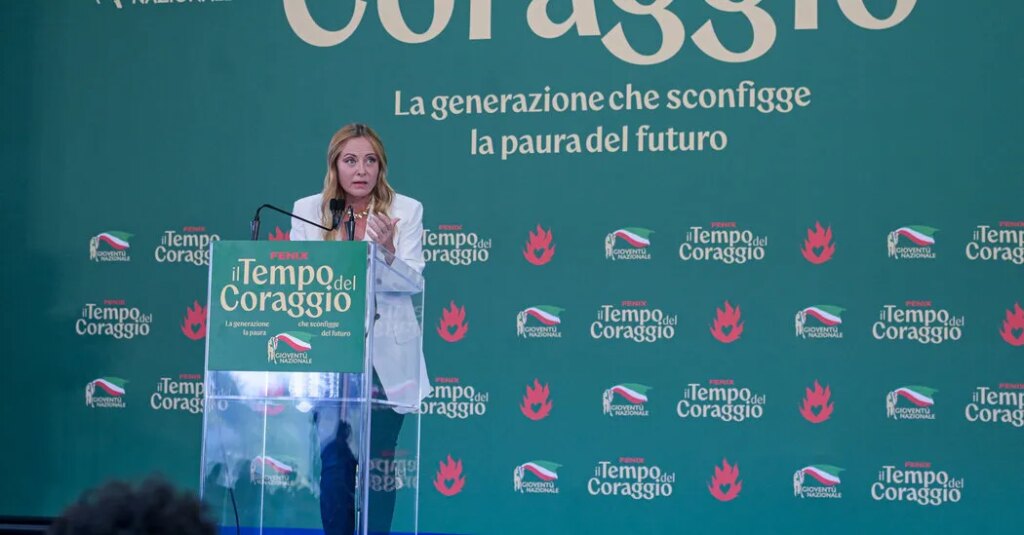
Prime Minister Giorgia Meloni cast the new rules as an attempt not to ostracize the students but to better integrate them into society. The measure calls for students to be moved to other schools if the cap is reached, but it is not clear how this redistribution would be put into effect. Critics of the measure dismissed that claim, with one accusing the government of engaging in a “witch hunt.”
Ms. Meloni, who will face a general election next year in a country where immigration is a political hot button, introduced the bill over the weekend. That set off days of heated debate in Italy over immigration, integration and the right to an education.
On Thursday the prime minister said that the measures were “tools of common sense” and that the goal was “avoiding ghetto classes and giving all students the same opportunities.”
The new rules will take effect immediately, but could be unwound if Parliament does not ratify them within 60 days. The limits on the number of foreign students per class would not go into effect until next year, or affect current rosters.
As the leader of a party with its roots in Italy’s Fascist Party, Ms. Meloni has worked to gain acceptance in the mainstream through pragmatic conservatism. But she has come under increasing pressure from the right wing of her governing coalition and from a new far-right party to impose restrictions on immigrants.
Far right parties have put similar pressures on candidates in recent elections across Europe.
Piero Ignazi, a professor emeritus of political science at the University of Bologna, said that identity issues have always been a hallmark of Ms. Meloni’s party, and so the new measures — and the insistence on “Italianness” — will “certainly resonate with its electorate.”
On Thursday, Elly Schlein, the leader of Italy’s largest opposition group, the Democratic Party, described the new measures as a “new witch hunt at the expense of the youngest children,” the news agency Ansa reported. “It is a shameful decree that attempts to hide the government’s inability to address the concrete problems of public schools behind a new ideological banner,” she said.
There are around 930,000 non-Italian students enrolled in Italian schools, about 11.6 percent of the total student population, according to the ISMU Foundation. More than 65 percent are in the industrialized northern regions, and the majority are the children of migrants. Many were born in Italy and speak Italian fluently.
Under the new rules, female students will be forbidden to wear burqas or niqabs in the classroom. Italy has no law explicitly banning the traditional Muslim dress worn by some women. A 1975 law prohibits most head coverings, including helmets, that do not allow for identification. In 2008, Italy’s highest administrative advisory board ruled that full-face veils can be worn for religious or cultural reasons.
Under the foreign student cap, no more than 30 percent of students in any individual class in primary and secondary schools can be foreign and not speak Italian. Italy’s schools already have such a cap, instituted in 2010 by a previous center-right government, but it did not have the full force of a law and allowed for exceptions.
Supporters of the change say redistributing non-Italian speaking students will help speed their comprehension of the language. The measure also aims to improve the language skills of adults, with the parents of foreign pupils who are underperforming in school now required to enroll in free Italian classes or face possible financial penalties.
“The government felt that something should be done to have greater balance in the composition of classes, and I say without any reservation that that is a didactically sacrosanct principle,” said Antonello Giannelli, the president of the National Principals’ Association.
He said the request for change had come from the parents of Italian-speaking students who believe their children were being held back by the presence of foreign students.
Several questions remain open about the new law, said Erica Colussi, coordinator of the education sector of the ISMU Foundation, a research institute on migration and integration. Among them: Where will children be moved to if the 30 percent classroom quota in their schools is reached.
“There’s a strong effort to establish a close relationship between schools and the local community that can help the families,” Ms. Colussi said. That means, she said, that the schools “are located near the family’s residence, precisely to create this local network.”
Sending children to other cities, or even other neighborhoods, would break that bond, she said.
Italy’s education minister, Giuseppe Valditara, said that the schools would be within a reasonable distance — “not 20 kilometers away.” He also said that more Italian-as-a-second-language teachers would be hired.
Prime Minister Meloni said the goal was “a school that integrates without giving up on rules, that supports those who have more difficulties, and that puts everyone in a position to start from the same point.”
There are schools in Italy with classes where most of the students are foreign, Ms. Colussi said. Among other places, they can be found in the regions of Lombardy, Emilia Romagna and Veneto, as well as in cities like Prato, which has many Chinese immigrants.
With the birthrate in Italy at a historic low, foreign students are often the reason that schools in certain neighborhoods remain open, Ms. Colussi said.
There are no statistics on how many classes the new law would affect, but Mr. Giannelli said it did not matter.
“If right now we have, I don’t know, 1,000, 2,000, 3,000 classes that are out of balance, and after the application of the law we halve them, it will be a positive result,” he said.
The post Italy Moves to Cap Number of Foreign Students in Its Classrooms appeared first on New York Times.