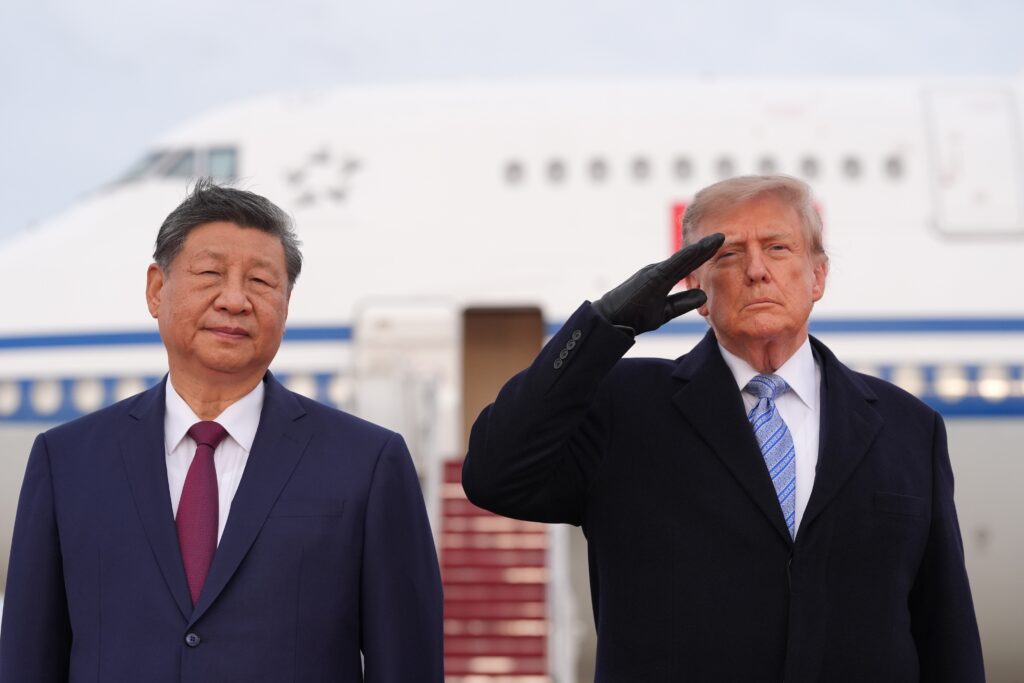
Ahead of his sit-down with President Donald Trump in Washington on Thursday, Chinese leader Xi Jinping wields a source of leverage that has strengthened his hand in the tense rivalry between their countries.
China’s overwhelming chokehold over rare earths — metallic elements essential to consumer electronics, green energy and the defense industry — has inflected nearly every major aspect of bilateral relations.
Rare earths are a key factor behind the White House’s less confrontational approach to China since the rapid escalation of a trade war early in Trump’s second term, analysts and former U.S. officials say.
The two sides on Wednesday agreed to extend a trade truce, including a pause on Chinese export controls on rare earths, through Jan. 10.
Chinese companies account for more than 90 percent of global rare earth refining capacity, according to the International Energy Agency, a Paris-based energy forum. If Beijing were to completely cut off its rare earth exports to the U.S., American industries could suffer annual losses of $1.5 trillion, according to an estimate from the agency.
“It would be very difficult for us to continue to operate our military at the pace and scale that we operate it today” without rare earths, said William Henagan, a former director for international economics on the National Security Council.
The ongoing U.S. reliance on Chinese rare earths could feature in Thursday’s talks alongside issues such as artificial intelligence safety, tariffs, Americans detained in China, Taiwan and China’s partnership with Iran.
The administration has not acknowledged any major concessions over rare earths. In an interview with CBS News last year, Treasury Secretary Scott Bessent said the U.S. responded to Chinese export controls by employing leverage of its own: the threat of additional tariffs. Washington has also signaled willingness to further limit China’s access to cutting-edge computing hardware.
On April 4, 2025 — two days after Trump announced a flurry of “Liberation Day” tariffs that intensified a U.S.-China trade war — Beijing enacted its first round of export controls on seven rare earth metals, then expanded the restrictions to include five more metals in October of that year.
“This administration truly is the first to feel the full brunt of the Chinese regulatory state against the United States,” said a former foreign policy staffer who served in the second Trump administration.
Beijing “never really punched the United States directly in this way,” the former official said, speaking on the condition of anonymity to discuss White House thinking. “That completely changed China policy.”
The Trump administration has since softened its approach to China in a range of arenas, abandoning plans to restrict exports of aircraft equipment and delaying arms shipments to Taiwan.
Though several factors may have tipped the balance, “all the conversation about human rights, or backing down in ways on Taiwan that the Trump administration seems to have done — these are all concessions,” said Adam Posen, president of the nonpartisan Peterson Institute for International Economics, a Washington think tank.
Trump and Xi struck a truce in Busan, South Korea, last October to pause U.S. tariffs in exchange for suspending Chinese rare earths export controls until November of this year. In a statement at the time, the White House called the deal “a massive victory.”
On Wednesday evening, Bessent announced in a Fox News interview that the deal had been extended through Jan. 10, giving the administration “more time to see what we can do on the economic front.”
But Bessent downplayed prospects of a longer détente.
“The U.S. wants to give some predictability to markets, but not enough to make the Chinese complacent” that the U.S. won’t restart the trade war, said Scott Kennedy, an expert on the Chinese economy at the Center for Strategic and International Studies, a Washington-based think tank.
Complicating matters, U.S. officials say China has not been upholding its end of the Busan agreement and continues to limit the flow of rare earths. China’s exports of rare earths to the U.S. in August dropped 20 percent from July, according to Chinese customs data.
In response to accusations it is limiting rare earth shipments, China’s foreign affairs ministry told Reuters the country was committed to maintaining global critical mineral supply chains.
China’s role in facilitating rare earths exports “has not been up to par of what we expect and that, I’m sure, will be a topic of discussion” during the Trump-Xi summit, a senior U.S. official said in a briefing on Friday, speaking on the condition of anonymity under ground rules set by the White House.
Meanwhile, the Trump administration is scrambling to reduce its dependence on rare earths sourced from China.
Since the Busan agreement, the administration has launched the Pax Silica initiative, a push to secure the raw materials — including rare earths — needed for the AI supply chain, and Project Vault, a $12 billion effort to stockpile critical minerals in the United States. At the Pentagon, the Office of Strategic Capital has provided billions of dollars in loans to fund domestic rare earth processing.
The U.S. has also pursued controversial efforts to access Ukraine’s critical minerals deposits in exchange for military aid.
But the administration’s approach is a “drop in the bucket by comparison to the centrally coordinated, multiagency approach that the Chinese are taking,” said Henagan, now a research fellow at the Council on Foreign Relations.
Ending U.S. reliance on Chinese rare earth metals would require five to ten years, at the cost of around $10 billion per year in subsidies for non-Chinese firms to process the metals, Henagan said. In a recent survey of experts, some said such an outcome could take even longer.
The U.S. also faces an uphill challenge in any spending competition with China, which has already marshaled hundreds of billions of dollars to preserve its dominance in rare earth metals.
“We’re more dependent on China now for some of these critical items … than we were four years ago or eight years ago,” Posen said.
The post As Trump meets Xi, rare earths give China a powerful hand appeared first on Washington Post.