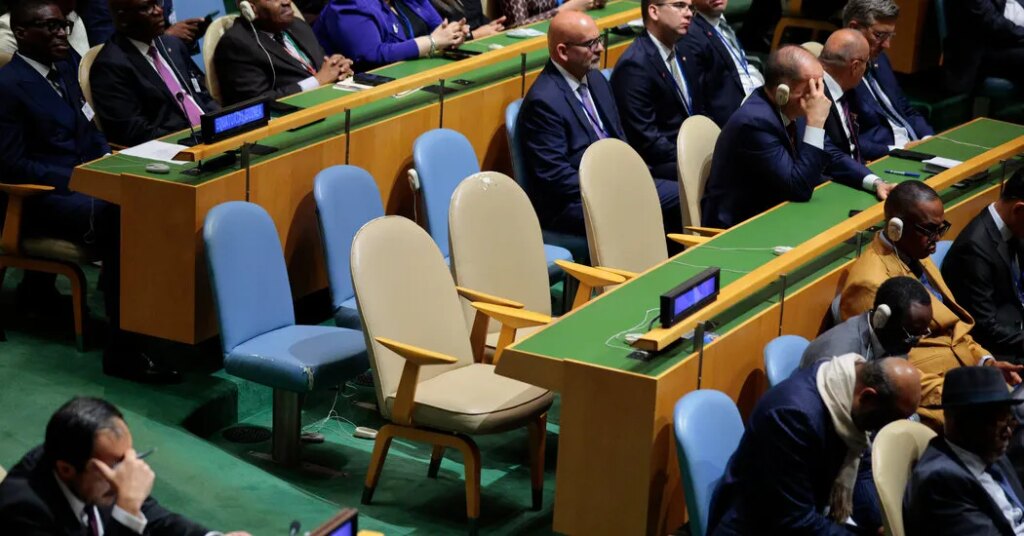
Nearly 200 world leaders get a lectern and two microphones to make their point at the United Nations General Assembly. The 1,000 or so lower-ranking diplomats in the hall have to settle for more limited options for self-expression: Stay seated or leave.
Walking out has become something of a tradition in recent years. On Wednesday, the lone U.S. diplomat in the hall left his seat as President Masoud Pezeshkian of Iran accused the United States of targeting his country’s civilians. It was a mirror image of the day before, when the Iranian delegations’ seats were nearly empty as President Trump described the choice he said he faced with Iran: make a peace deal or “annihilate” the country.
The Cuban delegation also exercised its right to leave the hall on Wednesday. As Mr. Trump labeled the country a “failed state” and vowed to bring about the downfall of its government, four Cubans stood up and walked briskly to the exit.
Rosa Freedman, a professor of law at the University of Reading in England who specializes in the United Nations, said walkouts were a permitted form of diplomatic protest that U.N. delegates had practiced for decades. “So long as it’s done peacefully, then there are no rules that prevent states from walking in and out,” she said.
For over 70 years, walk out they have. During the throes of Algeria’s war for independence from France throughout the 1950s, French diplomats left the hall when the body raised the conflict — something Paris held was none of the U.N.’s concern. In 1956, Hungary’s delegation walked out of the General Assembly after the Soviet invasion of Budapest. When South Africa’s foreign minister defended his country’s system of racial apartheid in a speech during the 1964 session, diplomats from about 40 countries staged a walkout.
When President Mahmoud Ahmadinejad of Iran repeated incendiary conspiracy theories in 2010, suggesting that the United States had orchestrated the Sept. 11, 2001, attacks, delegates from over 30 countries walked out, including the American diplomats.
Last year, Prime Minister Benjamin Netanyahu of Israel delivered his address before a sea of empty chairs, as many diplomats refused to take their seats in protest of Israel’s war in Gaza. Once Mr. Netanyahu started speaking, the number of diplomats who walked out was so high that they had to form a line to reach the exit.
Conducted peacefully, Professor Freedman said, walkouts are an important expression of freedom of speech and assembly, hallmarks of the 1948 Universal Declaration of Human Rights adopted soon after the body’s founding. She also noted that in comparison to parliamentary chambers, the General Assembly can be hectic.
“People are constantly walking in and out of the rooms and walking around the rooms, sometimes on mobile phones,” she said. “The filing out from the room in protest does not have the same level disruption as it would do in a parliamentary body, where everyone keeps their seat for the duration of a session.”
The post Walkouts Are a Longstanding Tradition at the U.N. General Assembly appeared first on New York Times.