On a recent Thursday, J. Galen Buckwalter drove 15 minutes from his home to the California Institute of Technology, steered his wheelchair into a laboratory and, as he had twice a week for two years, plugged in his brain.
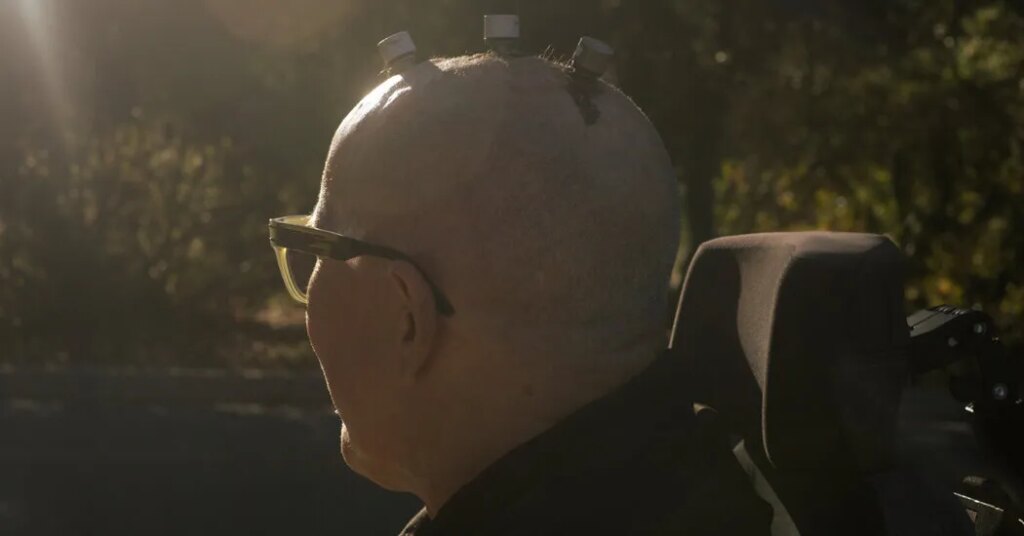
More precisely, he allowed a researcher to attach wires to three metal knobs screwed into his skull like a cyberpunk mohawk. The wires connect to six chips that were implanted in his brain during a seven-hour craniotomy. They record his neural signals — the firing of his brain when he thinks, speaks or moves — and transmit them to a computer to be analyzed.
“Check this out,” said the researcher, a Ph.D. student named Sean Darcy, pointing to three colored lines vibrating on a monitor.
“Where’s that?” Buckwalter said.
“Motor,” Darcy said — meaning the chip implanted in Buckwalter’s motor cortex.
“That’s nice,” Buckwalter said, admiring the image.
Those neural signals may prove to be hugely valuable. Already, brain-computer interfaces have enabled people with paralysis to fly drones and helped people who have lost the ability to speak to communicate — using just their thoughts. Eventually, researchers say, they could allow the regulation of emotions such as pain or fear; the instant transfer of knowledge, such as a new language; or the merging of human consciousness with artificial intelligence.
Buckwalter, 70, was almost totally paralyzed from the chest down after a diving accident in his teens. He signed up for the study, conducted jointly by Caltech and the University of Southern California, because he wanted to make life better for others like him.
Also, he was curious. After a distinguished career as a research scientist at U.S.C., he had developed the matching algorithms that powered eHarmony, the dating website. He later started companies that tried to use data to understand human psychology.
Now he had a chance to get an up-close, never-before-seen look at the brain’s limits and potential. He imagined what he could do with the information Caltech would collect: run new experiments, supercharge his companies, learn more about himself and human resilience.
But when he asked the researchers for access to the data — after the craniotomy, after weeks of recovery, after hours upon hours in the lab — they said no.
The output from his brain belonged to the researchers, they said, not to him.
Today, the argument over who controls some of the most intimate information about us — what we buy, where we travel, whom we text — has become familiar, even tired. But little has been said about brain data. That is largely because that data has seemed like the stuff of science fiction, accessible only to scientists armed with the most specialized technology.
But that is quickly changing. Researchers and private companies are exploring other applications of brain-computer interfaces, including wearable headsets and caps. Elon Musk has a company, Neuralink, that has already implanted more than a dozen people, and he has said he envisions a world where people can upgrade themselves by merging with computers. Someday, information about how we think, what we fear and the essence of who we are could be as accessible as our shopping history on Amazon.
Yet, at least for now, there are few rules in place for who controls it.
Every time Buckwalter went to Caltech, he passed down a hallway decorated with posters showing the lab’s research. Each was illustrated with colorful diagrams of the brain, with participants labeled by code name: P1, P2. As Buckwalter — P4 — passed each poster, he thought: “That’s my data, that’s my data, that’s my data.”
The question was whether he could get it back.
Buckwalter was 16 when he dived into a river near his hometown in rural Pennsylvania and was hauled out by a friend, never to walk again. Afterward, he spent six miserable months in a hospital for “crippled children,” as they were called then, where he said his pain went largely ignored. When he was released, he taught himself to push a manual wheelchair and to drive. He vowed to avoid ever feeling so helpless again.
It was that vow that led him, in January 2024, to get implanted. He had developed severe arthritis in his hips, and though he couldn’t feel the pain directly, the condition drove intense sweating and blood pressure that would suddenly shoot to 250. More and more, he needed help from his wife, Deborah, with daily tasks.
Buckwalter took pride in his accomplishments and loved his wife and stepchildren. But he’d also always believed that he had a right to end his life if he couldn’t enjoy it.
“Purpose and meaning are no joke, and I was losing it,” Buckwalter said, sitting in his lime-tree-lined backyard outside Los Angeles, where he likes to sunbathe because it helps the arthritis.
Then a colleague told him about the Caltech study. Researchers were teaching people with spinal cord injuries to control devices like robotic arms with their thoughts, and they needed more participants.
Deborah worried about the risks, but Buckwalter felt only excitement. He met with the researchers, who made clear that the implant would not lead to any physical improvements. There would be “no direct benefits to you,” according to an informed consent form he signed, other than the satisfaction of helping people with spinal cord injuries in the future.
Buckwalter, though, saw plenty of benefits. One of his companies studied how to build effective teams in the workplace, and he imagined how much insight actual brain data could provide. He had once examined how women’s brains changed during pregnancy, and he wondered how implants might change his own cognitive functioning. He envisioned sitting in on meetings with the researchers, dreaming up new experiments with them.
Buckwalter captured his excitement in a song he wrote for his longtime punk rock band, Siggy (a nod to Sigmund Freud). It was called “Wirehead.”
“I’m a Neuronaut/ I am Wirehead / All hooked up,” he sang. “Humanity is destined to be digital.”
During the surgery, doctors shaved Buckwalter’s shoulder-length gray hair, cut open his skull and slipped the chips into his brain tissue. The first night of recovery was excruciating. Alone in intensive care, Buckwalter felt 16 again, back in the Pennsylvania hospital.
But the pain seemed worthwhile when Buckwalter’s new chips were plugged in for the first time. Sitting in front of an oversize monitor, with Deborah, his grandson and the researchers crowded around him, Buckwalter touched his own hand and watched neurons jump. Deborah touched his hand, and the neurons reacted differently.
By the end of the session, he could move a computer cursor with his thoughts. It’s happening, he thought in awe. So what can we do with this?
The root of Buckwalter’s fight for his brain data was the musical fungi.
Before his surgery, a friend had sent him a YouTube video about a musician who recorded electrical signals from mushrooms, then turned them into musical notes. If mushrooms could sound like that, Buckwalter wondered, what kind of music would his brain make?
Darcy, the Ph.D. student and a fellow musician, volunteered to help him find out. He wrote a computer program he and Buckwalter called NeuralNote that could translate the firing of Buckwalter’s neurons into sounds, with the pitch changing depending on the firing rate. When Buckwalter curled — or just imagined curling — his fingers, the neurons associated with that movement might fire faster, making the pitch rise. Extending his fingers might lower the pitch.
As with any instrument, it took practice to control it. Buckwalter then experimented with other movements, like wiggling his tongue. He found that trying to play two notes simultaneously was like patting his head while rubbing his belly. He and Darcy spent time after Buckwalter’s lab sessions, generating a whirlwind of beeps and whistles, Buckwalter’s eyes fixed with steely concentration on the monitor.
“Having the opportunity to learn how to play and integrate this new instrument into the broader field of music kinda makes me feel like Elvis,” he texted Darcy after one session.
Soon, he was imagining laying the brain recordings onto a song. But when he mentioned the idea during a session, one of the senior researchers said he couldn’t have them. He was taken aback; he hadn’t expected any resistance.
That afternoon, as Buckwalter drove past the university’s Spanish revival buildings, he asked Deborah: “What did we sign up for?”
The lead Caltech researcher, Richard Andersen, declined an interview request, saying he could not comment on individual participants.
Buckwalter’s surprise turned to anger. This wasn’t just about the music. As he saw it, blocking him from using and sharing his data was a disservice to the advancement of knowledge.
“My brain, my data!! Damn it,” Buckwalter texted a friend. But he didn’t know what he could do, so he just stewed.
A few months later, the researchers asked Buckwalter to sign a new consent form, updating the one he had signed before the study. It was presented as a formality, mainly changes to wording. But Buckwalter said he would not sign unless other changes were made, too.
In an email to Andersen last September, he outlined them. Participants should have the right to copy and commercialize their own data, he said, and the right to contribute data to other studies, if those uses didn’t interfere with Caltech’s. He also wanted to know whether the university was sharing his data with anyone else.
He knew he was taking a risk. If he didn’t sign the new form, Caltech could kick him out of the study — meaning that under the terms of the trial, he would need to undergo surgery, again, to have the chips removed.
“Participating in this project is one of the most satisfying experiences of my life,” he wrote, aiming to be cordial as he made his demands.
Months passed with no response from Andersen. Buckwalter kept attending sessions at Caltech, even though he hadn’t signed the form. In March, Siggy released a music video for “Wirehead,” featuring an animated version of Buckwalter in a baby pink suit with dozens of spikes protruding from his head. The song featured a sample of his neural notes that he managed to get on his own.
On March 31, Buckwalter was at home when he received an email from Andersen with the subject line, “New Informed Consent.” The attached form directly addressed the question of data ownership. But not in the way he’d hoped.
“You are giving your data to the investigators for this and future research, and the data will no longer belong to you,” it said. “If you have concerns,” the document continued, “you should not participate in this study.”
Buckwalter fired off an email to a lawyer who specialized in data privacy. “They have gone to extreme lengths to say they not only own the data, but they can do whatever they want with it,” he wrote. “If you have any ideas for how I should respond, please let me know.”
Buckwalter sat in front of his computer screen last month for a meeting of the B.C.I. Pioneers Coalition, roughly a dozen spinal cord injury survivors with brain implants.
They were discussing the feeling of seeing their own brains.
“You can prove to your buddies that always said you never had a brain — well, I got proof,” Buz Chmielewski said of sharing his surgery photos.
“My sister still says I Photoshop that — she still doesn’t believe me,” Scott Imrie chimed in. “Your little brother never has a brain, right?”
The Pioneers met monthly to share advice, support and, often, dark humor. (Vexatious bodily functions were a recurring theme.) But they also had a larger purpose: They wanted their voices heard, especially by the scientists and chip manufacturers who talked about brain implants but didn’t actually have one. At this meeting, they were discussing a draft manifesto about the rights of participants in brain-computer interface research.
The document, “Our B.C.I.,” had taken months to write and included topics like how the risks of trials should be explained and what was fair pay for participation. One point had been added at Buckwalter’s request: “Brain data should be understood as the participant’s personal information, with researchers as stewards of this information.”
Since receiving what Buckwalter called the “consent form from hell,” he had been busily consulting with lawyers, scientists and other patients. At neuroscience conferences, he buttonholed executives of companies working on brain-computer interface technology.
“I’m providing the raw material, and as a user, anything that comes from that needs to be done in a way that respects and honors who I am as a person,” he said onstage during a neuroethics panel at Stanford. He said he wanted to collaborate with researchers, not just be their subject. “The process is one of partnership. That’s what should be our North Star.”
The response was not always encouraging. In the United States, the law does not clearly define who owns the data in clinical trials, but university and government policies have generally granted control to institutions, not individuals. Institutions then lay out rules around access in their consent forms.
But there is no uniform standard for what the forms should say. As a result, they can vary greatly. Buckwalter learned from some of the Pioneers who were enrolled in other studies that they had no trouble getting their data. But if Caltech wanted to exclude its participants, it could.
“The law is pretty settled, I’d say, right now, and I think it’s settled in a problematic way,” said Francis Shen, a University of Minnesota law professor specializing in neuroscience who has called for giving research participants more rights.
Not everyone agreed with Buckwalter that he should own his data. One researcher observed that although the data came from participants’ brains, it required technology and time from others to extract.
Buckwalter stood firm. He still had not signed the revised consent form — let alone the “form from hell” — and he worried that pressure from Caltech would grow. So he found lawyers to represent him pro bono, and in October he sent a letter requesting a meeting with the institutional review boards of Caltech and U.S.C., which are responsible for protecting the rights of human participants.
On the Pioneers call, he shared that the universities seemed open to a discussion.
“That’s fantastic,” Ian Burkhart, the group’s founder, said.
“We just have to be real loud, right, Galen?” Imrie said.
“Exactly,” Buckwalter said. “At least listen to us. Maybe not act, but at least give us the time of day.”
Later that evening, he sat with Darcy in his backyard, plotting their next musical adventure. NeuralNote, the brain music program, had become a shared passion, and they often hung out outside of the lab to explore ideas.
Buckwalter was brimming with them. He wanted to try setting off his neurons in a fixed rhythm. Eventually, he wanted to make an entire album with his brain notes.
“Remember we tried the metronome?” Darcy said. “You got pretty synced up with it there toward the end.”
“I got ‘Jaws’ — doo-doo, doo-doo — I got that down,” Buckwalter said. “It’s a start.”
Their plans, though, would soon be put on hold.
In an email in late October, the chair of Caltech’s institutional review board, Ralph Adolphs, assured Buckwalter that Caltech and U.S.C. valued his participation in the trial and wanted to address his concerns.
But he also pointed out that Buckwalter had never signed the updated consent form. Caltech would have to pause his sessions at the lab until he signed it, or until they could agree on a new one.
“This pause is intended to protect your rights as a research participant,” Adolphs said. “It is not a penalty.”
In an interview, Adolphs said that Caltech wanted to find a way to share Buckwalter’s data with him, and eventually do the same for participants in all research studies.
Historically, he said, few people had asked for access, and Caltech had seen little reason to give it. There were too many risks: The data, once shared, could be leaked, misinterpreted or abused — by, say, health insurers to deny coverage. And the benefits to participants seemed minimal. Most would not know how to interpret such data (especially brain data, which Adolphs described as “a gigantic amount of numbers”).
But with A.I., participants might be able to get more use out of their brain data, even if the risks of abuse were growing, too. Researchers were also recognizing the importance of giving participants more respect.
“It is very likely that the past way in which these studies and their data were set up will change — the question is exactly in what way and how much,” Adolphs said.
There were still many issues to work out. The university had to decide, for example, what limits to put on the data, to make sure its scientists weren’t beaten to publishing their research. Caltech hoped to have a resolution, Adolphs said, “sometime in the coming year.”
Buckwalter hadn’t heard that directly. All he knew was that the hours he had spent in the lab each week were now empty. He was surprised by how sad he felt — he even missed the most tedious experiments, like repeating words until his eyes glazed over. Every day of waiting felt like a waste of everything he and his brain could be doing.
He decided to focus on what he could still do. In November, he and the other Pioneers published their recommendations on the rights of patients. He looked forward to speaking at a conference on neurotechnology in Washington, where he planned to make his case again.
That night in his backyard with Darcy, Buckwalter had reminded himself, yet again, why this all mattered. They were discussing the album of brain music, and Darcy suggested they also include guitar.
“It can’t be all experimental,” Darcy said. “We’ve got to get the average listener to listen in, too.”
Buckwalter insisted that it should be mostly neural notes. That was the whole point: “Nothing like it’s ever been done before.”
The post Does This Man Have a Right to the Data From His Own Brain? appeared first on New York Times.