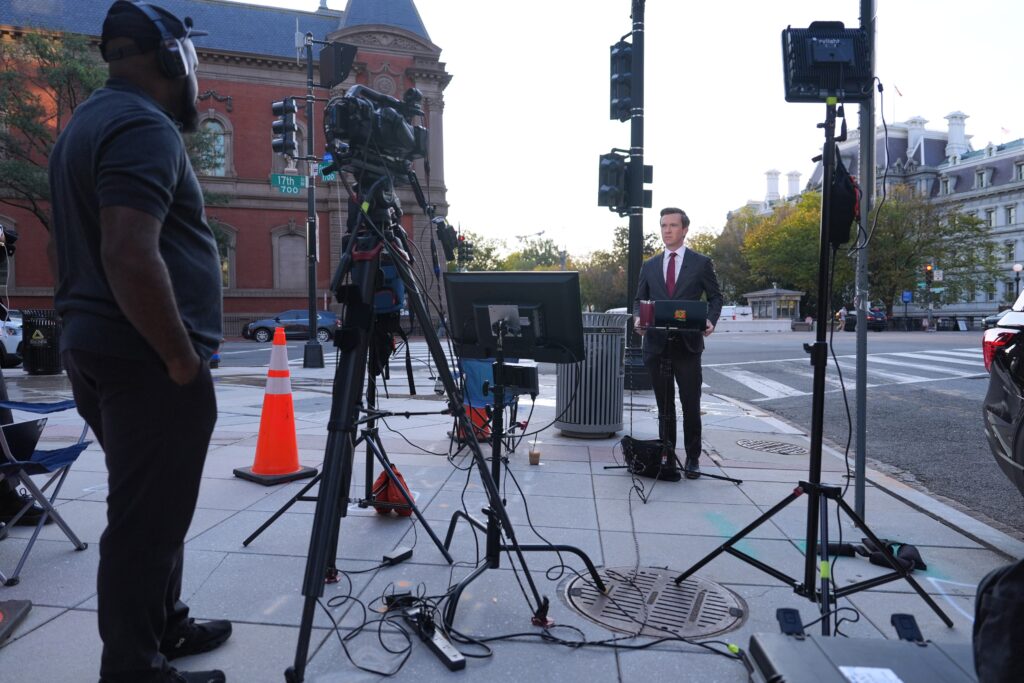
Numerous press freedom organizations have said President Donald Trump’s ban of certain journalists from White House grounds is an unconstitutional attack on Americans’ free speech. They predict it would quickly get struck down in court.
“The First Amendment extends to White House grounds as strongly if not more than pretty much anywhere,” said Seth Stern, chief of advocacy at Freedom of the Press Foundation. “It’s the People’s House; it’s the center of government.”
He and others said they worry about the precedent Trump’s ban could set for any politician in America who doesn’t like the media’s coverage. And some said it fits into a broader pattern of the Trump administration cracking down on free speech itself.
“Ten years ago, I would say the average person didn’t need to worry about this kind of aggressive government activity,” said Roy Gutterman, a journalism professor at Syracuse University’s Newhouse School and director of the Tully Center for Free Speech. “Law enforcement and the government give us a lot of freedom and wiggle room, and now we’re seeing that being eroded for specious political purposes.”
Here’s what to watch for next.
Get The 5-Minute Fix in your inbox
Trump has a losing record at the courts on banning journalists
This is Trump’s most sweeping attempt at banning journalists from covering him, but it’s not his first. In his first term, he banned a CNN reporter and Playboy magazine correspondent, but both were allowed back after they sued the government.
This White House ban may be even harder to argue in court. Media organizations already have sued the White House, arguing the ban violates their First Amendment right to report on the president.
The Trump administration is arguing that journalists at the White House are a threat to national security because they publish false, or sensitive and classified, information. “Access to the White House is a privilege — not a right,” the administration said in a court filing this week.
There are two problems with that, media law experts say: It’s generally not a crime for journalists to publish classified information, and journalists can be held legally responsible when publishing damaging false information only if it can be proved they knew it was false. U.S. law gives journalists a lot of freedom.
Above all else, Trump is openly saying he wants to ban journalists because of their coverage. “They’re fake news,” he said. The First Amendment of the Constitution prohibits the punishment of journalists based on what they report.
“The government can’t pick and choose to give White House access to reporters based on whether their coverage is favorable or not,” said Jessica Marsden, a lawyer who focuses on free speech issues with the nonpartisan group Protect Democracy.
Stern said if this ban doesn’t get struck down in court quickly, he worries elected officials across the country could try to ban journalists from covering them and limit the public’s access to records.
The ban underscores how Trump is struggling to control the public’s view of him
Polls show that Trump is deeply unpopular with Americans and that most disapprove of his handling of major policy issues, including the economy and immigration.
Faced with potential big losses for his party in November’s midterm elections, Trump so far has failed to end the war in Iran, or reverse a surge in gas prices and grocery, energy and health care costs. During the week he issued the ban, Trump lost at the Supreme Court to change mail voting, and the Federal Reserve raised interest rates despite his efforts to keep them down.
Some media experts pointed out that Trump leans heavily on distraction when things aren’t going his way.
“What happened yesterday they don’t want people to know about?” Gutterman told me Saturday, a day after Trump abruptly announced the ban on social media.
How this fits with the Trump administration’s broader crackdown on free speech
Trump’s administration also has aggressively tried to push back on criticism beyond journalism.
The ban happened the same week that a court said Immigration and Customs Enforcement agents probably violated the First Amendment by showing up at a man’s door after he wrote an angry email to ICE. ICE’s action “practically shouts” that an American “may be prosecuted if he continues to engage in his political speech,” U.S. District Judge Rudolph Contreras wrote in his opinion.
The administration also has tried to deport international students over their pro-Palestinian speech. That, too, has faced pushback from the courts.
“Stated plainly, in the United States, freedom of speech belongs to the people,” U.S. District Judge Noël Wise wrote in her opinion declaring that revoking students’ visas over their protests was unconstitutional. “It is not the government’s to take.”
Election officials are preparing for scenarios where Trump tries to rewrite election rules at the last minute or send troops to the polls to limit the ultimate expression of free speech: voting.
“You have to worry when any powerful politician seems to say they’re either above the law, or they don’t care about the law, or the law is ‘my’ interpretation,” Meredith McGehee, a government ethics expert who serves on the National Task Force on Election Crises, said in a recent interview. “And Trump has over time said each of these.”
Amber Phillips writes The 5-Minute Fix newsletter, a quick analysis of the day’s biggest political news. Send her an email here, or ask a question that could be featured in an upcoming newsletter.
The post Trump’s White House media ban may be on shaky ground appeared first on Washington Post.