There are two ice cream shops that matter in Ramallah, the crowded, chaotic and overcaffeinated seat of Palestinian self-government. Seemingly everyone in town has picked a side.
Rukab’s is the elder statesman, opened in 1941 by members of one of the city’s original families. It sits just off al-Manara Plaza along Ramallah’s main drag — unofficially but universally known as Rukab Street.
The ice cream named the street. The street did not name the ice cream.
Baladna — Arabic for “our town” or “our country” — is the upstart, opened in 1992 by a Rukab’s employee who quietly slipped out of work, strolled a few doors down and set up his own rival shop.
Any bitterness to the rivalry has long since melted away. But loyalties are steadfast in Ramallah, even on a matter in which the stakes could not be lower.
“I can’t say that one is better or tastier than the other,” said Azza Jabr, 46, a mother of two. “I just decided I’m a Baladna gal, that’s it.”
Ms. Jabr said she had patronized Rukab’s no more than twice since Baladna opened, and only because Palestinian expatriates visiting her from abroad had asked to stop by for old times’ sake.
Rukab’s inspires no less devotion. Issa and Sana Asfour have been customers for decades. Ms. Asfour, 59, ordered the five-flavor signature dish. “I especially love that it’s the same as when I was a child,” she said.
Her husband had a pistachio and chocolate cone dipped in chocolate. “If you come to Ramallah without having an ice cream here, it’s like you never came to Ramallah,” he said. Asked about Baladna, he said, “It’s just Rukab for us.”
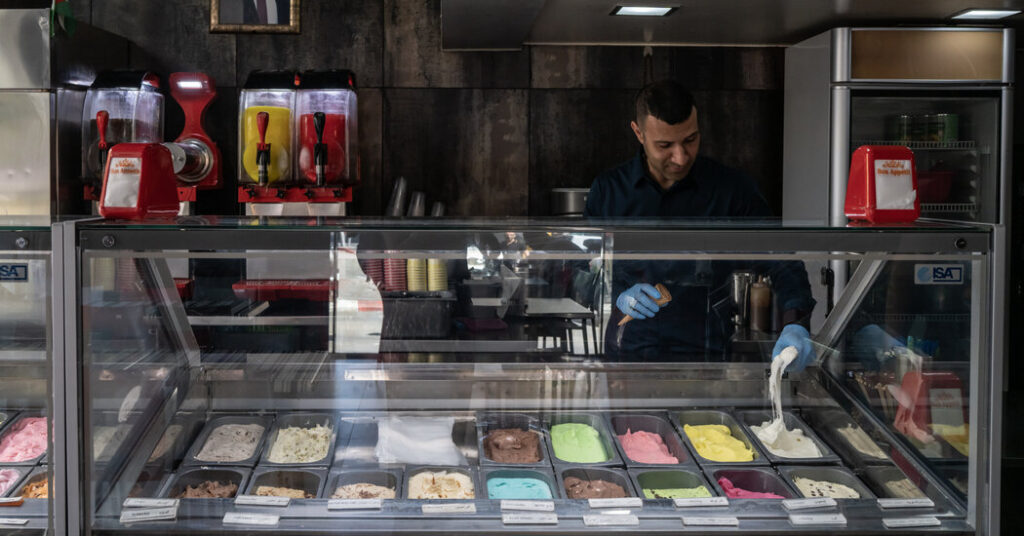
Both shops offer booza, a Levantine concoction unlike the soft-serve or hard-packed ice cream Americans know. It is pounded and stretched rather than churned with air, and it is thickened with gum arabic, the hardened sap of acacia trees, giving it a satisfying chew.
The result is dense, elastic and — much like the rush-hour gridlock at Israel’s Qalandia security checkpoint just south of Ramallah — slow to melt.
Rukab’s and Baladna can be seen as symbols of Ramallah’s resilience. The city, like the rest of the West Bank, is enduring a severe economic crunch under pressure from the Israeli government. Crowds may be rare at the ice cream shops, with tourists few and far between, but regulars keep returning.
The precise origin of the word booza is uncertain, but it is commonly traced to the Ottoman Turkish word for ice, “buz,” pronounced “booze.”
That could also be a clue to the Ramallah recipe’s origins, about which food historians disagree. Damascus has a popular hand-pounded ice cream, too, and Turkey has its dondurma, which is similarly resistant to the heat.
The classic booza order is five flavors on a cone: plain sweetened milk, lemon, strawberry, pineapple and chocolate.
In this city of 70,000, the de facto capital of the beleaguered Palestinian Authority, booza may be the one institution that never lets anyone down.
Zahra Etayyim, 37, moved back to the West Bank six years ago after 15 years in Louisiana and then Arkansas. She sat at Rukab’s one breezy afternoon recently, digging into a banana split while her daughter Suha, 16, enjoyed a helping of rocky road loaded with marshmallows, chocolate chips, nuts and gummy bears.
There may be few more wholesome ways to escape from the pressures of the unrefrigerated world outside.
“So many things have changed since my return — the pandemic, the war in Gaza, the way the occupation’s grip on the West Bank has tightened,” Ms. Etayyim said. “But the one standard thing that makes me feel stability is an ice cream at Rukab’s. My sisters living in the States and Egypt come almost every summer, and visiting Rukab’s is essential. It’s on the wish list before the plane lands.”
The two shops reflect much of Ramallah’s modern history.
Jimmy Rukab, 45, is the fourth-generation proprietor of Rukab’s. His great-grandmother, Sarah Rukab, was the first ice cream maker in the family; his grandfather, Jameel Rukab, obtained a permit from the British, who then ruled Palestine, to take their homemade booza to the streets in the mid-1930s.
Mr. Rukab spent part of his childhood in Florida after the start of the first intifada, or Palestinian uprising, in the late 1980s, and then went back to the United States to attend the University of Massachusetts Boston. He joined the family business 20 years ago alongside his father, who died last year.
The family’s vendors still walk the streets with white foam boxes as they have for decades, calling out “Booza Rukab!” with a stress on the final syllable. They vie to be heard over car horns, jackhammers and the occasional roars of military helicopters.
Two blocks away at Baladna, Imad Imseeh, 54, is just a second-generation manager. Then again, his family arrived in Ramallah only in 1949, refugees from Lydda (now Lod, Israel), a city from which hundreds of Palestinians were expelled in the war that established Israel in 1948.
It was his uncle Iskandar Imseeh who quit Rukab’s to start Baladna in 1992 with his younger brother, Imad’s father, Hanna. They had one hand-cranked ice cream machine. Imad, who was 20 then, remembers working 16-hour days.
“We tried many ways to modernize, but we settled on semiautomatic machines because this type of ice cream requires actual handwork,” he said.
Baladna has since introduced dozens of new flavors. One is inspired by knafeh, the Palestinian dessert of shredded pastry, sweet cheese and syrup native to Nablus. Several schools are nearby, and Baladna has become a hangout for teenagers.
“Over the years, our clients grew, and we literally watched them grow up and return to our ice cream,” Mr. Imseeh said. “This makes me very proud.”
Liana Shareef, 21, walked in with her mother, Hadeel, 46, and ordered a scoop of the knafeh flavor.
“I’ve been coming to Baladna since I was a little girl and have always loved it,” the younger Ms. Shareef said. “I don’t care for any other ice cream in the world as much as I like the Ramallah ice cream.”
Her mother, a teacher at a Jerusalem school, ordered the traditional five-flavor cone. Taking a bite and hiding a smile behind the cone, she said she didn’t usually even like ice cream. “But this one has a great taste you don’t want to miss,” she said.
The competition between the shops is anything but tense. Jimmy Rukab and Imad Imseeh are friends, they are related by marriage and their children attend the same Quaker school — where, at recess, street vendors outside can be heard calling, “Booza Rukab!”
Rather, the rivalry is a kind of running joke, an aspect of local identity that somehow binds Ramallah together by dividing it.
Then again, booza itself is gooey and stretchy and stubbornly delicious. Pull on it, and it somehow holds together anyway. Much like the city.
The post The Winner of This Rivalry Gets Ice Cream. But So Does the Loser. appeared first on New York Times.