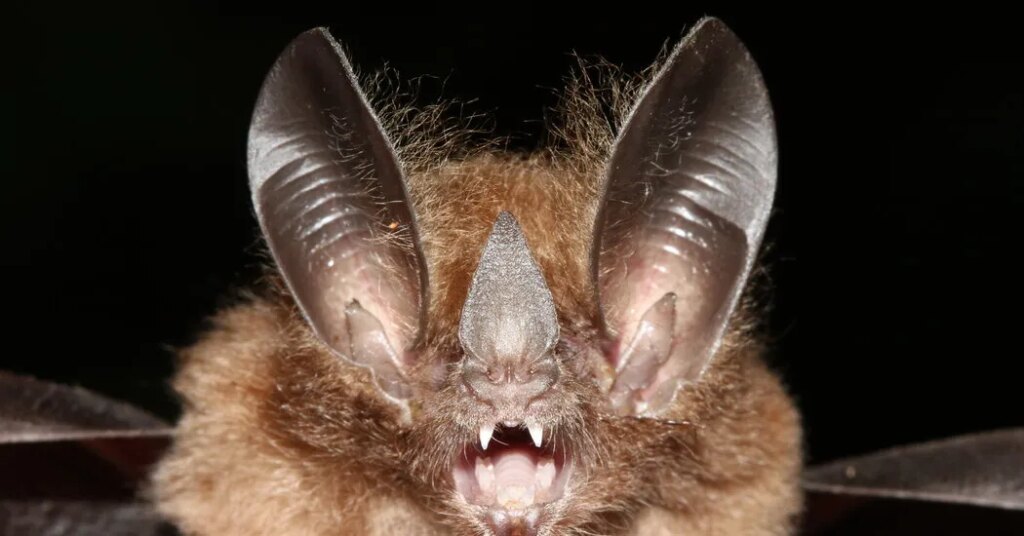
Bats are cryptic creatures. They inhabit the dark, roosting in hidden, often inaccessible places. And they possess some rare skills that can seem like superpowers: exceptional longevity, advanced echolocation abilities and a capacity for powered flight that is unique among mammals.
But their genes have been difficult to decipher and their fossils hard to find, leaving scientists puzzled about how these traits evolved — or even when and where bats first emerged.
A major new study — the largest analysis of bat genomes and fossils — sheds light on the origins of these mysterious mammals. The study, which was published on Wednesday in the journal Nature, suggests that the first bats emerged in Europe roughly 65 million years ago and that echolocation emerged early, before bats diversified into the many families existing today. It also presents a new evolutionary tree for bats, one that upends some previous conclusions about the relationships between different bat families.
The findings are “rewriting” the biological history of bats, said Ariadna Morales, an evolutionary biologist and research associate at the American Museum of Natural History and an author of the paper. “The evolutionary tree of bats changed.”
The study — which is the first phase of the Bat1K project, an effort to sequence and analyze the genomes of all living bat species — also lays the foundation for additional research into the underpinnings of their remarkable abilities.
“Bats are the most extraordinary of all our mammalian lineages,” said Emma Teeling, a zoologist at University College Dublin and a director of the Bat1K project, who is an author of the new paper. “This is a springboard.”
Bats are numerous, diverse and widely dispersed. There are roughly 1,500 living species of bats, which account for more than one-fifth of all mammal species, and they live on every continent but Antarctica.
For the study, scientists collected and sequenced the genomes of bats from 103 different species, spread across all 21 living families of bats. Then, they analyzed these genomes, and compared them with one another, using a variety of approaches. Some involved analyzing the full genomes of each species; others compared specific chromosomes, regions or other subsets of the data.
“Different parts of the genome tell different stories,” said Dr. Morales, an incoming assistant professor at the City University of New York.
But several lines of evidence converged, allowing the researchers to map the evolutionary relationships between different families of bats.
The resulting phylogenetic tree differed from previous ones in some notable ways. The sucker-footed bats of Madagascar, for instance, had been grouped with several bat families that live mostly in the neotropics. The new tree moved these Madagascar bats to the globally distributed superfamily that also contains vesper bats, the most common bats on the planet. The findings also suggested that this vesper bat superfamily was closely related to the superfamily containing sac-winged bats, whose members had previously been considered more distant relatives.
The researchers also analyzed bat fossils, using the data to estimate when different lineages had diverged and how bats spread across the globe.
Europe, Africa, North America and Asia had all been proposed as the birthplace of bats, but the new analysis pointed toward Europe. From there, bats most likely expanded into Africa and then to the rest of the globe, the researchers concluded.
The study also suggested that the fossil of an extinct echolocating bat belonged close to the base of the evolutionary tree — and that echolocation appeared before the modern lineage of bats did.
Scientists have long debated whether echolocation or flight evolved first in bats. One influential study, based on a 52-million-year-old fossil and published in 2008, suggested that flight evolved first.
But the new analysis, which is based on a much larger data set, indicates that the question is far from settled.
“It looks pretty clear that echolocation evolved before the diversification of all the living families,” said Nancy Simmons, a curator emerita at the American Museum of Natural History who is an author of the new paper, as well as the 2008 one.
“Now we’re sort of back where we were a number of years ago, which is flight and echolocation seem to have evolved at the base of the tree,” she added. “And we still don’t know whether they came at the same time, or one came before the other.”
The researchers said that they hoped that their new evolutionary tree would be a resource for scientists studying the genes and genetic variants that underpin flight, echolocation, disease resistance and more. That work is already underway at Bat1K, Dr. Teeling said.
“To be able to uncover evolutionary history is extraordinary,” she said. “But there’s so much more we can do with this.”
The post The Secret History of Bats: A New Study Redraws Their Family Tree appeared first on New York Times.