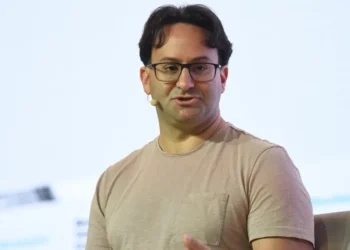
By 5 am every morning, Emma Waters is on the sofa with a blanket, plotting America’s baby-making future. For two hours, she stays off her phone, inspired by Deep Work, the self-help bestseller. At 7:30, she does emails. Waters, 28 years old, is a monk of productivity who makes motherhood look like all-natural Adderall.
At 8 am, it’s time for breakfast and the Bible. Waters tries to live her life according to the mantra “Love God, get married, have babies.” She asks that I not use the real names of her two daughters for their safety, even though they’ve been printed elsewhere. I’ll call them Gertie and Ophelia, which are close enough.
All morning, they play. Ophelia, the baby, runs around in white tights, shirtless, clutching a pink purse; Gertie’s doll won’t stop crying. Jack, Waters’ husband, flits in and out. There isn’t much to say about Jack, other than that he’s hot, is studying to be a preacher, and has a big desk at home, much bigger than Waters’, featuring a bust of Nietzsche. In the same room, Waters has a pull-out secretary where she takes meetings, not far from a portrait of a glowering President Trump.
The only thing Waters doesn’t really do is exercise; she hasn’t found the time.
Not many people outside of DC have heard of Waters, who mostly works from home in a dreary Pennsylvania suburb named after a long-offshored manufacturer. Yet Waters is a factory for policy papers and op-eds extolling the harms of unregulated reproductive technology, probing the moral issues that liberals don’t want to touch with a 10-foot turkey baster. At least once a month, reporting on fertility, I ask for an academic source and am instead directed to Waters, author of a biblical women’s leadership book that basically says the best thing about the Barbie movie was the patriarchy.
The craziest thing is that, in certain ways, she’s a voice of reason. America’s $10 billion fertility industry is suffering a massive PR crisis that makes the embryo mix-ups and baby-selling schemes of yore seem quaint. A few recent headlines: “The Chinese Billionaires Having Dozens of US-Born Babies Via Surrogate,” “The Family Law Loophole That Lets Sex Offenders Parent Kids,” “California Couple Busted for Running Suspected Baby Mill,” “Surrogate Mother Who Refused to Abort Baby Gives Birth Amid Ongoing Legal Dispute.” Polygenic testing companies promise today’s parents that they can pick the tallest, smartest, least-bald offspring, mainstreaming debates about the “Black-white IQ gap.” OpenAI CEO Sam Altman—a father via surrogacy—and Coinbase CEO Brian Armstrong are invested in an embryo-editing startup. If you believe what they told The Wall Street Journal, their first gene-hacked baby has probably already been born.
Many right-wing techies are jazzed about these developments, which might bump up birth rates or create “better” spawn. Many liberals don’t know how to talk about the ethical pitfalls. Emma Waters fills in the gaps. As a kind of backroom wheeler-dealer and political strategist, she is the mastermind behind Florida’s recent ban on international surrogacy, the Texas GOP’s souring on IVF, and the squashing of Trump’s “fertilization president” initiatives. This God-loving, JD Vance–stanning Gen Z-er might be standing between you and your ability to have a family, or she might be, somehow, the force that makes it possible. Waters has so much to teach us about optics and politics and why, in so many arenas, Democrats are losing so dramatically. Waters wants to dismantle fertility as we know it. And she wants to do it politely, during nap time, with her husband’s permission.
Waters wasn’t always political. She and her three younger siblings were homeschooled by their mother in a poor, rural part of southern Georgia, while their father worked 60-hour weeks as a facilities manager and HVAC repairman. (Waters describes her local high school as the kind of place where one-third of students got chlamydia.) Growing up, Waters never felt aligned with either party: Republicans praised free trade and cheap widgets; Democrats pushed equal pay and shoved kids into day care.
Then, in her junior year at a Christian college in Tennessee, Waters heard a podcast interview with JD Vance. “Everything he says, I relate to,” she remembers thinking. When she graduated a year later, in 2021—as valedictorian—she applied for an internship at American Moment, a training ground of sorts for rising conservatives. They gave her a full-time job.
Around this time, she met Jackson Waters at a mock-government event. Emma recounts their “whirlwind romance” in her book, Lead Like Jael. After “a summer of tense conversations,” she broke up with him “on a whim.” She wanted a career in politics; the thought of being a wife and mother felt like “a major letdown.” With the help of a pastor, she realized she only had these notions because of girlboss feminism. She begged Jack to take her back and got married at 24. She was an anomaly even among Republicans. Waters had heard older colleagues refer to women who got married at that age as “child brides.”
Waters loved life in DC: walking 24,000 steps a day, getting coffee with everyone and their mom, hosting dinners in her basement. When she got pregnant with Gertie, she and Jack wanted to prove that life didn’t end with a baby. But she needed a job with more flexibility that would eventually allow Jack to attend in-person seminary. In 2022, Waters approached the Heritage Foundation, the most influential conservative think tank. Heritage had recently shed its intellectual bona fides to become a MAGA mouthpiece; the next year, it would release Project 2025, the playbook for Trump 2.0.
Waters pitched Heritage that she would cover emerging fertility tech as an analyst: crafting policy briefs, penning op-eds, whispering into politicians’ ears. Waters found traditional pro-life policy banal—everything was about abortion. Debates around IVF started and ended with “Are embryos people?” She wanted to apply her dual major in political science and biblical studies to cutting-edge science. At the time, it seemed like “the least popular policy issue,” she says, but she promised the bosses it would soon be a big deal. They were sold.
Waters found her conservative colleagues ignorant about the state of assisted baby-making. One Hill staffer emailed Waters about a test that counts embryos’ chromosomes, asking, “Will this be around in 10 years?” It had been around for decades. At that point, a Chinese scientist had already embryo-Crispr’d babies, gone to jail for it, and gotten out. Sex selection had become a standard part of American IVF; the first sex-selected people were in their thirties. It was easier to open a surrogacy agency than an ice cream cart or a tanning salon.
Then there was China. In 2023, more than two years before mainstream media outlets reported on Sino-US infant import-exports, Waters was on Fox News, accompanied by an article headlined “Chinese ‘Rent-a-Womb’ Industry Using American Surrogates Is a National Security Threat.” She called it “the new face of birth tourism.” Intended parents didn’t even have to leave the country. Our nation’s lax laws meant that you could ship sperm over and get an American citizen shipped back.
Nobody wants to talk about women in tech anymore—not even women in tech. Is that progress?
Waters hates it when people harp on what she’s anti. Instead, she wants people to focus on what she’s pro: pro-“human flourishing”; pro-“the human person,” including embryos; pro-man-woman marriage; pro-life (duh); pro-Natural Procreative Technology, by which infertile heteros of breeding age clean up their diets, reduce their plastics, and ultimately get knocked up according to God’s will. Pronatalist? She prefers “pro-family,” which implies more straight marriages where straight penises and vaginas produce tons of babies. (Critics would add that the goal is really white Christian babies.)
Waters never says she’s against IVF per se. She doesn’t talk about “murdering” embryos; she makes it sound more like negligent manslaughter. She mostly argues that IVF doesn’t work. It encourages young women to postpone their true calling by falsely reassuring them that there’s still time.
To Waters, IVF is the conduit for many horrors. Ranking and selecting embryos tricks parents into thinking they can choose and control what kind of children they have, cheapening God’s handmade gift into an off-brand dustmop plucked off an Amazon wish list. It allows you to outsource reproduction to surrogates, objectifying women and commoditizing babies. Decoupling sex, marriage, and procreation distorts the natural order. Infertility explodes. Civilizations collapse. In her work, Waters fastidiously avoids mentioning gays, singles, or women over 40. When I ask her about this omission, she gets defensive: “It’s not about the desires of adults. It’s about the rights and well-being of children.”
Waters is a Republican, but that doesn’t mean all Republicans agree with her. The vast majority of Republicans support IVF as is. The pronatalist movement has two factions, the tech right and the trads. The tech right sees artificial wombs, surrogacy, and genetic optimization as tools to boost birth rates. Trads, like Waters, think these things will make the problem worse.
Besides China, nothing rankles Waters like embryo screening tools that promise to let parents “have your best baby.” Nobody really expects these so-called polygenic tests to move into the mainstream or ever become very accurate, but they set the tone for a future where parents can edit their children’s genes. On X, Noor Siddiqui, CEO of the startup Orchid and one of Waters’ least favorite founders, wastes no time in shaming breeders who fail to optimize. Getting knocked up the old-fashioned way is irresponsible: “What if your baby never walks?” Siddiqui has posted. “What if they’re never able to live independently? What if you could have stopped it … but chose not to?” (Stopping it, in this case, means making sure your disabled child isn’t born.) “Just be honest: You’re OK with your kid potentially suffering for life so you can feel morally superior, or because you can’t be inconvenienced.” In a decade, Siddiqui warns, all babies will be born using IVF and her test—Waters’ definition of dystopia.
Like many at Heritage, Waters was disappointed when Trump included free IVF in his 2024 platform, later declaring himself the “father of IVF” and “the fertilization president.” But Waters still found fertile ground (sorry) filled with low-hanging fruit. There were zero federal regulations governing surrogacy—she would shepherd the first one. “We have model legislation to SHUT DOWN foreign nations who rent the wombs of American women,” she wrote on X. She would rail against the creepy, unpopular polygenic tests that are opposed by every professional society. With the nation’s most influential conservative organization backing her, she’d push to mainstream so-called restorative reproductive medicine that co-opted the language of social justice while addressing the root causes of women’s broken, barren bodies.
Last November, waters sat onstage at the Heritage Foundation wearing a faux leather dress, slouchy boots, and a periwinkle double-breasted blazer while dozens of protesters in red Handmaid’s Tale cloaks screamed on the sidewalk outside.
I’d come to DC to meet Waters in person. It was a tough week for the organization. Its president had taken heat, and nearly had to resign, for defending Tucker Carlson’s choice to platform Nick Fuentes, a white supremacist. (Fuentes: “Hitler was awesome. Hitler was right. And the Holocaust didn’t happen.”) I wondered if there were always a dozen cops outside of the building. Sometimes the roar and the sirens were so deafening it was hard to hear Waters, but the disturbance seemed to make her smile.
First, Waters warmed up the room by having a “chat” with a mom who gets told by libs that she should’ve aborted her disabled son. Then Waters turned to the main event. “Welcome, gentlemen,” she said. She had assembled four white experts for “Editing Destiny,” a panel on the subject of polygenic tests and gene editing. Two seemed like MAGA partisans. Two were legitimate academics.
Waters had the energy of a high school newspaper reporter with a blowout and makeup that perfectly concealed her prominent chin. Everyone agreed that somatic gene editing on “born people” was good. Waters pointed out how it served the MAHA goal to eliminate disease at the source. But germline gene editing, the panel also agreed, was risky and unnecessary. No one said “fetus” or “God”; instead they evoked “the human person” and “flourishing.” Ben Hurlbut, one of the academics, made a moving, secular argument against polygenic selection. This was the “first relational act” you make with your future children, he told me, and it invites a serious rift.
Around the room, young female staffers in tight dresses held microphones for Q&A. The panel took a few questions. One attendee noted the harms of Tylenol.
After the event, Waters introduced me to Austin Rogers, then general counsel to Florida senator Rick Scott. Rogers wore a green Rolex with his hair gelled up in the front—he wouldn’t have looked out of place at a nightclub. Rogers told me they were using Waters’ model legislation to try to ban surrogacy from “foreign adversaries.” He was looking for a Democratic partner. He mentioned the latest story, covered by every major outlet, of a Chinese couple in California who had commissioned at least 25 surrogates to carry their children—a perfectly legal scheme—only to allegedly abuse most of those children in a mansion. He said, “I read it and my hair was on fire.”
That night, I walked Hurlbut, the academic, back to the train station and asked him why he agreed to speak at the Heritage Foundation. It wasn’t about party politics, he said. These issues couldn’t be split cleanly into left and right. “Anyone taking this seriously is creating a service to the public discourse,” he said. I asked who the big players were on the liberal side. “Big players? There are no big players. Just a few voices crying in the wilderness.”
Two months later, I visit Waters at home, in the type of town where hotels keep their lobby doors locked at all times. “I’ll have lunch to share with you,” Waters emails. When I arrive, she is wearing heeled boots and trendy jeans, making a butternut squash soup with bacon and brie. Ophelia watches from her high chair, wearing white tights underneath a fancy outfit. Over the next 27 hours, Waters will serve her husband and me a parade of elaborate orange foods: frittata with broken spaghetti, clementines, clam chowder (yes, also orange). (The girls will also eat Cheez-Its, Goldfish, and chicken nuggets.)
I recognize her hospitality tactics from Lead Like Jael, specifically the chapter titled “Motherhood as Warfare.” Waters advises women to embrace distinctly feminine means of influence. “No woman in the Bible picked up a sword to fight,” she tells me. Waters named her book after a biblical matriarch who offered an enemy commander a place to stay and then pierced his head with a tent peg, thus winning the battle.
I fear I am the enemy commander in this story.
In the book, Waters urges: “Take up your ladle like a sword. Stand behind your stove like a sentinel.”
Her house is modest yet beautiful, full of damask furniture. Christmas cards ring the kitchen doorway. In one photo, Simone and Malcolm Collins, the prominent pronatalist couple who embrace the term “hipster eugenicists,” smile from behind thick black glasses. On the credenza next to the dining room table, there’s a gilded Bible, a Venetian clock, and a ring light that never turns off.
Jack, home for lunch, says grace. Even 13-month-old Ophelia clasps her hands, closes her eyes, and bows her head.
Waters gets things done by being very, very nice. Simone Collins tells me, “I don’t know a single person in the pronatalist movement who doesn’t like Emma. She’s golden.” Even though the Collinses promote polygenic testing, IVF, and surrogacy, Waters considers them friends and makes a point not to publicly criticize them. In any given hour, Waters laser-focuses on a single issue. Another conservative tells me, “She could do an event with someone on Tuesday and be on the opposite side of a protest on Friday.” When she gets into a flame war with someone on X, she invites them to collaborate.
That’s how she secured the special guest for today’s Zoom working group: the founder of a polygenic testing company. One Tuesday a month, during nap time, Waters hosts private discussions with a group of bioethicists, activists, and policy wonks. Many potential collaborators do not want to be associated with Heritage, so Waters does much of her work in secret. She paraphrases a sign that Ronald Reagan kept on his desk in the Oval Office: “There is no limit to what a man can do or where he can go if he doesn’t mind who gets the credit.”
In the glow of the ring light, Waters and I huddle around her dining room table. I’m allowed to join if I don’t name names: I recognize a few prominent pro-lifers, and one or two liberals. “There is no dispute about how the technology works,” the polygenic testing founder says. He hammers home that two papers a day are being written about the associations between genes. His vibe oscillates between nerd and evil professor. He repeats at least a dozen times that his technology works. “There are ideologues masquerading as experts. You can easily fool a WIRED reporter into writing into her story that it doesn’t work.”
Waters asks a question about “children who have been born already.” Then someone asks about a recent paper showing that the sibling with the tallest-seeming genes is actually only the tallest about 25 percent of the time. This implies that, three out of four times, “picking the tallest baby,” well, wouldn’t work. The founder is irritated. One person might be predicted to be taller by 1 centimeter, but the error bars are 2 centimeters. “Falling within the error bars of the model means it’s successful,” the founder says.
Waters chimes in: “If the solution from a polygenic risk score for breast cancer was euthanasia, people would have a problem with it.” Then, she adds with a smirk, “That’s probably already happening in Canada.” To Waters, embryos are “human people”—but she won’t belabor the point or argue about metaphysical priors. The founder reminds us, “If you want to call it eugenics, you can, but don’t say it doesn’t work.”
Many of Waters’ critics dismiss her as a fool because of her retrograde gender views, which underpin all her other ideas.
I read Lead Like Jael in one sitting; my eyes got dry from popping so far out of my head. “There’s a hierarchy in marriage,” Waters writes. She advises her readers to become “good at being a woman” by “cultivating distinctly feminine strengths,” such as good posture. In an analysis of Greta Gerwig’s Barbie movie, patriarchy was “the first real innovation,” she writes. “Strong and godly men propel society forward.” Waters analyzes how, in the official portraits of First Lady Melania Trump, even her nails and eyebrows focus on the greater mission. She urges readers to redefine success as a joint pursuit, beginning with a husband’s career. Parents should start talking about marriage and motherhood at the same age as they ask kids what they want to be when they grow up. Women’s work should be flexible and easy to pause: “To neglect the home to pursue work is to invert God’s design.” Women are there to “support and strengthen” but not replace men. “Rightful authority” begins with husbands in the home. Women can lead, but only about 8 percent of the time.
Sitting in a trendy café, radiant in a puffy-sleeved red sweater and an Oura ring, Waters explains to me that the difference between men and women goes back to Genesis. Adam’s names mean “ground” and “man.” Eve’s names mean “fire,” “woman,” “mother.” So men are supposed to dig holes while women launch rockets? No: “A man is pulled toward the ground,” Waters says. “The wife is pulled to her husband and her children.”
She goes on: “We don’t want to go back to the 1950s. God put us in our time for a reason.” Still, there’s a lot to learn from the halcyon days when all 50 states allowed marital rape. Waters explains that the problem with the 1950s was that technology, like the dishwasher, stripped women of meaningful labor. “What would have been amazing is if women had radically rethought what they could do with the time they’d been given”—instead of just turning to wage labor. Despite providing most of the childcare, working full-time, and supporting her husband through school, Waters claims that balancing work and motherhood hasn’t been that hard. (Waters isn’t even so hot on federal paid family leave, since it encourages moms to go back to work.)
Here’s where I admit that Waters and I have more in common than I could have imagined. I got married at 25. I love being married and raising my child. We both go to church every Sunday (though mine has a gay pastor). I find it sad how young people see pregnancy as a funeral dirge for their hopes and dreams. I, too, expect low birth rates to cause big problems, and I suspect many “childfree” people will experience regret in 20 years. I’m inspired by Waters, how she cranked out more than 150 policy papers, interviews, and op-eds while I wrote this measly profile. I’m jealous of the time she spends with her daughters and how well behaved they are and how she managed to travel alone with a 4-month-old to Hungary to speak at a conference. But when Waters tells me that once you become a wife you have to subjugate yourself to your husband, it’s hard to keep a straight face.
If she wants to boost marriage rates, I ask, wouldn’t egalitarian partnership be an easier sell? She doesn’t have an answer. “It never crossed my mind.”
There’s a glaring gap between what Waters professes—that a woman’s highest calling is the home—and what she does, which is support her family financially while being way more influential and successful than her husband. She reconciles this by, literally, doing it all, while swearing she will slow down her career at a moment’s notice. By that same token, it’s also hard to distinguish between what Waters really thinks, what she is supposed to say, what’s rage-bait, and if there’s any meaningful difference between those categories. Her X background used to be a photo of “What’s Wrong With ‘Equal Rights’ for Women?” by Phyllis Schlafly, an activist who started speeches by thanking her husband for allowing her to be there. When I ask her about it, Waters says, “If your enemies think you’re oppressed, play up the trope.”
On the right, optics are everything. “How you project yourself is a political message,” Waters says. Before coming to DC, she had eight piercings, including belly button and eyebrow rings, but she didn’t want to be perceived like that. “Your appearance shows what you value,” she says. “I really value dressing well and pleasing my husband.”
If Waters had her way, there might be some IVF, but it wouldn’t involve ranking, destroying, or indefinitely freezing embryos. The only lawful surrogacy would be altruistic for heterosexual married couples with a documented history of infertility. (The gays, singles, and AOCs of the world would, in other words, put children’s well-being first and just not have them.)
In an international context, some of Waters’ views are perfectly normal. Almost every wealthy country besides the US bans elective sex selection. Every other wealthy country bans commercial surrogacy, which the UN called a form of violence against women and “the sale of children.” UN committees see anonymous gamete donation as incompatible with children’s rights. Most Western countries require tests to undergo some kind of approval process before going to market, so polygenic tests are out. In Germany, parents need government approval to genetically test embryos. Through a global lens, American Big Fertility is bizarro.
But for Democrats, it’s often seen as too politically toxic to criticize the largely unregulated industry. Challenging almost anything about it—even just that private-equity-backed clinics conduct most IVF cycles—opens the door for critics like Waters. Businesses have framed picking the sex of your baby, or even picking your Aryan-est baby, as a matter of “reproductive autonomy” on par with abortion. Lefties who disagree mostly keep their mouths shut. It’s almost too easy for Waters. Google will send anyone disturbed by the status quo straight to her op-eds.
While Waters invites journalists to her home and cooks them elaborate meals, some fertility professionals blame the reporters who dissect the scandals. After I wrote about a surrogacy gone wrong last year, Ron Poole-Dayan, the executive director of Men Having Babies, told me, “You are the problem. Journalists like you are a big part of the reason gay men can’t have families.”
People working in assisted reproduction see so many happy stories of family formation, they don’t even seem to understand what the problem is. At a recent conference for a surrogacy and egg donation ethics group, one attendee remarked, “An airplane takes off and lands a thousand times, and no one writes a story. A plane crashes once—everyone writes about it.” Someone else chimed in, “And flying is safer than driving!”
At the conference, surrounded by attorneys and professionals who seemed earnestly invested in doing the right thing, I thought of the left’s purity test problem: wanting so badly to be 100 percent correct that you forget how you look; ceding the hard topics to your opponents, who can wrap a kernel of truth in a bundle of nonsense; getting defensive when you could’ve invited the enemy in for a bowl of orange soup.
The biggest criticism lobbed at Waters is, obviously, that she wants to turn America into The Handmaid’s Tale. The second biggest criticism is that she’s a hypocrite. Waters’ kids aren’t in day care, but that doesn’t mean she doesn’t have help. At Waters’ house, I was surprised to meet a relative who consoled sobbing dolls and occupied the children while Waters entertained me and Jack studied the Bible or whatever. Waters’ mom is also a “full-time grandma” to Gertie and Ophelia.
The third biggest criticism is, let’s say, her credentials. “She’s not an academic. She’s not someone who actually has experience in these things,” says Lauren Hall, a political science professor at Rochester Institute of Technology. The feminist writer Jessica Valenti has essentially called Waters a failed influencer.
It’s not easy being an influential conservative mom who tells other moms of young kids to stay home. Criticisms of the Heritage Foundation, meanwhile, come from both the left and right. It’s “the worst-case scenario for a woman,” says Hall. She says Heritage puts “token” women forward, who have to hew to “a very particular party line.” In early 2025, an anonymous staff member sent letters to Heritage trustees alleging discrimination against childless women.
Waters disagrees, of course—she’s a fierce defender of Heritage. “America first,” she tells me. “MASS DEPORTATIONS NOW!” she tweets. She admits that Nick Fuentes says some “disgusting” things and describes him as “a young white man” who was “disenfranchised by the Republican Party because he dared to question our relationship with Israel.” When I ask her about the GOP’s unofficial strategy of “no enemies to the right,” a big-tent welcome for neo-Nazis and white nationalists, she snaps back, “Don’t you think the left is the same? Normalizing pedophilia. Abortion until birth. Rampant antisemitism … Why do you think Josh Shapiro wasn’t the vice presidential nominee?”
Waters’ master plan to undermine the fertility industry seems to be working. In November 2025, Senator Rick Scott proposed the SAFE KIDS Act, banning citizens of “hostile foreign regimes” from participating in surrogacy. In Florida, a similar law passed at the state level in May. At the start of 2026, Florida attorney general James Uthmeier stepped in to try to get two French dads un-recognized as their son’s legal parents, calling surrogacy “unconstitutional” and “modern-day slavery.” In July, Uthmeier intervened in another case, arguing that Florida should ignore an intended parent’s California parentage order, seemingly in opposition to the Full Faith and Credit clause of the Constitution. A proposed bill in Kentucky would ban all commercial surrogacy.
When Trump called himself “the father of IVF” in 2024, it looked like Waters had lost the battle against petri dish kids. But in June, Texas’ GOP denounced the procedure, and Trump has thus far reneged on his promises to make it free. In a recent grant application, the Department of Health and Human Services called frozen embryos “children.”
Many observers tell me they think Waters’ work is “the driving force” in pushing fertility regulation out of the fringes and into the mainstream. They also tell me the new laws are insincere and bad, fraught with unintended consequences. For example, the Florida attorney general’s anti-surrogacy argument would seem to prohibit Evangelicals’ sacred cow, adoption. Courts may challenge some of these laws in the coming months and years, but there’s no denying that American baby-making is going trad. On August 6, Trump issued executive orders banning birth tourism and denying passports to surrogate babies with foreign parents—measures proposed by Waters.
Her star continues to rise. Waters got a second book deal earlier this year (working title: Rethinking Fertility) and is contributing to a documentary about cryopreservation called Frozen Orphans. She recently presented at a Harvard summit on embryo law and ethics; four of the 20 other speakers have referenced Waters in their work. She is not opposed to running for office, although of course it will have to wait until her kids are older. In early September, she gave birth to her third child: another girl.
Let us know what you think about this article. Submit a letter to the editor at [email protected].
The post She’s 28, Loves God and Her Family, and Might Be the Reason You Can’t Have Kids appeared first on Wired.