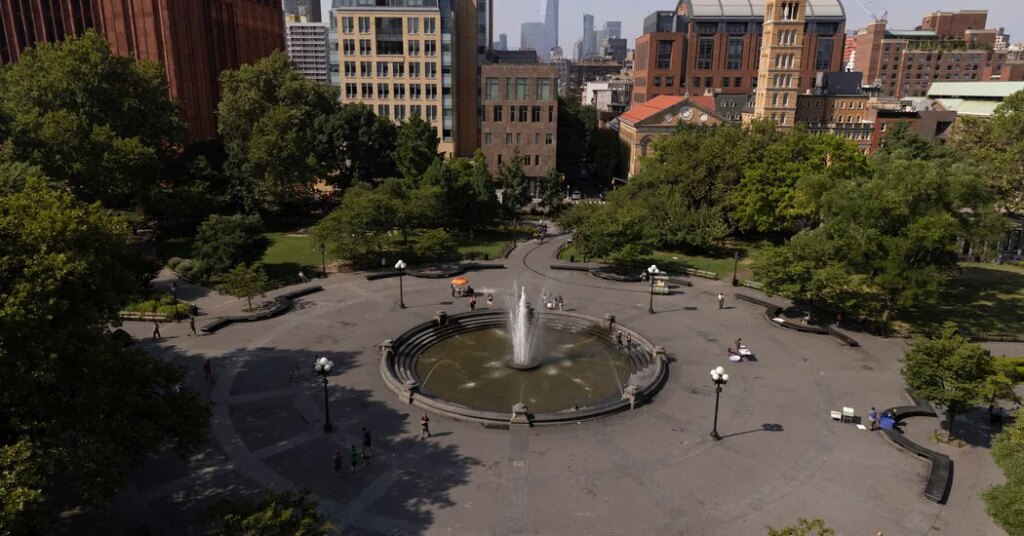
Two years ago, on a crisp November morning in Manhattan, a woman sat unconscious on a bench in Washington Square Park as joggers passed by.
Police officers and emergency responders rushed to her, administering a lifesaving dose of Narcan steps away from the park’s towering, triumphal arch.
That scene, captured on police body-worn cameras, was shown in Manhattan federal court this month during the trial of a man that prosecutors argued was a leader of a wide-ranging criminal network that sold millions of doses of crack cocaine and opioids, including heroin and fentanyl, in and around the park from 2020 to 2025.
A jury convicted the defendant, John Livigni, on Wednesday for conspiracy to distribute narcotics resulting in death, which prosecutors said led to two deaths and involved 19 other defendants. So far, 18 other people have pleaded guilty. Mr. Livigni, 49, will face a maximum sentence of life in prison.
“For far too long, New Yorkers were forced to live with the dangerous drug dealers who had turned Washington Square Park, in the heart of Greenwich Village, into an open-air drug market,” Jamie McDonald, the U.S. attorney for the Southern District of New York, said in a statement. “Not anymore.”
During the five-day trial, prosecutors argued that the leaders of the conspiracy used people who were addicted to drugs to conduct risky hand-to-hand sales. Among them was Antonia Hayes, the woman who overdosed on that November morning.
For decades, the park has attracted millions of people a year, including throngs of tourists and students from nearby New York University. It regularly draws chess players, pop-up musical acts and vendors selling arts and crafts, but prosecutors in Mr. Livigni’s case said the area had become an open-air drug market.
Law enforcement and politicians have targeted the park many times in recent years in attempts to reduce drugs and crime. In 1987, the New York Police Department arrested more than 1,300 people in just eight months, mostly for selling and possessing cannabis. But dealers continued to move in, offering new and more dangerous narcotics, such as crack-cocaine and heroin. In the 1990s, Mayor Rudolph Giuliani, as part of a citywide crackdown on crime, announced a program to bar those convicted of selling drugs in the park from returning there.
By 2020, however, a new criminal network had gained a foothold in the area, according to prosecutors. And the drug operation resulted in at least two deaths, prosecutors argued: that of Bailey Shaw, 18, who had moved to the city for a Broadway internship, and Bethany Hine, 43, who lived in a homeless encampment near Sixth Avenue.
Mr. Livigni’s lawyers argued that the operation he is accused of running was not in charge of selling drugs in the park and instead sold narcotics two blocks away. They also deny that he conspired with the dealers who sold drugs in the park.
Still, prosecutors said that Mr. Livigni’s team worked in tandem with other drug rings to form a greater enterprise that for years flooded the area with drugs.
During the trial, one of Mr. Livigni’s employees, Justin Barry, testified about the organization of the drug ring, which he said was called the “Yellow Bag Boys,” a reference to the color of the packaging the group used for crack cocaine. For each worker that Mr. Livigni employed, he also had at least two managers to supervise them, said Mr. Barry, a heroin user turned dealer who said he rose through the ranks under Mr. Livigni. Mr. Barry pleaded guilty in the conspiracy and is awaiting a sentence at a federal detention center.
To keep the sales going, Mr. Barry said, he and other dealers worked in shifts: 9 a.m. to 5 p.m., 5 p.m. to 2 a.m., and 2 a.m. to 8 a.m.
In one shift, Mr. Barry testified, a worker could sell up to 200 glassines of heroin and 180 bags of crack cocaine. The so-called Yellow team’s operation, prosecutors said, grossed at least $50,000 per week, including payment in stolen merchandise and public benefit cards.
At the heart of the federal case was the allegation that Mr. Livigini’s network relied on agreements with leaders of the drug operations in the park. Two of those leaders — Maliek Lugg, known as Scarface, and Jared Covington, known as King — pleaded guilty to conspiracy to distribute narcotics resulting in death.
The leaders divvied up the territory, kept out unknown dealers and helped one another evade the police, prosecutors argued. They also shared workers and, at times, helped each other resupply, prosecutors added.
Elena Fast, a lawyer for Mr. Livigni, disputed that narrative. In her closing argument on Tuesday, she described the park and the surrounding neighborhood as a free-for-all for narcotics sales. She said there was evidence the drugs that killed Ms. Shaw and Ms. Hine — and nearly killed Ms. Hayes — came from other dealers in other networks that were unaffiliated with Mr. Livigni.
“Everybody sells in the park,” Ms. Fast said as she showed the jury police photos of 15 dealers who she said were outside Mr. Livigni’s network. “What about these guys?”
“There was no Washington Park conspiracy,” she added. “Even if there was, Livigni and the Yellow team were not a part of it.”
The post Man Guilty of Conspiracy for Running Drug Ring in Washington Square Park appeared first on New York Times.