Mykhailo Biliak has spent most of his life in the funeral business, and he no longer remembers how many graves he has dug. But he knows he has buried more than 1,200 soldiers in Lviv, in western Ukraine, since Russia started its full-scale war in 2022. “The worst day was six funerals,” said Mr. Biliak, 62.
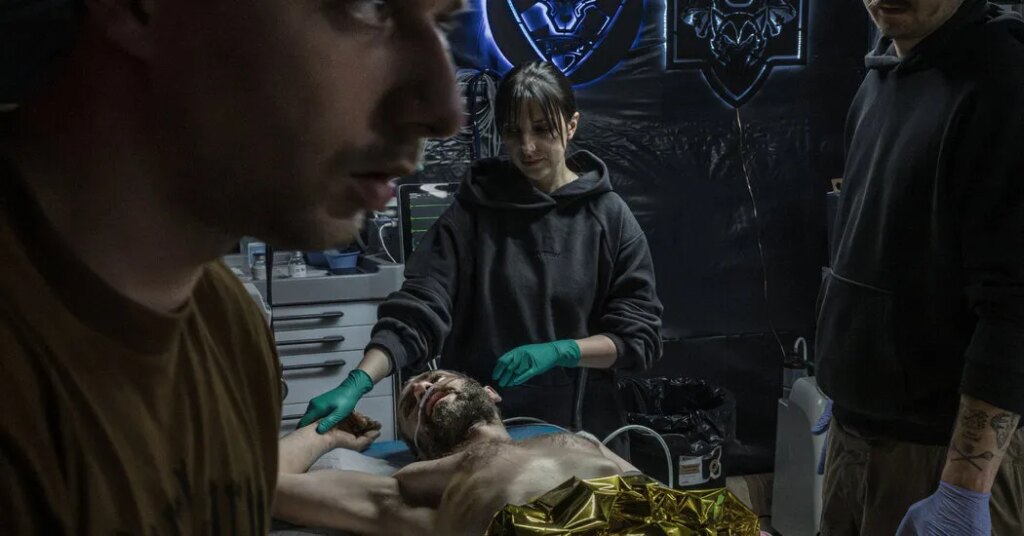
Hundreds of miles to the east, in a basement near the front line, Daryna Boiko, a 32-year-old anesthesiologist, prepared to attach an IV drip to a soldier wounded by a drone. “It won’t be scary,” she assured him. “It was scary out there,” he replied. “It’s fine here.”
In Kyiv, the capital, Hanna Buraho, a 53-year-old psychotherapist, made tea after a session with a group of soldiers. More than 5,000 service members have been through her rehabilitation program, which uses horses. “When the war started, everyone rushed to help each other, and every person wanted to do something of their own, so this is my contribution,” Ms. Buraho said.
In Odesa, in southern Ukraine, two morgue workers pushed open the heavy, rusted doors of a refrigerated rail carriage that contained the remains of dozens of soldiers killed in battle. A white bag was placed on an autopsy table, and Ruslan Fedorenko, 61, a forensic pathologist, turned to his work.
None of these people carry weapons. But like Ukrainians across the country, they deal with the war and its consequences every day.
‘It’s a Disaster’
Lychakiv Cemetery, the oldest in Lviv, has been a place of sorrow for countless families. For Mr. Biliak, it is a workplace. He is the first to arrive at a gravesite, and one of the last to leave after he and his colleagues shape the mound of earth over it.
This has been his business since 1992, after the Soviet Union collapsed and people clung to whatever work they could find. “We made monuments out of stone chips; back then, a job like that cost $200 to $300, and that was big money,” Mr. Biliak said as he chain-smoked.
At the cemetery’s Field of Honorary Burials, an excavator finished digging out a grave. Mr. Biliak and the other diggers climbed in and began to shape its walls. In a few hours, it would receive the remains of another soldier. The men joked as they worked. Oleksandr Dmytriv, 40, who runs the cemetery, brought them hot coffee.
At 9 a.m., loudspeakers announced the minute of silence that is now observed every day across the country. The joking stopped. Mr. Biliak took his cap off and looked out over hundreds of graves, as the flags of Ukraine and individual military units fluttered over them. He crossed himself three times.
“It’s a disaster,” he said. “You know how it wrecks your head?” He picked up his shovels and walked to a shed, waiting for the funeral to start.
‘Here and Now’
“A horse is a big animal,” said Ms. Buraho, the psychotherapist. “It can step on you or bite you, so a soldier standing next to it can’t stay inside his own memories,” she added. “He has to be here and now.”
She was explaining how horses can help soldiers with post-traumatic stress disorder, as well as problems with balance, joint mobility or vertigo — a process known as hippotherapy.
Each session begins with a circle of trust, where the soldiers talk about themselves and what they expect from the session. Then they are introduced to the horses and practice making contact with the animals.
Ms. Buraho said the exercise teaches soldiers to slow down, observe the horses’ reactions, become more aware of themselves and establish boundaries. A horse can sense aggression and pull away; the soldier has to calm down to restore contact.
Later, they moved into the saddle to focus on body awareness, balance and relaxation as riders swayed and moved with their horses. The horses’ movements send rhythmic pulses through the riders’ bodies that help them reconnect with physical sensations, Ms. Buraho said.
The war has affected her, too. Years of worrying about her family and others have left her exhausted and made it harder to feel joy, she said. She draws strength from nature and from other people, including her 4-year-old grandson, Daniel, who can distinguish the sound of a ballistic missile from that of a Shahed drone. “Don’t be afraid, it’s just a Shahed,” she recalled him telling her.
During the therapy session, some of the soldiers smiled, stroking the horses and leaning into them. At the end, they fed them. “They’re one step closer to healing,” Ms. Buraho said.
A Life Underground
Dr. Boiko, who works on the frontline, runs a “stabilization point” where wounded soldiers are rushed for initial treatment. Her facility is in a basement, divided between patients’ rooms and staff living quarters.
Medical staff spend nearly all their time there, because Russian drones make it too dangerous to go outside. “You get used to it,” Dr. Boiko said. “You adapt to everything.”
The facilities are meant for soldiers, but with medical care scarce near the front, civilians are often taken there too. Dr. Boiko remembered treating a woman, at another facility, who had been brought in by a soldier on a motorcycle. One of her legs was gone, lost to a Russian drone. “That stabilization point was later leveled by guided aerial bombs,” Dr. Boiko said.
The medical staff pass free time by watching sports, movies and TV shows. Some relax by smoking hookah. Dr. Boiko said she had no serious relationships, so as not to get attached to anyone. One of her colleagues, a surgeon, has a young daughter whom he sees just once a year, on leave.
“Our motivation is when we find out that a badly wounded man we stabilized made it to the next medical facility, that he’s all right afterward, that we managed to save someone’s limb or life,” Dr. Boiko said.
Identifying the Dead
“I lost everything,” said Dr. Fedorenko, the forensic pathologist.” All I have left is my wife, my son and my car.”
He was remembering Bakhmut, the city in eastern Ukraine that he fled in 2022, now in ruins and under Russian control. “It’s my hometown, and it’s gone,” he said. “It hurts to remember.”
Dr. Fedorenko went into forensic medicine to help solve crimes. Then, in 2014, as the head of Bakhmut’s forensic medicine department, he used his skills to identify fallen soldiers. Russian-backed separatists in the area had begun a low-level insurgency that would persist for years. He worked to identify dozens of war dead in 2015.
But that pales in comparison to what he and his colleagues now handle.
Dr. Fedorenko works on the platform of a railway station. Several autopsy tables stand under a tent covered with camouflage netting. On both sides of the platform are dozens of refrigerated railway carriages containing the bodies of Ukrainian soldiers, each in a white bag marked with a serial number. Some are only burned remains.
Working in protective gear, Dr. Fedorenko takes samples for DNA testing. “We try to identify the fallen as fast as we can, so the body can be sent to the family for burial,” he said.
He gets, at most, two days off a month. He spends as much time as he can with his wife, Nataliia. They walk along the shore of the Black Sea and talk about things that have nothing to do with work.
The post These Ukrainians Aren’t in Combat. But They Deal With War Every Day. appeared first on New York Times.