Matthew Walther is editor of the Lamp magazine, a Catholic literary journal, and author of a forthcoming biography of John Henry Newman.
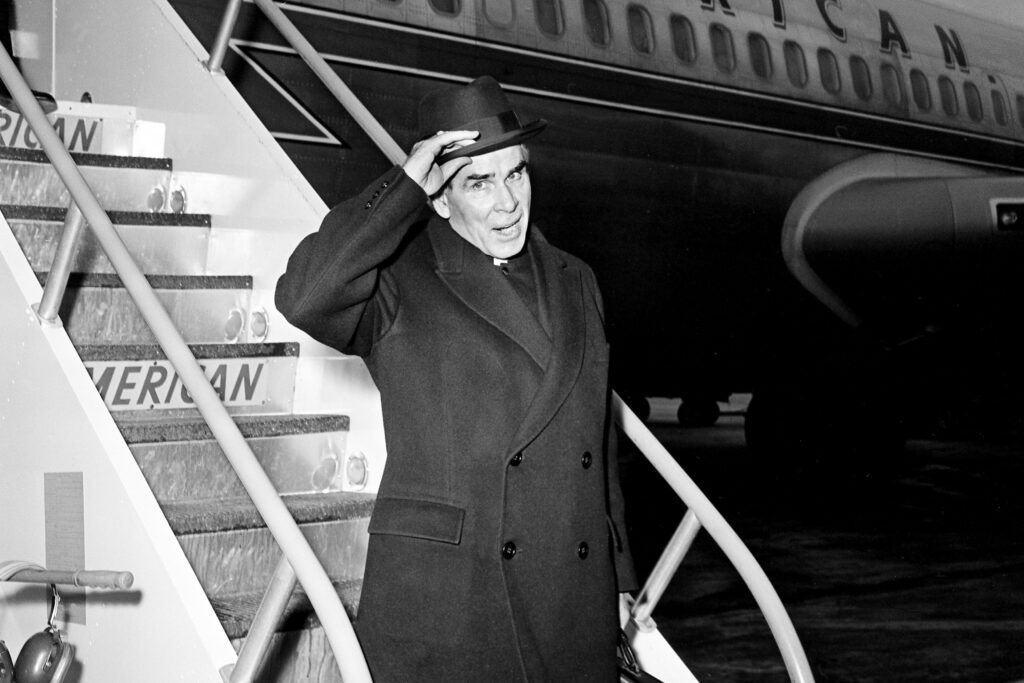
Fulton J. Sheen’s name is no longer one to conjure with except in some Catholic circles, but in the 1950s and ’60s, he was a familiar figure to most Americans, as well known as Howdy Doody or Doris Day. His television program, broadcast from 1952 to 1957 and then from 1961 to 1968, was a ratings monster, consistently beating out Milton Berle, “Mr. Television” himself. In his day Sheen was not merely a well-known member of the clergy but an actual celebrity, a status no priest has attained since or is likely to achieve in the foreseeable future.
On Thursday, he will be beatified in St. Louis. This act, the last step before canonization, recognizes Sheen as a figure of heroic virtue worthy of public veneration. For practical devotional purposes, at least in this country, it makes him a saint. Sheen’s journey to Rat Pack levels of fame (he was once roasted at the Friars Club) is a remarkable and indelibly American story.
Born in El Paso, Illinois, in 1895, Sheen was a prodigious intellect who carried away all the prizes at his high school, his seminary and the Catholic University of America, before proceeding to further studies in Europe. After serving only about a year as an ordinary parish priest in his home diocese of Peoria, he was recalled to Washington, where he taught at his alma mater for 23 years. In 1951, Pope Pius XII made him an auxiliary bishop of New York.
There, Sheen was charged with leading the Society for the Propagation of the Faith, an international charitable organization under the nominal jurisdiction of the papacy. He could not have known then that Cardinal Francis Spellman (1889-1967), the city’s archbishop, had been accustomed to using the society as a personal slush fund. On one occasion, Sheen refused to give Spellman a large loan; on another, he refused to pay the cardinal for hundreds of thousands of dollars’ worth of powdered milk that the government had donated to the archdiocese.
The two men disagreed about almost everything, including the Vietnam War, for which Spellman became the loudest cheerleader not only within the cautious episcopate but arguably across the United States. After repeatedly being passed over for various appointments, Sheen was finally made bishop of Rochester, New York, in 1966. The appointment — as unglamorous as it would prove to be short-lived — was considered to be the cardinal’s final act of revenge. Yet Sheen refused to criticize Spellman publicly; even in his autobiography, published in 1980, a year after he died, he had only kind words for a man who spent years attempting to destroy him.
It was against the backdrop of these conflicts that Sheen made his career in television. “Life Is Worth Living” was essentially a series of lectures, delivered without notes, on topics ranging from the nature of sin to post-Einsteinian physics to “The Russian People.” In those days of tawdry variety shows — ventriloquists, snake charmers, Bob Hope — the program was almost certainly the most tasteful thing on the airwaves. It won an Emmy in its first year and brought about the cancellation of “The Frank Sinatra Show” on CBS. By the mid-’50s, Sheen’s weekly audience had grown to more than 5½ million households at a time when there were only some 33 million television sets in the U.S.
But his success proved fleeting. From 1957 to 1961, Sheen was forced to “retire” from television, ostensibly for “spiritual considerations” but almost certainly due to the machinations of Spellman, whom he had embarrassed by exposing the cardinal’s financial chicanery to Pope Pius XII. A revived version of the series, “The Fulton Sheen Program,” was initially popular but didn’t perform as well as the original. In 1968, amid declining ratings, Sheen again ceased broadcasting. By then tastes had changed. The transition to color had done him no favors. Prancing theatrically around a cheap-looking set in his red cape, he sometimes looked less like an actual bishop than Peter Cushing playing one in a Hammer Horror film.
Most saints are identified with one or more causes or classes of people. (St. Lucy, for example, who had her eyes gouged out during the reign of Diocletian, is the patron of eyesight.) Some have suggested that Sheen will be the patron saint of “influencers.” This notion is as ludicrous as it sounds. Sheen’s television career offers no lessons for Catholics today. The political, social and cultural conditions that made him a safe, almost avuncular avatar of Fordist economics and anti-communism for non-Catholics more than half a century ago no longer exist and cannot be recreated on TikTok.
Today, even the most wildly successful attempt at creating something like “Life Is Worth Living” would reach only a narrow, self-selecting fraction of Sheen’s original audience. It isn’t clear that he would approve of most new media today. It is, however, easy to imagine that he would have agreed that the answer to what one contemporary churchman has called “the dictatorship of noise” isn’t to join the cacophony but to resist it by spending as little time as possible having our attention stolen from us by algorithms.
Instead of encouraging us to form YouTube apostolates, Sheen offers Catholics — and all Americans — a much more urgent and old-fashioned lesson. The great paradox of his life is that this decidedly public man — in addition to his broadcasting career, he wrote more than 60 books — was content to endure ill-treatment at the hands of superiors silently. This virtue of bearing wrongs lightly, which the church lists among the Seven Spiritual Works of Mercy, is difficult to acquire. It is modeled almost nowhere in public life, and one sometimes gets the sense that most of us no longer even regard the patient treatment of our enemies as salutary. Even an official publication from the U.S. Conference of Catholic Bishops resorts to a cheap psychologization (“Frustrated with someone? Step away from the situation, take a few deep breaths”) to explicate it.
Sheen’s almost supernatural willingness to suffer the slings and arrows of outrageous fortune mirrors the example of Christ himself. It can inspire all of us in a way no podcast ever could.
The post Fulton J. Sheen’s unfashionable virtue appeared first on Washington Post.