At a fundamental level, artificial intelligence leaders, evangelists and their allies want you to believe that their novel technology demands a novel political approach.
Calls for self-regulation from the chief executives of Anthropic, OpenAI and other such companies rest on the idea that the A.I. labs and their funders are the only people equipped to handle and regulate this potentially dangerous technology. This is why, for example, Dario Amodei, the chief executive of Anthropic, recently called for antitrust waivers to allow “industrywide coordination” around A.I.
As my colleague Tressie McMillan Cottom observed in a recent column, the ostentatious panic around the prospect of superintelligent A.I. seems to cash out, politically, in a call to abdicate democratic authority to the companies in question. “They want us to panic, instead of seriously deliberating at the polls, in community meetings and in Congress,” she writes. “Panic is chaos without direction, affect set free from the discipline of curiosity, debate and accountability.”
Even potential regulation is framed as a collaboration between government and the A.I. companies rather than a relationship of oversight and control. It is noteworthy, too, that as framed by these leaders, the conversation around A.I. safety is more about science-fictional scenarios and future apocalypses — rooted in a set of questionable assumptions about the nature of intelligence, among other things — than it is about more immediate concerns like the impact of A.I. on jobs, mental health and the environment.
But novel technologies do not actually require novel political solutions, especially when those technologies either evoke, replicate or recapitulate age-old problems of political and economic life.
There is, in fact, an American tradition of fighting to bring collective and democratic authority to bear on disruptive technologies — of using politics to try to shape and direct the impact of major economic transformations.
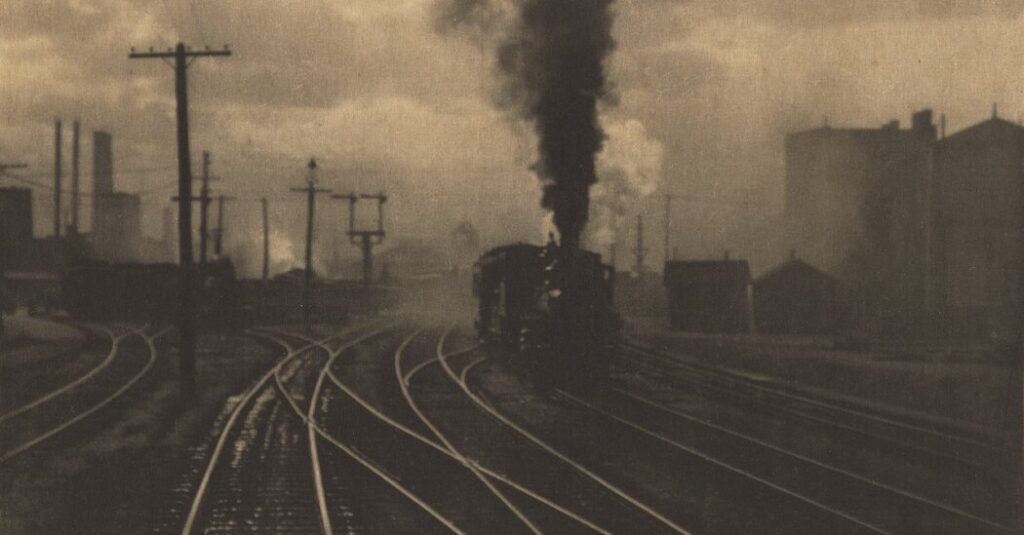
The United States of the late 19th century was an unimaginably fast-moving society in which new technologies enabled a theretofore unknown degree of connection between peoples. The railroad stood, in particular, as the innovation that disrupted the very fabric of American life.
In its vast scale and tremendous ability to produce wealth and power, the railroad was, the diplomat and historian Charles Francis Adams Jr. wrote in the late 1860s, “an incalculable force practically let loose suddenly upon mankind; exercising all sorts of influences, social, moral, and political; precipitating upon us novel problems which demand immediate solution; banishing the old before the new is half-matured to replace it.” It might be, he concluded, “the most tremendous and far-reaching engine of social change which has ever either blessed or cursed mankind.”
Railroads, which were wrestled and consolidated by industrial titans such as J.P. Morgan into national corporations of mammoth proportions beginning in the 1880s and 1890s, amassed enormous profits, most of which flowed to small cadres of creators and financiers at the top. As bureaucracies, railroads rivaled the federal government in size; as political entities, they rivaled most state governments in power. They could extract immense subsidies and shape the direction of economic development across entire regions. They incurred large debts, produced huge losses and grew to such size that when one or more collapsed, they took the whole economy with them.
Railroads were also politically powerful. “Their influence,” wrote William Larrabee, a former Republican governor of Iowa, in 1893, “extends from the township assessor’s office to the national capital, from the publisher of the small crossroads paper to the editorial staff of the metropolitan daily. It is felt in every caucus, in every nominating convention and at every election.”
The often oppressive power of the railroads invited hostility and critique from a broad cross-section of the American public. The novelist and critic William Dean Howells channeled these doubts in his 1888 reflection on the Burlington railroad strike of that year: “Shall the railroads fulfill their public obligations by agreement with their employees, or shall the government take possession of them and operate them? It is folly to talk of the withdrawal of capital and the consequent ruin of the country. The country belongs to the people and they are not going to let it be ruined.”
Still more dramatic was Ignatius Donnelly, a Minnesota populist who denounced the state of the nation and demanded reform in what would become the preamble to the platform of the People’s Party. “We meet in the midst of a nation brought to the verge of moral, political and material ruin,” he said, speaking at the 1892 St. Louis Industrial Conference. “Corruption dominates the ballot box, the legislatures, the Congress and touches even the ermine of the bench.”
“The fruits of the toil of millions,” he continued, “are boldly stolen to build up colossal fortunes, unprecedented in the history of the world, while their possessors despise the republic and endanger liberty.”
For the Populists, railroads were not just any business — they were public highways that allowed for public communication and public transportation. They were financed by public loans and built on public lands. The solution, then, was public ownership and democratic control. “The time has come,” reads the 1892 platform of the People’s Party, “when the railroad corporations will either own the people or the people must own the railroads.”
“Transportation being a means of exchange and a public necessity,” it continues, “the government should own and operate the railroads in the interest of the people.”
A.I. is not equivalent to railroads. For one, rail travel met an immediate need whereas, outside of highly technical fields, artificial intelligence is still a product looking for a market.
But like the railroads, the infrastructure of A.I. marks the built landscape; like the railroads, the wealth of A.I. companies shapes the overall political arena; and like the railroads, the sheer economic power and force behind A.I. is in tension with democracy and self-government. If A.I. promises to transform the entire society, then the entire society is entitled to have a say, even a decisive one, over the use, development and direction of the technology. And crucially, this does not require new and novel forms of accountability. The old ways, even the old laws, still apply.
“Law enforcers already have authority to charge companies and their C.E.O.s for creating and releasing dangerous, unvetted or defective products,” observed Lina Khan, former chairman of the Federal Trade Commission, on X. “We shouldn’t let discussions about new legal regimes distract from the fact that there’s no A.I. exemption from laws already on the books.”
Rather than allow self-regulation or build some bespoke new regime, we can treat the A.I. companies like the powerful businesses of the past. If the laws apply, they should be enforced, and if these companies break them, they should be punished accordingly. Above all, the public must demand a role and a say in the future of this technology. New technologies must serve our needs, not the other way around.
Writing on the eve of the completion of the transcontinental railroad, the economist Henry George asked from his perch in San Francisco whether the railroad would bring misery or prosperity to the people of California, and whether anyone could resist the consequences of a great new concentration of wealth and power. “Can we rely upon sufficient intelligence, independence and virtue among the many to resist the political effects of the concentration of great wealth in the hands of a few?”
Well, can we?
The Times is committed to publishing a diversity of letters to the editor. We’d like to hear what you think about this or any of our articles. Here are some tips. And here’s our email: [email protected].
Follow the New York Times Opinion section on Facebook, Instagram, TikTok, Bluesky, WhatsApp and Threads.
The post New Matrix, Meet the Old Matrix appeared first on New York Times.