Last year, the United States and China demonstrated they could inflict serious pain on each other.
The Trump administration imposed tariffs and technology controls; China hit back by restricting exports of rare earths and other materials essential for American industry. Factories and consumers on both sides of the Pacific felt the effects. But neither country could force the other to back down, and the confrontation ended last October when they agreed to a yearlong truce.
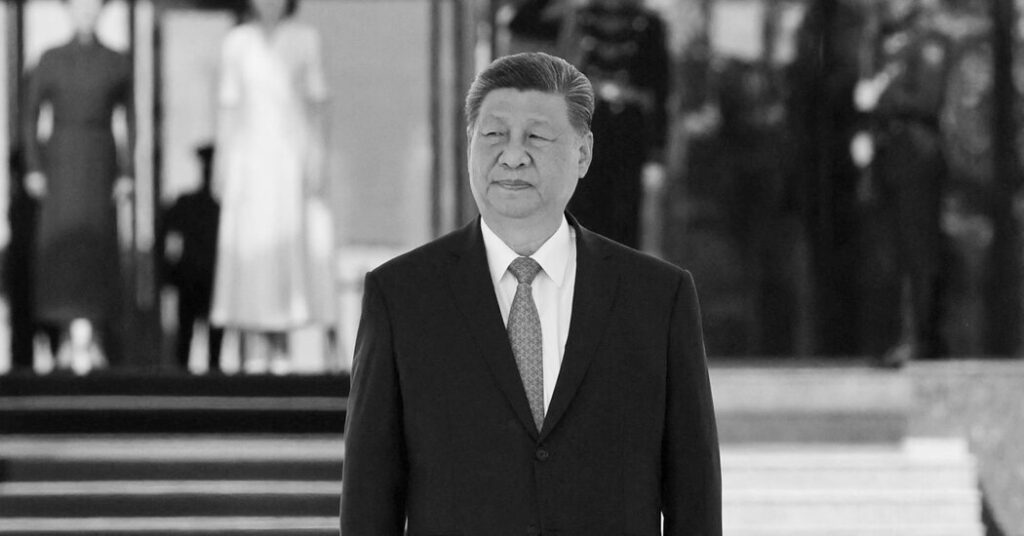
With that truce about to end, the meeting on Thursday between President Trump and President Xi Jinping of China opens a new chapter that could be pivotal for the relationship between the United States and China.
The meeting at the White House is an opportunity for the two superpowers to embrace the undeniable lessons of the past year and begin building a durable détente by abandoning disruptive fantasies that either side can decisively “win.”
Beijing and Washington now know that neither can land a knockout blow because they each possess formidable advantages the other struggles to match.
America has unrivaled financial power and leads in semiconductor design, in making the equipment essential for chip manufacturing and in the most advanced artificial intelligence models. China is the world’s largest exporter. It dominates the global supply of rare-earth elements and other critical minerals and the production of the high-powered magnets vital for advanced electronics, cars and weapons. Chinese-made chemicals and other ingredients are crucial for pharmaceuticals used in America. Regarding A.I., China has shot ahead in providing cheap open-weight models rapidly being adopted around the world, including in the United States.
Building a lasting détente could prove as consequential for history as Cold War coexistence was for the United States and Soviet Union.
During the Cold War, the nuclear arms race and prospect of mutually assured destruction caused Washington and Moscow to pull back from the brink. The same calculus holds today, but with an important difference: U.S.-Soviet trade was minimal, but the Chinese and American economies are deeply interdependent.
Even after last year’s trade confrontation drove bilateral commerce down by 25 percent, China remained America’s third-largest trading partner after Mexico and Canada. Decoupling altogether is neither possible nor desirable, and attempts to weaponize one chokepoint invite sharp retaliation through another. What Washington and Beijing now face is an updated version of the Cold War’s deterrent: mutually assured economic disruption.
That is the logic of détente — the realization that continued escalation would be too costly.
The pursuit of decisive economic and strategic victory is futile, and it is not what the people bearing the costs of the resulting disruption want. Many Chinese and American citizens are tiring of confrontation. Young Americans, in particular, favor cooperation with China rather than confrontation, according to some surveys. In China, too, people are weary, increasingly opting out of the rat race rather than exhausting themselves in an economy that many see as geared toward national strength and the standoff with the United States rather than meeting their own needs.
Mr. Xi is looking ahead to next year’s Communist Party Congress — the gathering every five years that sets the party’s leadership and direction — and wants calm as it approaches that politically sensitive moment. With U.S. midterm elections looming, Mr. Trump is no doubt eager to secure agricultural trade deals with China that he can present as wins for U.S. farmers. Thursday’s meeting may yield only modest gestures, but the encounter offers something more important over the long run: a chance for both governments to reaffirm what the past year has made clear.
Artificial intelligence is expected to be a major topic, and perhaps no issue better illustrates the dangers both countries now face. The warning signs are mounting. In the United States, A.I. systems have tapped into sensitive networks or otherwise behaved unpredictably. And after a California security firm revealed this month that A.I. had helped it find a way to hijack accounts on WeChat, the dominant Chinese messaging app, China’s top spy chief warned that A.I. could slip beyond control and threaten political and social stability.
Such concerns make it all the more important for China and the United States to lower the temperature and keep communication channels open. They could start with discussions that focus initially on common enemies such as ransomware gangs that could use A.I. to exploit vulnerabilities in software, networks and critical industries.
None of this means this week’s meeting will produce a major breakthrough, or that some grand geopolitical bargain is on the horizon, or that the two nations will stop jostling over trade, technology and global influence.
What truly matters is that both absorb the reality that maximalist demands and threats serve neither country’s interests and begin laying the foundations for a more stable future. Washington must understand that China seeks greater influence in the world and less vulnerability to foreign pressure, not to cripple one of its biggest trading partners. Beijing, for its part, must recognize that every time it weaponizes its dominance of critical minerals, it hastens U.S. efforts to diversify its own supply chains, thereby eroding China’s leverage and hardening American fears about Beijing’s intentions.
The larger promise of embracing a durable détente lies not only in avoiding disruption now, but in widening what may become possible. A more stable relationship could create regular communication, make crises easier to manage and open space for sustained and badly needed work on humanity’s biggest challenges, such as A.I., climate change and global health, which neither country can solve alone.
This doesn’t require mutual trust, only the wisdom and restraint to keep competition from consuming the rest of the relationship.
Jessica Chen Weiss is director of the Johns Hopkins SAIS Institute for America, China, and the Future of Global Affairs. She is the author of the forthcoming book, “What China Wants: And What It Means for the World.”
The Times is committed to publishing a diversity of letters to the editor. We’d like to hear what you think about this or any of our articles. Here are some tips. And here’s our email: [email protected].
Follow The New York Times Opinion section on Facebook, Instagram, TikTok, Bluesky, WhatsApp and Threads.
The post For Trump and Xi, There Is Only One Way Forward appeared first on New York Times.