Prosecutors in Marion County, Indiana, criminally charged five Indianapolis police officers Wednesday, accusing them of misusing their access to Flock license-plate-reader cameras. The action comes weeks after outreach from The Washington Post highlighted thousands of questionable Flock searches, leading the city to suspend one officer and conduct an audit of its system.
“A lot of this was initiated by The Washington Post,” Marion County Prosecutor Ryan Mears said in a news conference Wednesday.
The five officers — Michael Rogers, Jonathan Schultz, Cassandra Crawley, Matthew Binford and Abigail Cramer — were all charged Wednesday with fraud and official misconduct, court records show. Cramer resigned, while the four other officers have been suspended and recommended for termination, the Indianapolis Metropolitan Police Department said in a statement.
None of the five immediately responded to The Post’s requests for comment. “Misuse of any law enforcement tool is unacceptable, and we will continue investing in safeguards that help agencies detect misuse and hold users accountable,” Paris Lewbel, a spokesman for Atlanta-based Flock Safety, said in a statement.
A Flock tool that automatically scans for potential misuse will soon be mandatory for all agencies, Lewbel added, one of several safeguards the company announced days after The Post reported in August on officers abusing the tool.
Nationwide, at least 100 police department employees have been charged with or accused of misusing license-plate readers for unauthorized purposes, according to a Post investigation, based on thousands of pages of police and court records. In many of these cases, officers used Flock’s roadside cameras to track the location of romantic partners and exes.
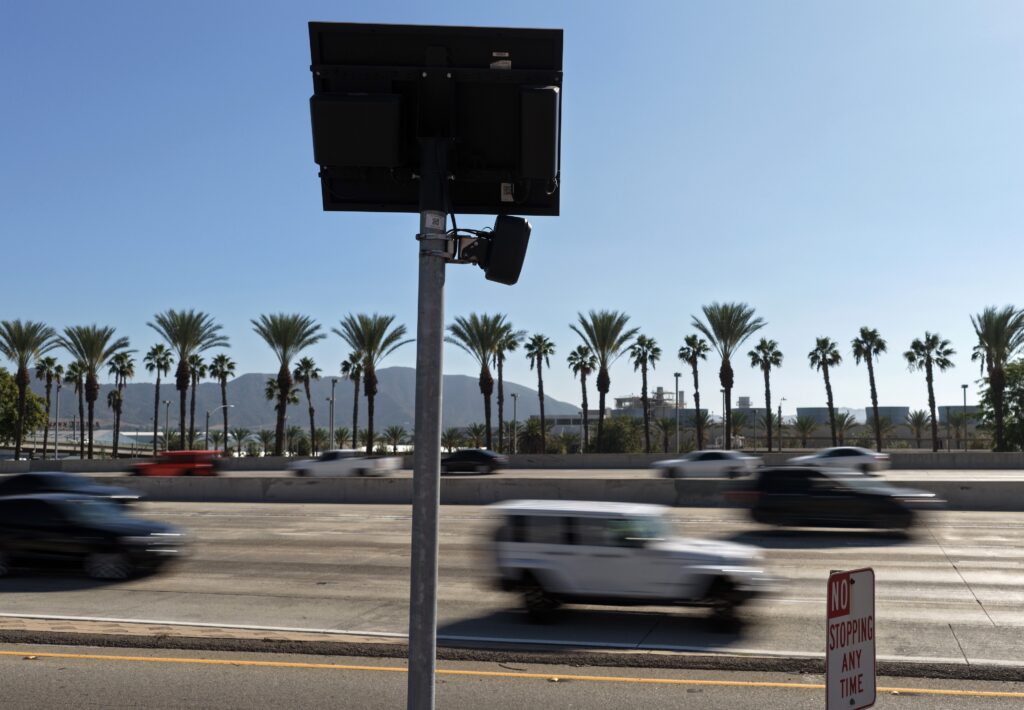
The widespread misuse has contributed to a backlash against the tools, which take photos of passing cars to create a database police officers use to track the location of individual license plates. Florida Gov. Ron DeSantis ordered the removal of Flock cameras from state roads by the end of this month, Texas Gov. Greg Abbott froze state funding, and this week Sen. Josh Hawley (R-Missouri) led a congressional hearing focused on how Flock amassed what he said was “a surveillance network unlike any we’ve ever seen in this country.”
The charges in Indianapolis came nearly seven weeks after The Post asked the city about potentially suspicious activity from one of its officers. Using publicly available information, The Post found that Rogers, one of the officers charged Wednesday, appeared to have relied on Flock cameras to track vehicles used by his wife and two close personal acquaintances, searching the plates 3,759 times over a 10-month period — an average of about 12 lookups per day.
At the time, Police Chief Tanya Terry said she suspended one officer while the department conducted an investigation into possible misuse and a systemwide audit of the city’s 301-camera Flock system.
That audit led to the discovery of more widespread abuse, Mears said Wednesday.
Mears said the department’s findings highlight the vast power Flock cameras give police officers and raise questions about whether the government should be doing more to prevent the misuse of that power.
“Many of the proposed guardrails and the things that have been proposed would not have prevented the behaviors and actions we see here today,” Mears said. “Does there need to be independent oversight? Does there need to be judicial oversight of the Flock camera system?”
One of the Indianapolis officers, Schultz, an 18-year veteran of the police department, was accused of using Flock to track his ex-wife and women he met while on duty or out in public. He was charged with multiple counts of official misconduct as well as two counts of stalking.
Schultz told one woman he was an FBI agent, according to prosecutors, and began texting her and showing up at places she frequented, including at her gym and at a school function with her daughter. Prosecutors said he arrived at her gym within an hour of her at least nine times between June 12 and Aug. 1 of this year. In one conversation, he said he had to find her number because he spilled yogurt on his pants and told her, “You know what that looks like.”
Another woman met Schultz after her car was stolen from a mall parking lot, and he began texting her flirty messages later that night. The two dated briefly, and Schultz later looked up where the woman went on dates with another man.
Schultz searched the plates of a third woman 178 times and also frequently showed up where she was, including her gym, a Smoothie King and a Walmart earlier this month. During this time, Schultz handed her a note in the gym parking lot that read: “Theres always some type of crazy in our lives. We shouldn’t let it get in-between what we want in life.”
Mears said the case demonstrated that misuse of Flock technology has “real-world victims.”
“I think it speaks to the power of the Flock camera system in general, and just the enormous amount to information that is available to police officers,” he said. Flock “gives them an incredible amount of information to determine where people are going and when people are going there.”
Investigators found that another accused officer, Cramer, used Flock to look up people related to her current wife’s ex-wife, a court affidavit said. That woman told investigators she had issues with Cramer in the past, including receiving anonymous hate letters and having her driver’s license photo posted online, and said she felt “uncomfortable, unsafe and … harassed.”
A third officer, Binford, told investigators he had used the log-in credentials of another officer who had logged in to Binford’s laptop during a field training exercise. Binford searched the plate of his ex-wife more than 1,000 times between April 2024 and April 2025.
Indianapolis police had no regular practice of auditing officers’ Flock searches until recently, Terry said in an interview last month. The department’s investigation into the tool’s misuse has been “a learning process for us,” she said at the time.
The post Five Indianapolis officers charged following The Post’s reporting on Flock misuse appeared first on Washington Post.