The unscheduled phone call turned out to be worth $1 billion.
University of Oregon leaders have long been accustomed to big checks from Phil Knight, a Nike co-founder whose surname is splashed on everything from the library to the law center. When Mr. Knight called Oregon’s president this year, though, he and his wife, Penny, had a greater gift in mind: the largest known contribution to a public flagship university in the United States.
Oregon announced the donation, which will go toward starting an engineering college, on Wednesday, bringing the Knight family’s known total giving to Oregon to more than $2 billion.
But the contribution underscores how even the biggest gifts rarely erase financial strains at places like Oregon, which is weighing millions of dollars in fresh budget cuts as enrollment ebbs. Declining birthrates suggest a darkening outlook for colleges in the coming years as the number of children drops, and the Trump administration is pursuing a vigorous campaign to overhaul — and reduce — federal research funding.
“One of the most successful businesspeople in the history of humanity, and one of the most generous philanthropists in the history of humanity, has said higher education is worth an investment of this magnitude,” Karl Scholz, Oregon’s president, said in an interview. “At a time when we’re all feeling a little bit under siege, this is tremendous news.”
The donation, Dr. Scholz said, amounted to “a screaming endorsement of the importance of what we’re doing.”
The Knights declined to be interviewed. In a statement, though, Mr. Knight signaled that he agreed with Dr. Scholz’s view.
“To make an audacious dream a reality requires more than a vivid imagination,” Mr. Knight said. “It also requires the sort of opportunity that our great American universities, both public and private, have historically provided. This is no time to abandon them.”
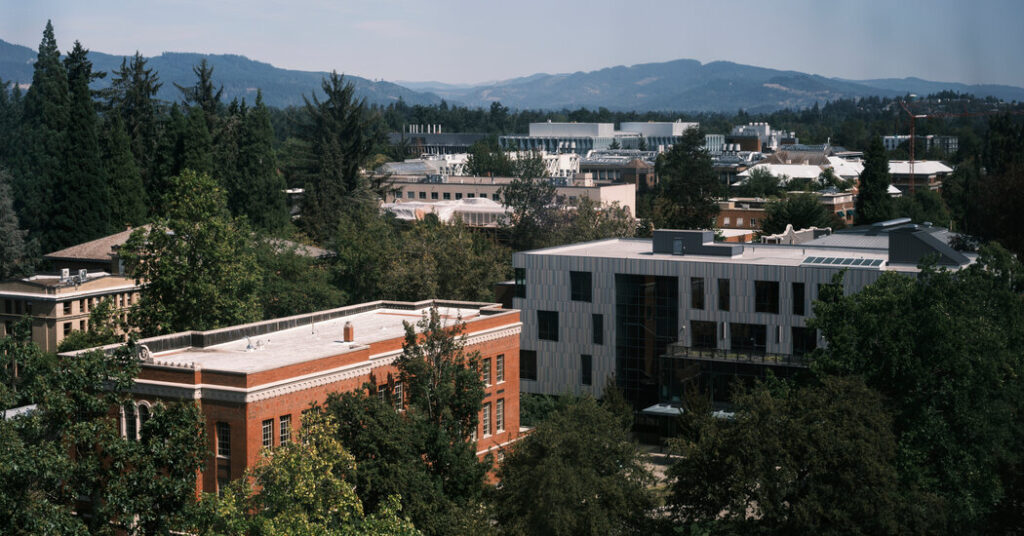
Bob Guldberg, an Oregon vice president who is a professor of bioengineering, said the contribution built on previous donations from the Knights. In the past, some of the family’s donations contributed to the Knight Campus for Accelerating Scientific Impact, a glittering hub of classrooms and labs.
The $1 billion donation, Dr. Guldberg said, would allow Oregon to move beyond offering engineering minors and graduate programs to create a full undergraduate program that could help alleviate a shortage of engineers in the state.
Oregon officials expect the process to take about a decade.
Dr. Scholz and Dr. Guldberg said they had routinely briefed the Knights over the years on their ambitions for the university. But a call from Mr. Knight, Dr. Scholz said, had not been on his calendar as he passed some time at San Francisco International Airport.
For the most part, the largest contributions to American universities have gone to private schools. Johns Hopkins University, for example, said in 2018 that Michael R. Bloomberg had given $1.8 billion, pushing his lifetime contributions to Hopkins above $3 billion. The California Institute of Technology, Harvard and Stanford are among the schools that have reported individual donations of at least $500 million over the last decade.
Such largess has rarely flowed to public institutions. Stony Brook University, which is on Long Island, said in 2023 that it had received a $500 million donation. Two years earlier, Western Michigan University announced a $550 million contribution.
But much of the Knight family’s giving has gone to public schools in Oregon. Last year, Oregon Health & Science University announced a $2 billion contribution from the Knights to its cancer institute.
Although that contribution is believed to be the single largest gift to any American university, the Knights have more often been associated with the flagship in Eugene. In 1964, Mr. Knight, working with his former track coach at the university, started the company that became Nike.
Today, Mr. Knight is 88, and his company is so entwined with Oregon that some refer to the school as “the University of Nike.” The Knights have been prolific givers for athletics. The basketball arena, for example, is named for a son who died in a scuba accident. They have also supported academics, underwriting projects like the Knight Campus.
The university is nevertheless grappling with some financial challenges. Last fall, about 43 percent of Oregon’s roughly 21,000 undergraduate students came from out of state. Those students tend to pay much more in tuition than Oregonians, giving the university’s budget extra breathing room.
But Oregon has been expecting out-of-state enrollment to erode this year and into the future. This past spring, Dr. Scholz announced plans for about $65 million in new budget cuts.
Oregon officials hope the newly expanding engineering program will attract students who might have gone elsewhere.
For now, though, Dr. Scholz acknowledged he will most likely have tightrope conversations as Oregon moves ahead with cuts while celebrating an enormous gift. He hopes to focus those conversations on what the university should be in the future.
“What is really going to matter for our students, for the state going forward?” he said.
The post $1 Billion Donation to University of Oregon Makes History appeared first on New York Times.