Call it the distrust election.
For as much as Americans disagree these days, one common denominator runs through American life: a profound distrust of the institutions and industries that make the country run. Whether on data centers, chemicals in food, the Epstein files or the war in Iran, Americans across the political spectrum say they have the feeling that they are being lied to.
“I feel like I was sold a bill of goods,” said Paul Carroll, 66, an insulation salesman in New Orleans whose anger at President Trump for starting a war when he said he wouldn’t has gotten worse with the rise in diesel prices. “The goods I agreed to buy were nothing like what was delivered.”
It’s not just Republicans. Voter distrust is powering support for democratic socialists and other candidates on the left, while the Democratic establishment’s early support for data center development in the critical swing states of Michigan and Pennsylvania is souring some voters there on their elected leaders.
Phyliss Paone, 65, a retired utility company worker in Archbald, Pa., said she was a lifelong Democrat, but that she would not vote for Gov. Josh Shapiro’s re-election because of what she described as his political about-face on a proposed data center in her town.
“I don’t trust him now,” she said. “He’s just saying what he needs to get votes.”
As for the data center developers, “they just lie to the people because they think we don’t know anything,” she said.
Political scientists and sociologists have said for decades that a healthy society needs trust, both in fellow citizens and in political institutions. It greases the wheels of collective action and political change. Without it, people do not cooperate with each other or with the authorities. That can lead to political paralysis.
In the United States, trust in government topped 70 percent in the 1950s, during the post-World War II economic boom, according to the Pew Research Center. It declined dramatically in the following decades during the tumult of the civil rights movement, the Vietnam War and Watergate.
It has fallen more in recent years, including during the pandemic in 2020. These days, outbreaks of food-borne intestinal diseases, airplane crashes and flight delays, the proliferation of Flock cameras and internet scams have Americans wondering if anyone has a hand on the rudder.
Past wars were aired on television, with news conferences at the Pentagon and reporters embedded with troops. Not so with the war in Iran. The “existential threat” of artificial intelligence is being aired by scientists and billionaire executives in language that is hardly accessible, while others, including Mr. Trump, tell voters to ignore it. People are dying of measles, public health officials say, though the health secretary, Robert F. Kennedy Jr., continues to cast doubts on that fact.
A president who returned to the White House as Americans suffered through Covid-era inflation tells Americans “affordability” is a hoax as they experience sticker shock at the grocery store and the gas pump.
Pew’s most recent measurement, in September 2025, found that just 17 percent of Americans trusted the federal government.
But the collapse in trust has also brought a new fluidity to the electorate — for the first time in the Trump era, our politics are suddenly, strangely, unpredictable. The less Americans trust the establishment, the bigger the opening for populists and outsiders.
Perhaps most remarkably, Americans from warring political tribes are now joining forces to fight what they say is the bigger enemy — untrustworthy politicians working with wealthy industry.
Establishment politicians are feeling the heat. In Pennsylvania, Governor Shapiro told CBS News last month that the executive order he issued in August to restrain data centers was not politics, but instead the result of listening to constituents about how developers were “running roughshod.” A spokeswoman said the governor came to Archbald, Ms. Paone’s town, in May.
The White House is also on the defensive. In a statement, White House spokeswoman Taylor Rogers wrote, “President Trump has been clear and consistent for decades: Iran can never have a nuclear weapon. President Trump remains committed to unleashing American energy dominance, cutting costs, and putting more money back in the pockets of hard-working American families.”
For more than a decade, Mr. Trump’s brand of outsider politics has dominated precisely because he tapped into voter distrust. The durability of his approval among Republican voters seemed to ratify his brag that he could shoot someone on Fifth Avenue without denting his popularity.
But that seems to be changing, particularly on the issue that voters care most about: the economy. In a poll released last week by The New York Times and Siena College, 60 percent of likely white voters without a college degree — Mr. Trump’s core base — disapproved of his performance on the cost of living. Among Republicans overall, just 29 percent said the economy was better than it had been a year ago, down from 72 percent in January.
“We drank the Kool-Aid, and we were wrong,” said Ryan Wagner, 41, a conservative in northern Michigan who was once an enthusiastic supporter of the president.
Mr. Wagner, a manager with a home restoration company, has had a slow-motion realization that Mr. Trump has been lying to Americans, he said.
It began last year with the investigation into the assassination of Charlie Kirk, which Mr. Wagner thought did not add up. It continued when Mr. Trump started a war. Now, Mr. Wagner said, when he hears Mr. Trump talk about how much food prices have gone down, “my freaking eye is twitching.”
“I can’t even listen to him talk anymore,” he said.
“How many times has he said the war is over, the strait is open?” he asked, referring to the Strait of Hormuz. “No it’s not, you big liar.”
Mr. Wagner said he had taken down his American flag and considered the Republican Party mostly dead. He doesn’t think he will vote in this election.
His friend Jeff Sieting, the mayor of Kalkaska, Mich., where they both live, has turned away from Mr. Trump, too, after years of supporting him, even hanging a large banner in town during Mr. Trump’s first term. For Mr. Sieting, 64, a general contractor, it was the Epstein files.
“When Trump said, ‘Let’s move on,’ that pierced my heart,” Mr. Sieting said. “I was like, ‘Are you kidding me?’”
He has even stopped watching Fox News, which he said he could no longer trust to tell the truth.
“If you listen to the media, you’ll hear that New York is in collapse, they’re doing government grocery stores,” he said. “The reality is, that is absolute bullshit.”
Mr. Sieting said Mr. Trump’s promise this month of $5,000 if Americans keep Republicans in power these midterms was “the most insulting, pathetic thing.”
He said that he did not plan to vote for anyone at the state or federal level in November, and that he had many friends, staunch Trump supporters, who are not planning to vote either. He added: “I full well expect the Democrats to sweep the midterms.”
For many people interviewed, Mr. Trump had essentially become the establishment he once railed against.
“It didn’t take a whole long time for him to march to the same tune as establishment Republicans and Democrats,” said Brandon Bell, a veteran who works part time as a security guard and is a township supervisor in Penn Forest Township, Pa. Mr. Bell, who is 30 and living with his parents, said he felt “hopeless” about the economy and being able to start life on his own.
Republicans and Democrats are “all part of the same system at this point,” he said. “It’s more about benefiting themselves and their donors.”
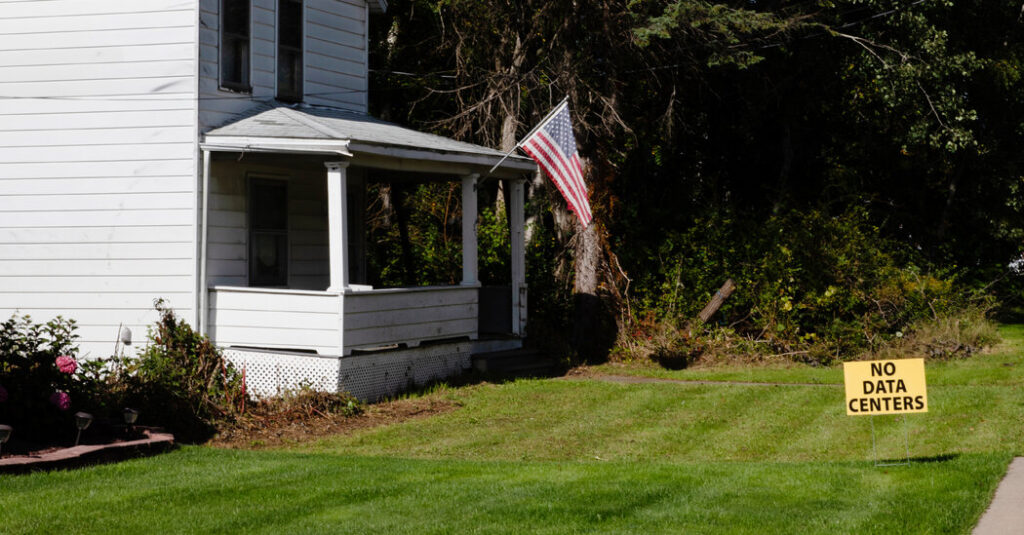
Trust is also at the heart of the data center issue, which has swept the country as technology companies spend hundreds of billions of dollars to build the centers. In Michigan, Pennsylvania and Wisconsin, people said their opposition stemmed less from a fear of tech and more from a sense that they were being lied to by elected leaders who were at best too weak to stand up to or at worst in cahoots with wealthy industry.
The effect has been surprising: a growing mutual trust in one another against a common enemy.
Tamara Misewicz-Healey, 38, a mother of three in Pennsylvania, said she usually voted Democrat but otherwise was not politically active. Over the past year, she and her husband, Justin Healey, 36, have become a full-time force behind the 14,000-member Stop Archbald Data Centers Facebook group, doing things they never imagined, like starting a GoFundMe to pay for a lawyer to represent townspeople, and filing government right-to-know requests. She was so fed up with her state representative, a Democrat, that she began a write-in campaign to run against him.
“I’m no longer a Democrat,” she said. “I no longer believe in either party. They both abandoned us.”
In neighboring Carbon County, residents were so frustrated with their state representative, a Republican who ran unopposed in the May primary, that hundreds of people wrote in the name of Christian Bartulovich, a 37-year-old manager in the medical device industry and registered Republican, getting him the Democratic nomination for November.
“I am getting all these text messages saying, ‘I’ve never donated to a Republican in my life — I hope you win,’” Mr. Bartulovich said, speaking to the fluidity of 2026 politics.
Jeff Rechten’s house in Bridgewater Township, Mich., is about a mile from a hyper-scale data center construction site. But as an employee of a cybersecurity firm, his distrust is different — less about being lied to and more about his industry’s hubris. He said he believes the tech companies started out trying to develop A.I. safely, but “have lost their way” over time, with profits and competition crowding out caution.
“Now they are rushing toward the finish line without knowing what will happen when they get there,” he said. “All they are doing is saying, ‘trust us.’”
The post ‘I Was Sold a Bill of Goods’: Americans and the Distrust Election appeared first on New York Times.