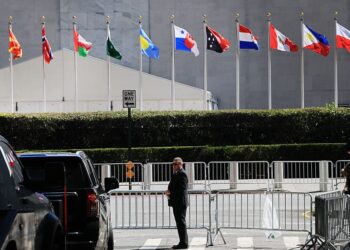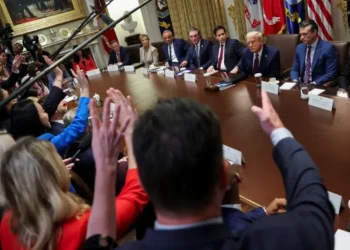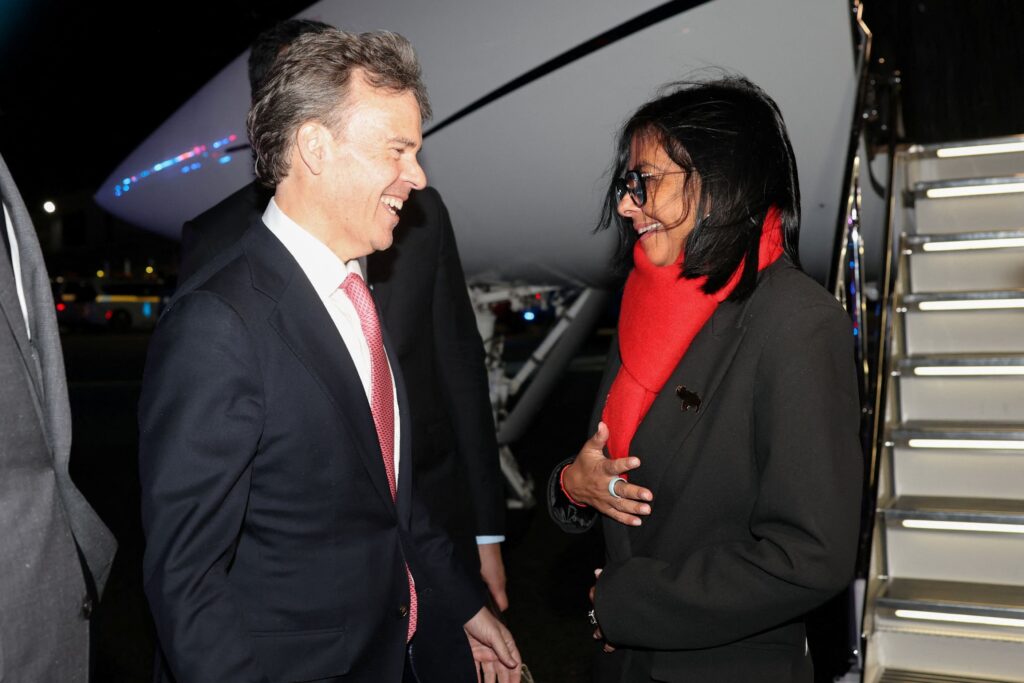
As acting Venezuelan president Delcy Rodríguez prepares to meet Tuesday with President Donald Trump on the sidelines of the United Nations General Assembly, her former running mate Nicolás Maduro sits in a Brooklyn prison cell about six miles away. Their diverging fortunes testify to the influence the United States can exert over Caracas.
Rodríguez has proved more pliable than many expected after January’s operation to capture Maduro, but it looks to us like she is buying time. No matter how many friendly photo ops she secures with Trump administration officials, Rodríguez remains illegitimate. The longer Trump waits to push for a timetable to schedule free and fair elections, the more entrenched she becomes. Rodríguez may assume that a future American administration would be unwilling to commit military force to remove her if she can outlast Trump’s term.
Political freedom is the best way to ensure sustained economic prosperity. A democratically elected leader will help inspire the kind of confidence American businesses need to make capital-intensive investments that take decades to pay off. “To have stability and growth, ultimately you have to have legitimacy,” said Ian Vásquez, vice president for international studies at the Cato Institute.
Trump took a big step in the wrong direction last month with his ill-conceived deal to give the Pentagon a stake in roughly a fifth of Venezuela’s oil reserves. The agreement puts the U.S. government in bed with shady businessman Alejandro Betancourt.
Rodríguez’s government also continues to oversee gross human rights violations. Despite some early humanitarian concessions, Venezuela’s state institutions continue to carry out arbitrary arrests and torture political prisoners, according to a U.N. fact-finding mission.
Trump has said Venezuela is “not ready yet” for elections, and successful transitions to democracy rarely happen overnight, but the president risks alienating his own supporters in the diaspora if he keeps dragging his feet.
Venezuelan opposition leader María Corina Machado, a supporter of free markets and friendship with the United States, is eager to return home after nine months in exile and wants to campaign for the presidency. Last December, she sneaked out of Venezuela, where she had been in hiding, to accept the Nobel Peace Prize.
Many of Trump’s allies understand that elections are a prerequisite for long-term stability. Speaking Sunday on Fox News, for example, Sen. Bernie Moreno (R-Ohio) called for scheduling elections in Venezuela on July 24, 2027. That is the birthday of Venezuelan-born independence leader Simón Bolívar.
Trump would win plaudits from investors and Venezuelans alike if he announced a timeline for elections during his address to the General Assembly. Rodríguez need only travel to visit her old boss in Brooklyn to see why cooperating is in her best interest.
The post Long-term stability in Venezuela requires scheduling elections appeared first on Washington Post.