Mark W. Moffett is an entomologist studying animal societies at the Smithsonian National Museum of Natural History.
A world war is raging at this very moment, with millions dying each week along battlefronts that have never made front-page news.
The combatants in this war aren’t people but ants, whose supercolonies have for decades been locked in ferocious combat across six continents. It’s a fight that is at once miniature in scale and far larger than any human war has ever been.
But in a strange way, a close look at the fighting — and the logic that drives it — can feel uncannily like looking in a mirror.
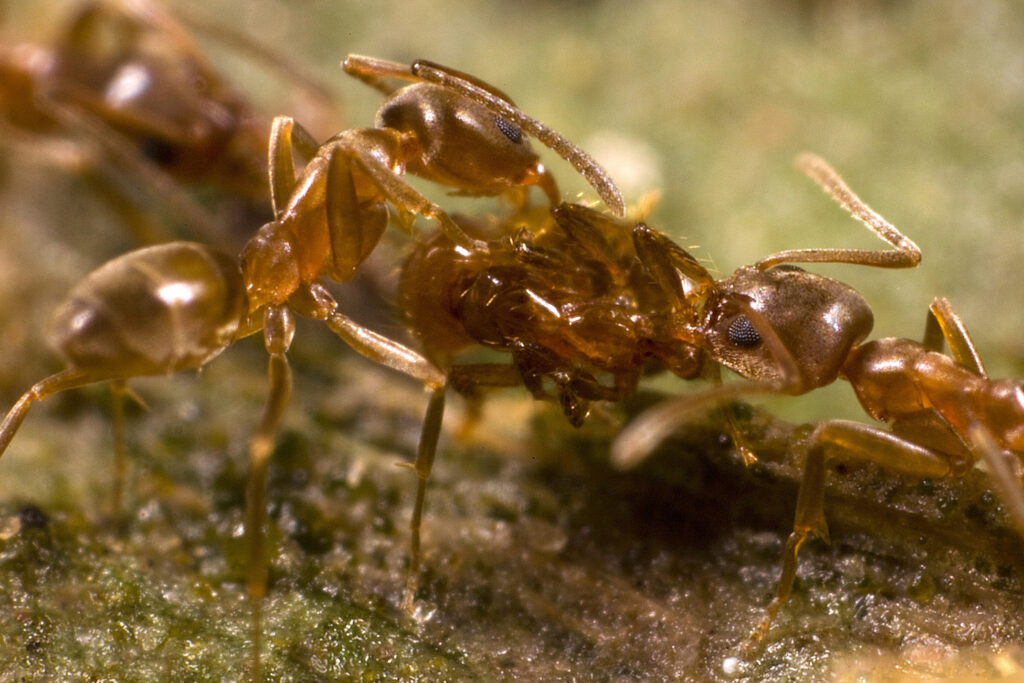
The Argentine ant is an invasive species originally from northern Argentina and adjacent regions. After a century-plus of hitchhiking on human transportation, the species has reached far-flung parts of the world, where it is organized into at least a dozen massive supercolonies that have expanded over huge areas and often bump into each other — with savagely violent consequences.
In the United States, the war rages prominently around Escondido, California. There, if you peel back the neatly trimmed grasses of suburban lawns, you may uncover narrow belts of piled corpses, on top of which the living compatriots of the dead are methodically tearing at their enemies. It’s fortunate for local property values that ants can’t scream.
I became familiar with Argentine ants when I lived in the San Francisco Bay Area, where a yard can harbor a million of the two-to-three-millimeter-long workers. The species is superabundant enough to cause environmental damage that includes wiping out native ants (which are, contrary to popular opinion, often beneficial).
If I had taken a Bay Area Argentine ant on a drive 500 miles south to Mexico, I would have needed my passport to cross the border — but not so for my traveling companion. Members of a supercolony recognize each other by scent, their version of a “national flag,” and the ones in San Francisco and Mexico are part of the same ant nation. My long drive would have transected the largest California supercolony, inhabited mile after mile by ant citizens in the billions.
But if instead I took my companion to Escondido, north of San Diego, and dropped her on the wrong side of the battlefront, she would have been identified as a foreign interloper and slowly pulled asunder. Southern California is occupied by four warring Argentine ant supercolonies, each controlling tracts that converge around this city. The battle lines meander year after year as the fortunes of the colonies shift during unceasing engagements that may well have been going on for more than a century, when this species first arrived here.
Standing in my yard you might have been tempted to feel, well, above it all. But be careful: The aggression among colonies of ants of the same species shows similar patterns to those that occur within the human species.
In both human and ant societies, the nature of violent conflict tends to depend on population. Small societies generally avoid head-on assaults. When our long-ago ancestors lived as hunter-gatherers, their dispersed bands simply moved away from confrontations when they could. They had little to lose by leaving, having no elaborate homes or larders to defend. When hunter-gatherers did attack, they generally sneaked in and out quickly to avoid casualties on their side.
The same is generally true for ants living in small colonies. But war is another business entirely. Warfare, in the sense of fighting that puts both sides at risk of mass destruction, comes to the fore as societies grow large and become rooted in a place with resources. The greater numbers, in both human and ant societies, tip the scales. That’s how you get cannon fodder, ant or human — take your pick.
Does dividing up the world among enduring, clearly membered groups inherently lead to conflicts? This is doubtless so for the ant: No colonies of the same species get along; either they avoid each other or they attack.
But it’s also true among our fellow vertebrates. Species such as wolves, lions and some bats, birds and fish also live in enduring, territory-holding societies. Tolerance — let alone collaboration — between the societies of most vertebrates seems to be virtually nonexistent.
Perhaps the convivial bonobos, close kin to the chimpanzee, and hence to us, are an exception? While chimps are notorious for aggression between societies (largely carried out in sneaky raids), some bonobo communities do socialize. It’s often suggested that a key to bonobo sociability is the limited competition they show for resources worth fighting over. Still, as observations on this so-called hippie ape increase, primatologists have been witnessing more examples of tension, and at times violence, between communities. As with human nations, it seems good relations between bonobo societies can be fragile.
Thus viewed in the context of nature, the warlike tendencies of humans are no anomaly. The mystery, then, is the emergence not of war but of peace. Like bonobos, humans are open to visitors from amicable societies. We go further, too, nurturing intergroup relations that permit societies to obtain what they need without theft yet require constant vigilance to sustain.
Still, our deep-rooted urge for self-protection will no doubt continue to lead us to consider violence toward outsiders when times are tough and competition extreme.
King Solomon advised, “Go to the ant, thou sluggard; consider her ways, and be wise.” As someone who, like King Solomon, turns to nature for insights on humanity, I can only be thankful that, unlike ants and in fact most other animals, the human mind shows us at our best in its capacity to imagine peace.
The post There’s a world war raging. You might be standing on the front lines. appeared first on Washington Post.