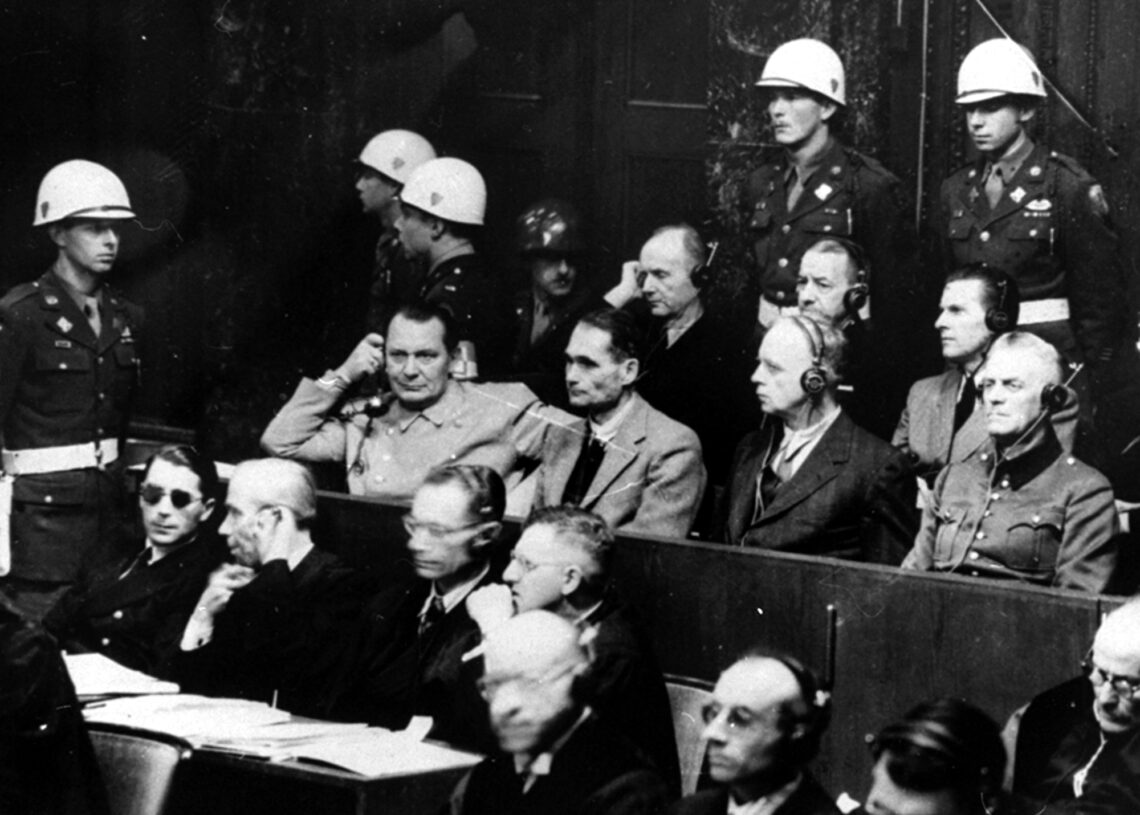
The camera lights in Courtroom 600 were so bright that the defendants were issued sunglasses.
World War II was over, and the victorious Allies — the United States, the Soviet Union, Britain and France — had gathered in Nuremberg, Germany, to convene history’s first international war crimes tribunal.
More than 20 surviving leaders of the Third Reich stood accused of war crimes, crimes against peace and crimes against humanity, and the U.S. Army Signal Corps was filming the proceedings for newsreels to show in movie theaters around the world.
The choice of venue was symbolic. Nuremberg was where the Nazi Party had orchestrated its annual mass rallies, as captured in Leni Riefenstahl’s propaganda film “Triumph of the Will.” At the 1935 edition, the party announced rules stripping German Jews of their citizenship, public offices, professional licenses and other legal rights — the Nuremberg Laws — laying the foundation for the Holocaust.
Allied bombers had destroyed much of the Bavarian city, but its Palace of Justice and adjacent prison remained largely intact. The first trial opened on Nov. 20, 1945, 81 years ago Friday.
Chief among the Nazis’ crimes was the extermination of 6 million European Jews and millions more Poles, Roma, homosexuals and others. In the indictments, prosecutors pioneered a new legal term: genocide. The accused, they charged, had committed “murder and ill-treatment of civilians” in a “deliberate and systematic genocide, viz., the extermination of racial and national groups.”
The first defendants, all men, included Deputy Führer Rudolf Hess, Luftwaffe commander Hermann Göring, foreign minister Joachim von Ribbentrop and war production minister Albert Speer. All pleaded not guilty. (Adolf Hitler, propaganda minister Joseph Goebbels and SS chief Heinrich Himmler killed themselves before the German surrender.)
The International Military Tribunal included one judge from each of the four European Allies. President Harry S. Truman appointed former attorney general Francis Biddle the U.S. judge and named Supreme Court associate justice Robert Jackson the chief U.S. prosecutor.
The courtroom held hundreds of members of the international media. The proceedings were translated into several languages and fed live to participants’ headsets, the first major use of simultaneous translation.
The prosecutors presented documents, witness testimony, including from the commandant of the infamous Auschwitz death camp, and graphic footage showing the Allied liberation of Nazi concentration camps — one of the first uses of film as trial evidence.
Defendants argued that they had merely done what they were told by their superiors, their actions had been legal under German civil and military authorities and they should not be held responsible for violations that weren’t clearly defined before the war.
The tribunal rejected the just-following-orders defense, ruling that individual conscience and international law supersede obedience to command, an important precedent. The judges found that the charges were based on existing principles in the conduct of war, not new concepts.
Of the first group of defendants, 19 were convicted and three acquitted. Twelve were sentenced to death; 11 were hanged. Göring killed himself by taking cyanide on the eve of the scheduled execution.
Trials of Axis leaders would continue in Nuremberg and Tokyo, where the panel included judges from the four European allies plus China, the Philippines, India, Australia, New Zealand and the Netherlands, as the colonial ruler of the Dutch East Indies, much of which is now Indonesia.
Through 1951, the Allies tried and convicted thousands of defendants and sentenced nearly 1,000 to death.
Nuremberg was the first time multiple countries had come together to prosecute defendants jointly, and the first time individuals were personally held accountable under international law. It’s remembered as a key step in the development of international law and the law of war, and a model for the International Criminal Court in The Hague.
Photo Almanac is an occasional series from The Washington Post, using photo archives to understand where we are today by examining where we’ve been.
The post When Nazis were held accountable for war crimes appeared first on Washington Post.