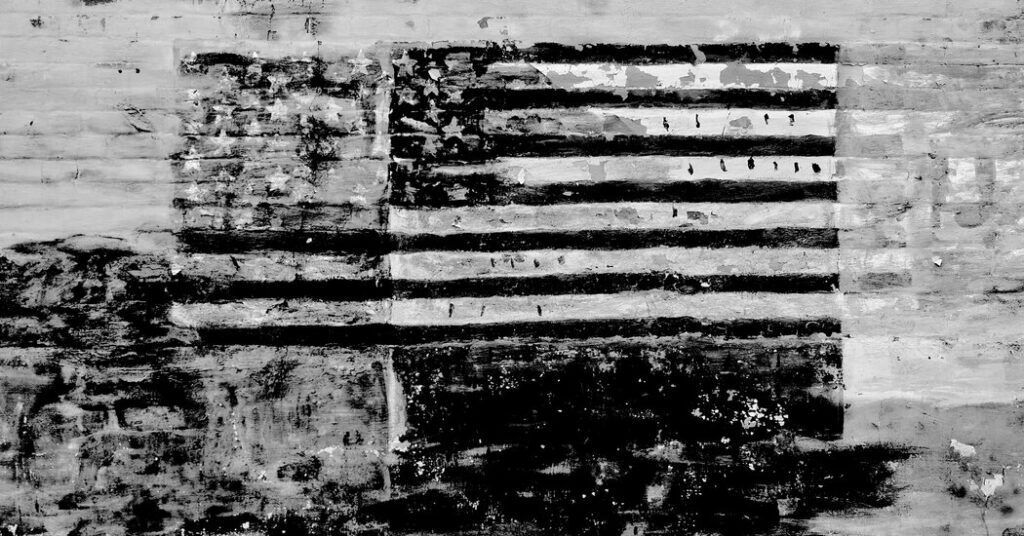
America’s days as the exceptional nation seem to be over.
At home, President Donald Trump is weakening the foundations of representative government. In the rest of the world, he has set aside democracy promotion and seems more inclined to work with autocracies like China and Russia than with America’s traditional democratic allies.
While Mr. Trump’s assault on American democracy is both without precedent and dangerous, he is right to hold off on the promotion of democracy abroad and to reach across ideological dividing lines. Improving relations with China, as Mr. Trump will aim to do at his summit with its leader, Xi Jinping, on Thursday, is a must in an interdependent world.
Not only is a pragmatic realism needed to navigate today’s fragmenting world, but it is in keeping with much of U.S. history. From the founding era until World War II, Americans tended to focus on their own affairs and let other peoples do the same.
Mr. Trump sees things the same way, as his administration laid out in its 2025 National Security Strategy: “We seek good relations and peaceful commercial relations with the nations of the world without imposing on them democratic or other social change that differs widely from their traditions and histories.”
Yet Mr. Trump’s dismissal of democracy promotion is flawed and out of step with U.S. history in one critical respect: By compromising America’s own democracy, and backing illiberal populists in other democracies, he is extinguishing the nation’s founding mission to change the world by example. The version of exceptionalism that long guided the nation mandated pragmatism abroad so that Americans could focus on advancing their democratic experiment at home. The settlers of the New World were to build a “city upon a hill,” as the Puritan leader John Winthrop put it in 1630, ultimately changing the world, but only by serving as a democratic model that others would follow. This is the version of U.S. statecraft that urgently needs to be resuscitated.
We are in a worldwide battle for hearts and minds. The future of republican government in the United States, and globally, hangs in the balance. As Mr. Trump oversteps executive authority, weaponizes the Justice Department and tries to cow the media, private sector and universities, the citizens of China, Iran, Russia and other autocracies are watching America’s democratic beacon flicker. The stumbling of the American experiment, alongside the favoritism Washington is showering on far-right parties worldwide (even in a Germany haunted by its Nazi past), is blurring the ideals that long inspired repressed peoples to strain for the dignity and autonomy that only representative government can provide.
The United States is squandering its ability to bend the arc of history toward more freedom.
Americans embraced a democratic messianism from the get-go. As Thomas Paine put it in 1776, “We have it in our power to begin the world over again.” But for the next century-plus, the United States sought to foster the spread of republican government by serving as an exemplar rather than by intervening abroad. As John Quincy Adams, then the secretary of state, expressed in 1821, the nation would change the world not by force but through “the countenance of her voice, and the benignant sympathy of her example.”
This patient approach to spreading democracy was the product of three main considerations. First, Americans were acutely aware of the fragility of their own experiment in self-government. President George Washington explicitly warned in his 1796 Farewell Address that ambition abroad, by centralizing power and requiring an oversize military, risked compromising freedom at home. Adams was also concerned that foreign wars, even if fought for the republican cause, risked changing “the fundamental maxims of her policy … from liberty to force,” tempting the nation to become “the dictatress of the world.”
Second, the nation’s leaders believed that republican government had to emerge organically and could not be imposed from outside. As Americans in the 1820s decided not to intervene in Latin America to support countries breaking away from European empires, Adams asserted that he saw “no prospect that they would establish free or liberal institutions of government” — a view that would prevail for decades.
Third, America’s leaders appreciated the need to navigate the world as it was, not as they might like it to be. As President James Monroe explained in 1823, U.S. policy toward Europe’s monarchies was “not to interfere in the internal concerns of any of its powers; to consider the government de facto as the legitimate government for us; to cultivate friendly relations with it.”
By the late nineteenth century, this pragmatic and transactional brand of statecraft contributed to impressive results at home; Americans not only kept their republic, they turned it into a world power. The results abroad were more modest; only a handful of countries were beating a path toward liberal democracy by the turn of the century. But as the founders had hoped, the success of the American experiment set an example that others were starting to follow.
Beginning in 1898, America’s growing power and ambition lured it into the trap that Adams had warned against: Its idealist aspirations began to outstrip its strategic interests.
President William McKinley launched a war to expel Spain from Cuba and went on to annex Spanish possessions in the Caribbean and Pacific, asserting that he was acting “in the cause of humanity.” Less than two decades later, President Woodrow Wilson ordered a succession of military interventions in the Caribbean and Latin America, reportedly vowing that he would teach “the South American republics to elect good men.” He also guided the nation into World War I, declaring that “the world must be made safe for democracy.”
Americans quickly soured on these more costly efforts to export their ideals. The annexation of Spanish territories turned the nation into a colonial empire; the United States became an occupier, not a liberator. And despite victory in World War I, many Americans regretted entanglement in Old World rivalries, and the Senate rejected U.S. participation in the League of Nations, Wilson’s brainchild to keep the postwar peace. So began America’s interwar retreat and the abandonment of its idealist aspirations in favor of a stubborn isolationism. After trying to do too much, Americans opted for doing too little.
During World War II and the Cold War, the United States finally arrived at a stable equilibrium between its strategic interests and its lofty ideals. To do battle with the Axis powers, Washington set aside its ideological misgivings to ally with the Soviet Union, but after vanquishing Nazi Germany and Imperial Japan, it went on to democratize both countries.
Amid the Cold War, Washington formed sturdy alliances with fellow democracies while also working with autocracies as needed to contain communism, at times compromising its ideals. Yet the West ultimately prevailed not by defeating the Soviet Union on the battlefield, but by demonstrating the superiority of free societies and open markets, patiently waiting for the Soviet bloc to collapse from within. In keeping with the founders’ intentions, the United States changed the world by example.
As had happened roughly a century earlier, America’s idealist ambitions again began to outstrip its strategic interests after the Cold War ended. The Clinton administration embarked on a strategy of “democratic enlargement,” incorrectly presuming that countries in all quarters of the globe would rush to take their place in a global order anchored by republican values. At the same time, the triumph of capitalism stoked excessive confidence in the benefits of the unfettered marketplace.
These idealist illusions produced a succession of major setbacks for the United States. After 9/11, regime-change missions in Afghanistan, Iraq and Libya cost trillions of dollars and produced little good. The United States integrated Russia and China into global markets, expecting the expansion of their middle classes to liberalize their politics and tame their foreign policies. Nothing of the sort happened. Both countries have become more autocratic and more hostile to the United States.
In the meantime, a combination of automation and free trade has undermined the industrial-era social contract, hollowing out middle classes and political centrism across Western democracies. Mr. Trump and the world’s many other populists are a symptom more than a cause of the resulting anti-establishment anger. Liberal democracy is in worldwide retreat, including in its birthplace — the United States.
We have come full circle. As during the founding era, American democracy is under threat from within. Meanwhile, republican ideals are in retreat; the world is becoming decidedly less free. And since managing an interdependent globe necessitates broad international cooperation, the United States again needs to navigate the world as it is, not as it would like it to be.
Under these circumstances, Mr. Trump is right to pull back from strategic excess, avoid nation building and end illusory ambitions of spreading democracy by toppling autocratic governments. To be sure, Mr. Trump has failed to practice the restraint he preaches; he has used a combination of armed force and economic coercion to try to alter regimes in Venezuela, Iran and Cuba. But at least he has lowered his aim, seeking to install compliant governments, not democratic ones. And Mr. Trump’s Iran debacle will hopefully reinforce the due caution that Washington should exercise when it comes to trying to change regimes by force.
So, too, has Mr. Trump headed in the right direction by seeking to work pragmatically with all countries, regardless of government type. His foreign policy has admittedly been erratic and impulsive. But after decades of ideological and strategic overreach, his efforts to build good working relationships with Russia and China are overdue. Collaboration with these powers is needed to counter the competitive forces that are fast fragmenting an interdependent world.
But in threatening democracy at home and supporting illiberal populists abroad, Mr. Trump is corrupting, not reviving, the original version of American exceptionalism. By imperiling the American experiment, and encouraging fellow travelers to do the same in their own democracies, Mr. Trump is certainly setting an example, but one that will decidedly darken the course of history.
Americans must urgently rescue their democratic experiment. Their ability to do so is critical to reversing the illiberal tide that is rising globally. Only if Americans get their own democratic house in order and demonstrate that democracy can outperform autocracy will they be able to ensure the arc of history again bends toward more freedom.
Charles Kupchan is a professor of international affairs at Georgetown University.
The Times is committed to publishing a diversity of letters to the editor. We’d like to hear what you think about this or any of our articles. Here are some tips. And here’s our email: [email protected].
Follow the New York Times Opinion section on Facebook, Instagram, TikTok, Bluesky, WhatsApp and Threads.
The post The End of American Exceptionalism? appeared first on New York Times.