Oliver Libby is the founder of Strong Floor No Ceiling.
It is tempting to attribute Tuesday’s historic blue wave to anger, affordability, tariffs, Iran, artificial intelligence, anti-Trumpism or the Democratic Socialists of America. But although all these forces played their roles, they do not explain the central lesson of this cycle.
If you want to know what voters want, look at who won the most competitive races — and how. Understanding their victory can inform how Democrats lead, and how the party’s presidential hopefuls can craft the messages and strategies that will define the 2028 race.
The Democratic Party, famously a “big tent,” saw two seemingly contradictory things happen Tuesday. First, some safe blue seats became more progressive. Second — and more interestingly — almost every toss-up victory was won by a centrist Democrat. That delivered the margin of the majority, handing soon-to-be speaker Hakeem Jeffries (D-New York) a caucus with real room to advance practical policies and lift the Democratic brand out of its deep slump.
Look at who won. Johnny Garcia, a Bexar County sheriff’s deputy who calls himself an old-school Democrat, won Texas’s 35th by championing “the American promise for everyone, no matter their background, zip code, or bank account.” Military veteran and businesswoman Rebecca Bennett (D) flipped New Jersey’s 7th saying she is “ready to use her private sector experience to bring Republicans and Democrats together to build a healthy economy.” Jocelyn Benson (D), governor-elect of Michigan, doubled down on innovation, arguing that “entrepreneurship is beautiful because one person starts with an idea that becomes an engine for economic growth.”
Democrats were well on their way Wednesday morning to large majorities in the House and Senate, and the map of those gains runs through candidates like these. (Strong Floor No Ceiling provided financial support to a number of Democratic candidates, including Garcia.)
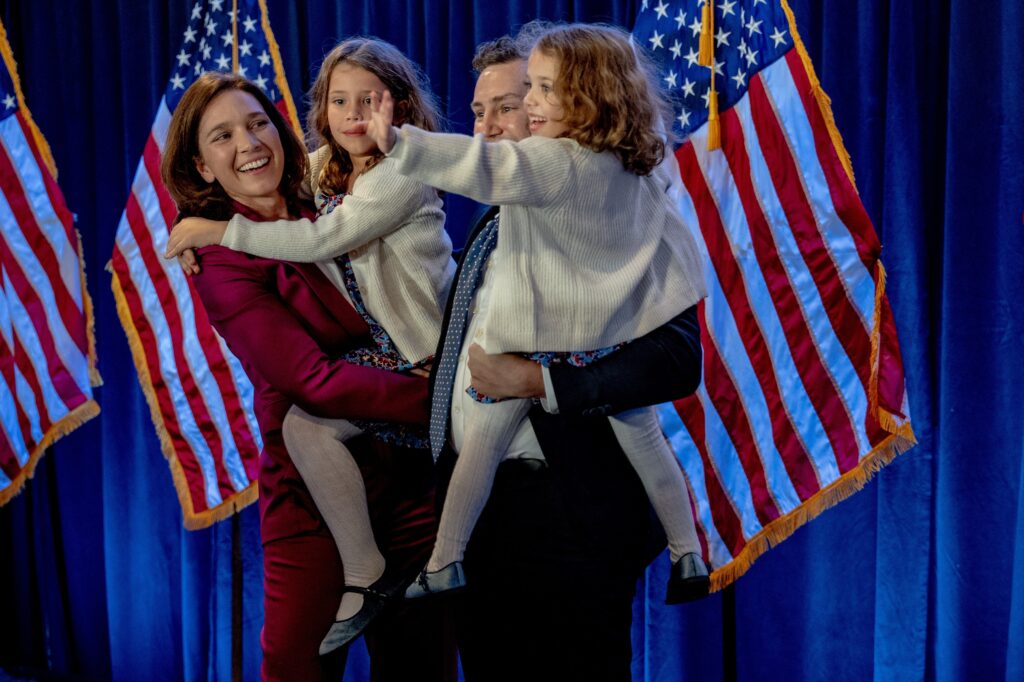
This class of ’26 represents a powerful new generation of radical moderates, many with business or military experience, who might not agree on everything but who won by painting a vision of an America that would prevent people from slipping through the cracks, while celebrating the American Dream. They ran against the chaos of the Trump era and the rising cost of living. But they also offered something to be for, speaking convincingly about a country that has people’s backs, without holding them back.
On the trail, in districts both urban and rural, that sounded like health care that won’t bankrupt a family, well-paid jobs, affordable housing, quality schools, integrity over corruption and durable Social Security and Medicare. In short, the building blocks of opportunity.
Yet these candidates didn’t shy away from success. In the words of Sen.-elect James Talarico (D-Texas), they are “old-school” capitalists, embracing what is the very best of America — hard work, entrepreneurship and ingenuity. They often framed this vision as an investment in a vibrant, educated, healthy, economically active population. They recognized that steady economic growth can increase average household incomes, help reduce the ballooning national debt and give people hope.
According to a survey that Strong Floor No Ceiling commissioned, the sentiment that America should reward grit and celebrate success is popular across virtually all political tribes in the country, from the politically homeless to some of the most progressive. The justified anger that has animated our politics recently isn’t against success itself, but against a system that has locked so many out. These candidates understood that — even if wealth must come with rules and responsibilities — reigniting the American Dream will lead to the world’s strongest middle class, best companies and most optimistic population to match.
Getting this right will not be easy. Jeffries and this new class of Democrats have two years to show that they can deliver despite President Donald Trump’s nearly inevitable veto, record-low optimism and little faith in American institutions.
Taking cues from the winning arguments of this cycle — even if their bills are destined for the veto — a legislative plan and blueprint for 2028 starts to emerge. It needs to address health care costs and quality; prepare education and the workforce for the age of AI and robotics; remove permitting barriers to housing and infrastructure; end unnecessary trade fights and shooting wars; shore up America’s alliances; root out corruption across parties; ensure safe communities; and promote orderly immigration policies. There are no quick fixes, but parts of this could even be done via reconciliation to help Americans rapidly.
If successful, these Democrats will define the party’s vision for the country for generations, rehabilitating a brand that is nearly as unpopular as the president’s.
Blame and anger will not be a winning strategy in 2028, nor will internecine warfare within the party for the next two years. Democrats’ great vision cannot be simply that Americans won’t go bankrupt on their watch. The New Deal came out of the despair of the 1930s and the Great Society out of the chaos of the 1960s, and both promised far more than simple survival; they called the nation to greatness. The radical moderates of ’26 just showed us how to do that again.
The post Now it’s clear who could save the Democratic brand appeared first on Washington Post.