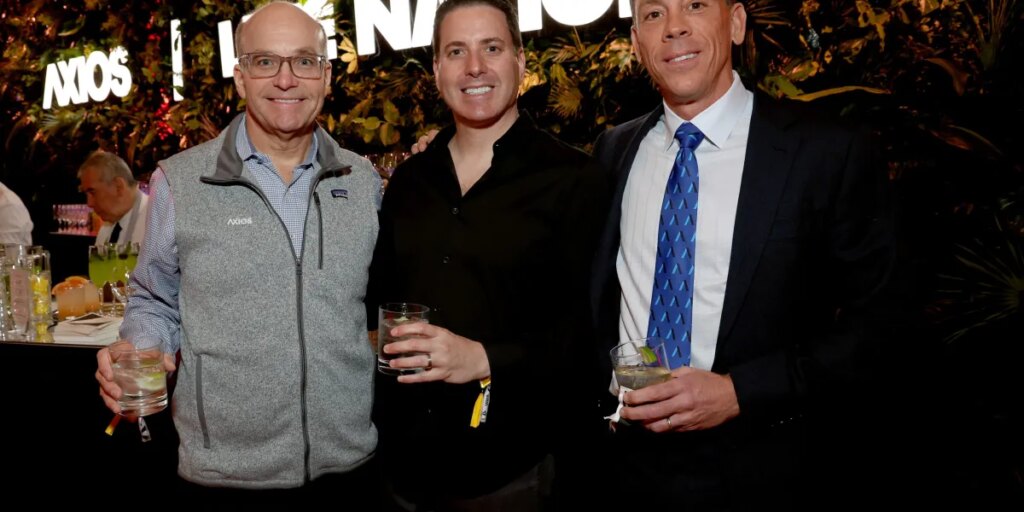
Three years after Smart Brevity became gospel inside corporate comms departments, the founders of Axios are back with a diagnosis of what broke their own prescription: artificial intelligence.
Jim VandeHei, Mike Allen and Roy Schwartz sat down with Fortune to talk about their new book, Simplify: Do 50% More with 50% Less, out this month. The pitch: AI hasn’t lightened anyone’s workload so far—it’s flooded offices with more decks, longer emails and more “work-like activity” that produces motion without progress. Their fix is a framework the trio says they built by testing it on themselves first.
How AI ruined your inbox
The argument is a familiar one amid the “AI slop” discourse of 2026: the technology sold as an efficiency unlock has, in the short run, made everything worse. “When I talk to people at corporations, they’re like, ‘My team is drowning, everyone thinks they’re smart now,” VandeHei said, adding that it’s a “real issue” with how many people who never made a deck or presentation before are suddenly generating things that need an exhaustive review.
At the same time, incoming pitches have all multiplied, Allen added, both inside companies and in how they present themselves externally—a two-front squeeze, not just an internal one. “Everybody’s more verbose,” Allen said, chalking it up to human nature. “Left to our own devices, we’re going to complexify,” Allen said. “Our meetings stack up, our habits, all our time sucks, and unless you are ruthless about auditing, confronting, looking at what you can delete, then [you won’t feel] the liberation of having more.”
Allen borrowed a phrase from former Slack CEO Stewart Butterfield to describe the trap of “work-like activity,” which McKinsey partner Kate Smaje previously told Fortune is like a “false productivity trap.” The two run together in most organizations, Allen said, and that’s precisely the problem.
VandeHei pushed back on the idea that humans are lazy by nature, a common criticism of the “cognitive offloading” enabled by AI. “People are not being lazy or stupid,” he said—they want to work hard but are having trouble right now distinguishing from real work and work-like activity, further clouded by AI. “It just creates this, like, energy and life of its own that has no meaning. It does not help.” He said they decided to write this book because of this “freaky” current moment in AI: “Everyone’s going to be scrambling, like, ‘How do I do this? How do I navigate this?’” He argued that most companies have been “very, very clumsy” in implementing it: Even if it’s amazing, which I think the technology often is, the minute you introduce it into a company and its process, its data pool, its privacy laws, its security systems,” he trailed off, “it’s just womp womp.”
Their proposed remedy is a recurring audit, done more often than most companies are used to. VandeHei used to run this exercise quarterly; now he says he’s trying monthly, and flirted with a weekly cadence in conversation with Fortune. “What are the things you actually need to be doing in one order? What are the things that you can stop doing? What are the things that you can automate?” he said. “That’s basically what every company is going to have to go through.”
A companion column Allen published on Axios lays out the stakes in raw hours: of 168 hours in a week, sleep and work eat up roughly 90 to 100, and the authors cite Harvard research suggesting people spend half of what remains thinking about things unrelated to what they’re doing—leaving most people in control of only “about one-sixth” of their own lives.
The power of ‘I’m booked’
Allen, a famously private person, as captured by a Mark Leibovich profile in 2010 for The New York Times Magazine, described how he’s implemented the “simplify” tenets to his own personal life: “two words that we teach people are, ‘I’m booked.’ Anytime somebody wants you to do something, join something, you don’t have to apologize, you don’t have to explain, just say, ‘I’m booked.’”
Allen reflected back to earlier in his career: “So many of us coming up thought that we had to hang out and do all that stuff, and it turns out, you don’t.” The book’s actual instruction, he said, is almost comically simple: if your gut response to an invitation is “eh, I probably should, I guess so, whatever”—that’s a no.
He said that as he, VandeHei and Schwartz talked to successful people for this book, “it was surprising how many of them said, ‘I never accept any obligation that’s not family or work.’” On the flipside if you commit to something, really commit to being there, and then it will be worth your time. He invoked a favorite saying of Oprah Winfrey’s: “no is a complete sentence.”
VandeHei said the phrase reflects a broader refusal to separate his work and personal obligations into different systems. “I don’t know how people distinguish between work and life. To me they’re just life. And work’s a part of it,” he said.
Schwartz, the third head of the Axios trifecta and an unlikely near-20-year veteran of journalism, said the real breakthrough for him wasn’t the phrase itself but the guilt it’s designed to erase. VandeHei and Allen hired Schwartz from Gallup in 2008 and roughly a year later he became chief revenue officer, a move they credit with transforming Politico’s model before they co-founded Axios together in 2016.
Schwartz helped lead Axios through its funding rounds and its $525 million acquisition by Cox Enterprises and now runs Axios HQ, the company’s AI-powered internal-communications spinoff, which recently turned profitable on roughly $20 million in annualized revenue. He ties the milestone to the same simplification principles laid out in the book. His personal thread in Simplify centers on dyslexia, which he says became the root of his instinct for distilling complicated material into simple, structured points.
Even after living by the book’s principles at work and at home, Schwartz said, he kept feeling guilty about declining opportunities he hadn’t formally ruled out. “What was really clarifying is when you set down the goals and you put them in writing… it actually gives you permission,” he said. “I had sort of done that mental map. I had my goals. But I still had the guilt feeling of like, ‘No, I should be doing everything.’ And the reality is you can’t do everything. So then do the things that matter most.”
Schwartz said the same dynamic paralyzes teams inside companies, where employees “can’t find a way to say no” to a recurring meeting or obligation because no one has given them permission to do so. The fix, he said, is a line a client once gave back to him: “Everything in an organization is usually done by default, and you want it done by design.”
Why the ’90s were slower, if not better
Simplify seems to be part of a trend: the longing for an analog era, before AI, before even cell phones. VandeHei and Allen, White House reporters dating back nearly 30 years at the Wall Street Journal and the Washington Post before co-founding Politico, said they remember the 1990s and this isn’t nostalgia, it’s fact. People today are carrying more cognitive burden than they were 20 years ago, and the strain is real, not imagined. “You’re getting hit with an infinite amount all day, every single day from a million directions,” he said. “That has ramifications. That means you have less time to be able to do the things you want to do or even make sense of things.” That’s why Allen’s old Politico Playbook and now the Axios newsletter, both famously read by the White House first thing in the morning, were successful: one place to focus on important information.
The book leans on research about decision fatigue—the idea that even trivial choices drain the mental capacity available for harder ones—to argue that the sheer volume of daily inputs, not just their content, has a cost. Does VandeHei long for a return to those days? “I don’t know if they were [better], but they were slower,” he said. “Whether they were better or not is like a different thing, but they were authentically pre-internet, pre-text, pre-email, pre-Tinder. Like you had fewer alerts and fewer bells. There’s a cost to that, not just a distraction cost,” draining your ability to really focus on the things that matter.
That tension extends to AI’s effect on cognition itself. With test scores declining and AI absorbing more of daily mental life, Schwartz and VandeHei offered a split diagnosis of what it means for how sharply people think.
VandeHei argued “there’s not a clean answer,” and that the right approach depends entirely on where someone is in their career. It’s “controversial and feared” because it raises “existential” issues in threatening to disrupt everything in your work and personal life, “even if the outcome could be really good.”
“If you were in college and you’re asking me how to use AI with your schoolwork, I would say minimally,” he said. “You’ve got to let your brain develop. You’ve got to get some kind of domain knowledge outside of the thing you might be going into the professional world to do because most good ideas flow from fact pattern recognition. So I would get your brain working that way.” For someone further along, he said, the calculus flips: “I feel like I’m smarter and a little bit deeper today than I was two or three years ago… I’ve been able to find the time to think what I need to think, go deep when I need to go deep, but also use this technology to maybe have a more elastic experience with content.”
Asked what the book offers someone just entering the workforce, VandeHei’s answer centered on speed and specificity, not general AI literacy. “As quickly as you can, figure out how to leverage this technology so that you’re one of the best users of it for the very specific job you’re about to do,” he said. “It doesn’t mean you have to become an AI savant.” For someone in marketing, he said, that means identifying “the five things that the smartest people are using this technology to do as force multipliers”—knowledge he said is freely available from “tons of people on YouTube, Spotify, Podcast, Substack” already doing the job. “To me that’s like the price of entry.”
Allen agreed, saying the key in his view is “being ruthless about what matters.” In your work life, just look at your job and evaluate exactly what you need to do to succeed, personally and as an organization. “What is going to matter to you this week, month, year? And by articulating that and by being super intentional about that, you can even quantify, like, how you’re doing, how your schedule, how your life flow, how your work flow will match up with what you’re doing.”
VandeHei described watching his own sons and their friends discover this dynamic firsthand during summer internships at government agencies and major companies. Despite being early in their careers, he said, the interns found themselves treated as in-house AI experts simply because they were comfortable experimenting with the tools and no one around them was. “They’re like, ‘We’re treated like we’re savants, [but] we’re fine in AI,” he said the interns told him. They described their work more as “nobody knows what they’re doing,” but the Gen Z experimenters are being treated like “internal consultants on how to use AI broadly.” VandeHei’s takeaway: that’s valuable, in the age of simplify.
For this story, Fortune journalists used generative AI as a research tool. An editor verified the accuracy of the information before publishing.
The post The Axios founders on how AI ruined your inbox, why the ’90s really were different and how to succeed through ‘Simplify’ appeared first on Fortune.