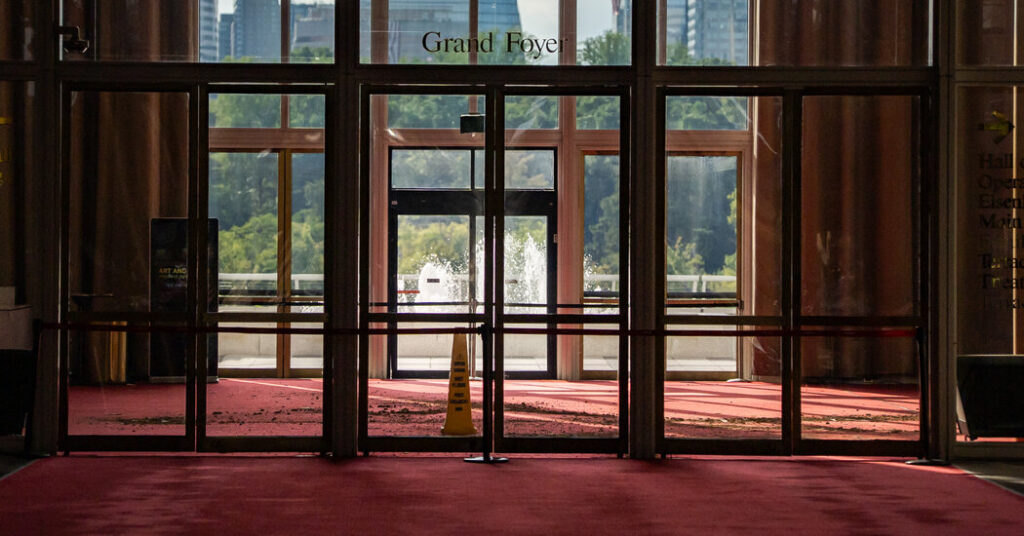
A storm brought down a five-foot piece of ceiling plaster at the John F. Kennedy Center for the Performing Arts this month and its leadership sprang into action. One thing they did not do was repair the damage.
Instead staff members left the mess on the carpet for nearly two weeks, posting photos on social media with commentary like “the place is falling apart and @realDonaldTrump wants to fix it.” They measured plaster shards and mapped the “debris field” like investigators after a plane crash, for a 55-page briefing for the center’s board about the building’s decay. No one was injured but Mr. Trump claimed online that a security guard had narrowly avoided “certain death.” Less than two hours later, his allies on the board voted to close the center, citing safety concerns.
Mr. Trump’s threats this past week suggest that saving face, not lives, better explains why he shuttered the Kennedy Center on Tuesday for what officials said would be a temporary closure.
The president, who is the center’s chairman, first announced in February that it would close for two years of renovations. Democratic lawmakers on the board said it was an excuse to avoid the humiliation of plummeting ticket sales and fleeing artists. Since then Mr. Trump has fought to add his name to the memorial to a slain president, drawing multiple court injunctions. When a judge denied him again last week, the president made his priority clear. He decreed that the closing would take place immediately but that the renovation would not begin until courts — potentially the Supreme Court — allow his name on the building front.
Then, as heavy construction fencing went up around the building, he went further. “The Trump administration should certainly have recognition,” he said, arguing that his name on the center would help lift it out of physical and financial turmoil. “Because frankly if we don’t do that it’s going to close, it’ll end up being ripped down.”
On Friday night, a large crowd of demonstrators locked arms to form a human chain around the building in protest of Mr. Trump’s efforts to close the center amid fears that he might ultimately bulldoze it.
The closure is the apotheosis of the wreckage and chaos created in the less than two years since Mr. Trump’s takeover of the center, once a bipartisan global model of public access to the arts. Internal emails and documents obtained by The New York Times demonstrate the political capture of the institution by the whims of Mr. Trump, who at the start of his second term installed a board that made him chairman. Audiences and donors fled, and its finances cratered.
The center’s first Trump-appointed director, Richard Grenell, pursued a plan, not previously reported, to replace works in the center’s art collection, including gifts from foreign nations honoring Kennedy, with art selected by Trump patrons. “You can definitely start sending stuff back to the countries who donated it now,” Mr. Grenell said in an email to Josef Palermo, a curator he hired. “Figure out everything you don’t want and just send it back A.S.A.P.”
Conservative groups and friends of the president staged events for free or at steep discounts, including a conference on “ending Christian persecution.” The center threw parties and dedicated rooms to Trump donors and political allies.
Workers renovated Mr. Trump’s three theater boxes in the center, installing gold plumbing fixtures and tearing up newly laid tile whose color was not to the liking of the White House. In one email, a Kennedy Center staff member, Lisa Dale, alerted colleagues to Mr. Trump’s demand for a certain type of tree on campus: “Our Chairman loves maple trees and is insisting we plant maple trees from a very specific Grove by a very specific gardener.  I actually love this about him!”
Mr. Trump and center officials blame past leadership for the maintenance and financial problems. Despite recent removals of art from the campus and from public display, they say there is no active plan to dump the collection.
“Our nonpartisan approach is evident by the consistent practice of welcoming everyone and continued invitations to bipartisan members of Congress and their staff for briefings, tours and our programming,” a spokeswoman, Roma Daravi, said in a statement on Friday. (Hours later she lost her job in a round of layoffs, one of several this year.) On Wednesday she told Real America’s Voice, a pro-Trump television network, that Democratic critics “are knowingly stopping any work that is going to save this institution because they don’t want President Trump to get the credit.”
Democrats scoffed. “It is bonkers,” Representative Chellie Pingree of Maine, the top Democrat on the House appropriations subcommittee that oversees funding for the Kennedy Center building, said in an interview. “The No. 1 problem the Kennedy Center has had is President Trump.”
Five Bipartisan Decades
It was first known as the National Cultural Center, conceived in the 1950s by a Republican president, Dwight D. Eisenhower, and then championed by Kennedy, a Democrat, as an artistic oasis for all. The two presidents built public support and raised money for the center, and their wives were honorary co-chairs of its board.
After Kennedy’s assassination in 1963, Congress passed a law that named the center for him and required it to operate as a living memorial. The governing framework that developed aimed to insulate the institution from partisanship. The building would be maintained with federal money, and its arts programming paid for by private donors and ticket sales. Board members included legislators from both parties and presidential appointees whose six-year terms overlapped administrations.
For five decades, legislators of both parties attended events like the Kennedy Center Honors, the center’s biggest night of the year. The Supreme Court justices Ruth Bader Ginsburg and Antonin Scalia sat together at the opera. A benefit concert after the Sept. 11, 2001, terrorist attacks included tributes from Laura Bush, the first lady at the time, and Senator Ted Kennedy, Democrat of Massachusetts.
“You had a whole bunch of Republicans and you had a whole bunch of Democrats and everyone was just trying to make art and arts education,” said Michael Kaiser, who ran the center from 2001 to 2014.
Mr. Trump, snubbed by many in the liberal-leaning arts world, was a no-show at center events for most of his first term. But less than a month into his second term, he purged the Kennedy Center board of Biden-era appointees and installed allies. They made him chairman, the first time a sitting president has served in that role.
‘We’re Returning the Art’
Mr. Trump brought on Mr. Grenell, his pugilistic former ambassador to Germany, who stocked the center’s upper ranks with partisans. Internal emails and documents — including some from the office of Senator Sheldon Whitehouse of Rhode Island, the ranking Democrat on a Senate committee overseeing the center — show that politics shaped Mr. Grenell’s effort to replace the center’s art collection.
A proposal circulated by Kennedy Center officials late last year made it clear on its first page that “de-accession” of artwork “may include disposal via the following means: return to country of origin, transfer or exchange with another institution, public sale or destruction.”
Mr. Grenell left the center in March, and Mr. Palermo, the curator, was laid off the same month. In an Atlantic article published in April, Mr. Palermo described himself as opposed to the plan to purge the art collection. But the documents portray him as an eager participant who crafted a plan to recruit Trump-friendly philanthropists to a new “Collectors Council.”
A memo about the proposed council described some of its functions as de-accessioning “outdated or inappropriate artworks,” and replacing them with works that reflect “shared American values.” Donors would pay up to $100,000 to join.
“It was my job to take orders and try to implement them,” Mr. Palermo said in an interview. He added that Mr. Grenell told him that “the president wants all new art” for the center.
In an interview, Mr. Grenell said he did not discuss art with the president. “What I instructed Josef to do was go back to every gifted piece of art and tell the giver, ‘Thank you very much, we’re returning the art,’” he said. In a subsequent interview, Mr. Grenell said he was particularly focused on returning art in need of repair or restoration, which he said the Kennedy Center could not afford.
The plan described in the documents targeted more than 20 artworks inside and outside the building, including “Blue,” a towering outdoor sculpture given to the center by its artist, Joel Shapiro, that this month was hauled away without public notice or explanation.
Inside the center, the removal plan targeted 15 artworks in the African Lounge, an events space near the Opera House that opened in 1977 and was closed and locked some time after Mr. Trump took over. The lounge’s textiles, artwork and a carved wood sculpture from Ghana representing Africans’ grief over Kennedy’s death were removed without public explanation.
In response to questions about the art removal plan, the center said the works remained “fully safeguarded with no planned or imminent changes” and that the collection “has been comprehensively cataloged.” It said the African Lounge works are being preserved within the center and declined requests to see the art.
Staff members and former Kennedy Center officials speculated that “Blue” was removed because Mr. Trump, who has said he considers much of modern art “a con,” did not like it. But a White House official said Mr. Trump was unaware of the plan to remove “Blue.” The center declined to comment. The sculpture has since been sold to the philanthropist David Rubenstein, the former Kennedy Center chairman ousted by Mr. Trump.
This summer a series of unsigned, unattributed gold-plated reliefs appeared in the Reach, a newer Kennedy Center annex that is slated to remain open during the main building’s closure. The images depicted include Mr. Trump raising his fist after he survived a 2024 assassination attempt, the billionaire Elon Musk and Health Secretary Robert F. Kennedy Jr.
The artist is believed to be Trish Duggan, a major Trump donor. The center declined to comment. Ms. Duggan did not respond to multiple requests for comment.
The Name, the Tarps and the End
In July 2025 Mr. Trump secured $257 million from Congress for a Kennedy Center renovation.
In December, the board voted to put Mr. Trump’s name on the building’s front. More performers and patrons fled.
Representative Joyce Beatty, Democrat of Ohio and an ex officio member of the center’s board, sued over the name change.
In March Mr. Trump replaced Mr. Grenell with Matt Floca, a facilities manager with no arts programming experience, whom the president had been calling weekly for updates on everything from new boilers to theater seat armrests that he wanted to be marble.
Judge Christopher R. Cooper ruled that only Congress could change the name of the center and ordered Mr. Trump’s name removed. Late at night in mid-June, journalists and a festival-like crowd gathered to watch.
Mr. Floca was worried that the public spectacle would enrage Mr. Trump, according to three people familiar with recent Kennedy Center events who did not want to be named for fear of retribution. Mr. Floca had workers cover a tower of scaffolding with tarps, blocking the crowd’s view as they pulled the letters off the wall. Mr. Trump’s name is gone, but the tarps remain. Center officials have said they are there for maintenance.
Barred by Judge Cooper from shutting down the building entirely, the center began closing off entire sections, citing safety concerns. Its sweeping Potomac terrace has been off-limits since midsummer. The fallen ceiling plaster led to the closure of the entire Grand Foyer, a space nearly two football fields long.
The damage has made a cameo appearance in a White House video, with voice-over by Mr. Floca, justifying the closure. Late last week employees in hard hats finally vacuumed up the debris from the carpet.
Kitty Bennett contributed research.
The post How President Trump Broke the Kennedy Center appeared first on New York Times.