SUMMERVILLE, S.C.—
Before she was called a groomer of children and a traitor to America, Dinah Chollet opened Facebook at her kitchen table.
On a community page for her suburb of Charleston, she noticed that a conservative blogger had riled his online audience. Local high-schoolers, he’d warned, intended to stage a walkout to protest President Donald Trump’s immigration crackdown.
One commenter suggested they throw water balloons at the students. A second man proposed spraying them with apple cider vinegar. A third recommended deer urine.
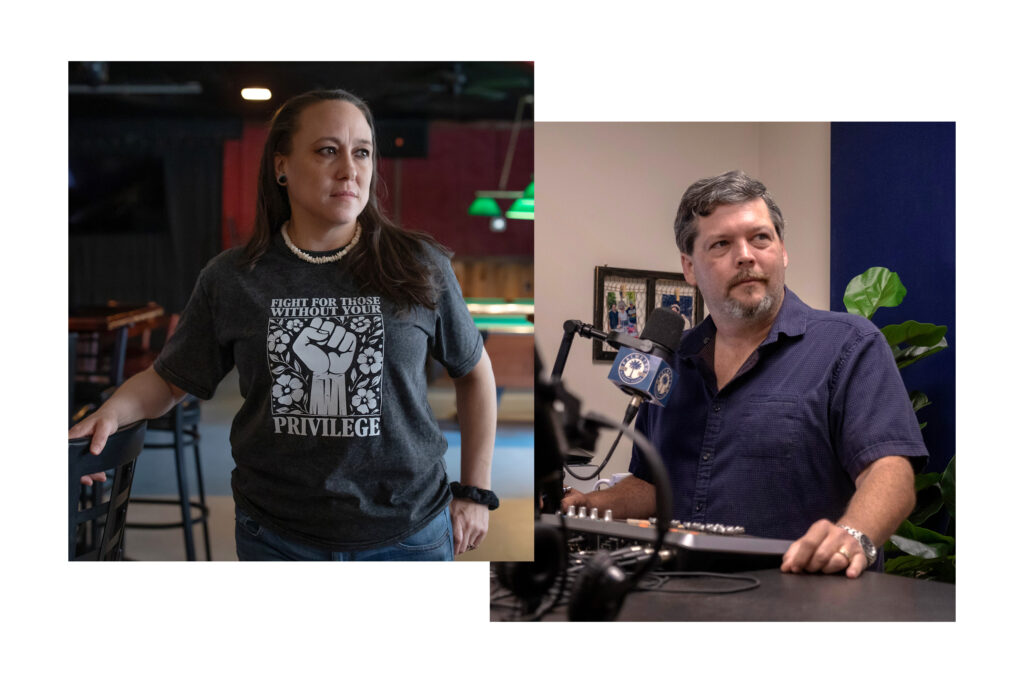
Chollet, 45, shook her head. She and the blogger, Corey Allen Whittington (who goes by Corey Allen), had been feuding online for years by that afternoon in early February. She was a profane, unreserved liberal who ran a pub in a county Trump won by 15 percentage points in 2024. He was her political opposite, so devoted to the president that he had marched to the U.S. Capitol on Jan. 6.
Chollet sipped a bottle of 5-Hour Energy as she alerted students’ parents to the comments on Whittington’s post, sharing screenshots on her own Facebook account. “If your kid is gonna be part of the walk outs, tell them to be very careful,” she wrote. Then Chollet went further. She followed a QR code from Whittington’s page and joined the Instagram group chat where dozens of Summerville High students were planning their protest.
“Hi! My name is Dinah Yo!” she wrote, using the moniker most people know her by. “We are very proud of yall!”
Chollet (pronounced sho-LAY) shared a link to her Facebook post and pledged that a group of adults would come out to support the protest, scheduled for a week and a half later. She told the students she wanted to help them make it “the BEST.”
Then she kissed her fiancé and dogs goodbye and headed to Food Lion. On the way to pick up tacos, her life began to unravel.
Whittington had been watching her in the chat.
In the hours and days that followed, he shared screenshots of her comments, suggesting that she’d encouraged the students to threaten him and to wish the president dead. Libs of TikTok, a far-right influencer with more than 6 million followers, picked up the posts and called them “so creepy.” Strangers labeled her a pedophile and bombarded the pub with 1-star reviews, then threatened to burn it down.
Versions of that experience play out weekly in the United States, where every issue, no matter how grave or trivial, can become an online outrage, often laced with violent imagery and toxic accusations. People get mad about yard signs or billboards, book bans or Pride flags. They call each other stupid and unpatriotic, then the furor subsides, most of it passing unnoticed by the wider world.
In Summerville, it didn’t subside, becoming a brief national fixation. The reasons were many, among them the speed at which falsehoods and conspiracies bloom on social media. But there was another, more consequential reason. At a time when many Americans have embraced Trump’s crusade to jail his political enemies, legions of online activists insisted that, in a small South Carolina town, one of their political enemies should be jailed, too. And law enforcement listened.
When Chollet was told that the town police, county sheriff’s office, Secret Service and FBI were all investigating her, she didn’t believe it.
Her ideological foe was not the president, but a middle-aged podcaster with a Facebook page called “The Overton Report.” This was not Washington, it was Summerville, “Flower Town in the Pines,” reputed birthplace of sweet tea. And she was just a way-too-online firebrand who sold smash burgers and raised money for abused animals, made provocative T-shirts about reproductive rights and wore a belt buckle that read, “LAND OF THE FREE BECAUSE OF THE BRAVE.”
You did nothing wrong, she told herself.
But the police decided she had done something wrong — criminal, in fact.
One week after that moment at her kitchen table, Chollet got a call.
“We have a warrant for your arrest,” the Summerville officer told her. “We need you to turn yourself in.”
ELEVEN DAYS EARLIER, a Summerville High junior heard from a friend about a school walkout in a conservative community outside Indianapolis. Inspired, the 16-year-old, who was taking a class on intolerance and genocide, announced a walkout at her school.
“NO KKK, NO ICE, NO FASCIST USA,” she wrote from an anonymous Instagram account in the first week of February. “OUR VOICE SPEAKS FOR FUTURE GENERATIONS.” To organize the Summerville protest, she started a group chat.
In the aftermath of two fatal shootings in Minneapolis, thousands of students protested U.S. Immigration and Customs Enforcement, walkouts that many conservatives denounced as left-wing disorder and many liberals lauded as civic activism. But a survey of news reports showed that unless demonstrations turned violent or dangerous, administrators in most cases either let the walkouts happen, often with supervision, or handled them as matters of school discipline, issuing unexcused absences and suspensions.
That’s not how officials at Summerville High handled it. Within a day or two, school resource officer Leanne Biles learned about the group chat and, according to her subsequent reports, infiltrated it. On Feb. 9, she used a “burner” account with a fake identity to request to join the chat, which included about 80 people by then.
The officer had worked in law enforcement for nearly a decade but started at Summerville High just six months earlier. Biles, whose department didn’t make her available for an interview because of potential litigation, would eventually reveal that she had monitored other student conversations, too. The school declined to comment for the same reason, but Biles’s boss, Summerville Police Chief Douglas Wright, later called the practice necessary to keep the school of 3,400 safe.
On the same day Biles entered the chat, Whittington, 39, shared on Facebook a flier for the walkout that had spread on social media. “Weird stuff,” he wrote, questioning whether the district condoned the students’ plan.
Whittington, who doesn’t have children at Summerville High, told The Washington Post that he spotlighted the teen walkout because he lives a mile away and didn’t believe it was “organic.”
There’s no reason to believe it wasn’t, according to a review by The Post of more than 5,000 group chat messages and interviews with four teens involved, including the founder. Their nervous, naive chatter about how to coordinate a protest exposed their inexperience.
The students, some as young as 14, fretted about how police would respond. One freshman girl wondered whether she should bring pepper spray for protection, and another asked about a pocketknife. Other students told them not to.
“we have SROS,” the founder reassured them, referring to officers like Biles. “and were just kids.”
As the uproar from Whittington’s Facebook post mushroomed, the tone inside the chat also shifted. A student Trump supporter taunted the organizers, and some lashed out. One wrote that he hoped the president would “get shot one day in the f—ing head,” adding, “Kill trump.”
Chollet joined the chat hours later, on the afternoon of Feb. 10, to praise the students’ advocacy and promise solidarity. Over 85 minutes, she commented six times, never mentioning Whittington.
In messages Chollet said she didn’t notice, the teens griped about him, questioning why a man they’d never heard of would vilify them.
“Corey Allen gonna get jumped,” one person wrote. Some wanted to protest at his house or egg and graffiti it. At least one tried to find his address.
Other students rebuked them, but Whittington ignored their cautions to each other, quickly posting screenshots of the threats against him and Trump. He included the teens’ internet handles, some containing real names. And he called out Chollet.
“the owner of ‘The Knot’ in Summerville, Dinah Yo is in the chat egging them on the whole way,” he wrote. “This is crazy.”
Whittington then escalated his demand for attention, tagging the Summerville police and county sheriff’s office.
He questioned how many other adults were in the chat but didn’t acknowledge that he already knew at least one: his own wife, who’d joined six hours before Chollet.
Whittington, who describes himself as an investigative journalist, later told The Post that he kept her presence a secret because he didn’t want to lose access to the students’ conversation. On Facebook, though, he suggested a wider conspiracy.
“What are they REALLY trying to do here?” he asked.
His followers volunteered answers: Democrats, Communists, Marxists, antifa, schoolteachers and Dinah Chollet were corrupting their youth with leftist ideology. Liberals, wrote one of the men who’d first discussed harassing the students, had become a “stain” on America.
Chollet watched the frenzy erupt on her computer screen. If she’d seen the students’ comments about Whittington before he publicized them, Chollet said, she would have interjected — to protect the teens, not him.
As always, she couldn’t help defending herself.
“these are CHILDREN, and people on Coreys page have been threatening them,” she replied on his post. “so they NEED adults by their side.”
Whittington’s followers were unconvinced.
“This is beyond free speech,” one wrote, “and venturing into grooming treasonous behavior.”
“MY, OH MY,” WHITTINGTON, in front of an American flag and a newspaper headlined “INSURRECTION,” said at the start of his Feb. 11 podcast. “Do we have a show and a half for you.”
Whittington opined nearly every day about something — trans women in sports, the crimes of undocumented immigrants, Islam’s incompatibility with Western society. His takes seldom spread beyond South Carolina. But he knew the walkout could draw a wider audience.
On the podcast, Whittington framed the story as one with grand national implications. Propaganda was seeping into American classrooms, he said, and in Summerville, malevolent adults had poisoned children’s minds for “political gains.” Local investigators, he divulged, had told him the FBI was now involved. His revelation came at a time when conservative media was consumed with the agency’s prominent cases: election rigging, antifa terrorism and America’s most infamous sexual predator, Jeffrey Epstein. And now, Whittington implied, the feds were looking into Chollet, too.
“Dinah Yo and the Knot Burger Pub has gone way too far. They’ve been after me for years,” said Whittington, wearing a blue and orange Hawaiian shirt. “It seems that this was a way that they could do it — that she, Dinah Yo, could do it without getting her own hands dirty, using high-schoolers to do what she has wanted to be done.”
The adults who’d influenced the children, he pronounced, would “pay the price for this.” In a YouTube video two days later, he described his discussions with police, saying he’d been “very adamant” that the adults “egging this on … be held accountable.”
Before he found a platform to excoriate Democrats and interview Republicans running for statewide office, Whittington spent a brief time cycling in and out of jail. Between 2015 and early 2018, state records show, he was convicted of four misdemeanors, from petit larceny to failing to stop for a police officer.
Whittington doesn’t hide his troubled past, ascribing it to an opioid addiction seeded at 17 when a doctor gave him OxyContin for a skateboarding injury. Whittington didn’t grow up with politics, he said, but rehab taught him to disdain government assistance.
“It was me finding personal responsibility,” he said. “Living in this way of self-pity, thinking I’m owed certain things, didn’t really work out for me.”
He and his wife sold their small service business in 2019, Whittington said, and when covid hit, he watched more news. In 2020, he attended a protest against the removal of a statue of a famous South Carolinian who’d defended slavery. Local media underreported the counterprotesters’ aggression, Whittington said, so he bought a $200 video camera and started filming. He railed online against critical race theory and mask mandates and, within months, conservative activist Candace Owens’s Blexit group invited him to the South Lawn of the White House.
“It all happened very, very quickly,” he said of his transition to punditry. “I don’t know that I really ever had a chance to think about it.”
Facebook, he said, has banned him twice. In 2024, Whittington was sued for defamation by a middle school teacher he accused of “grooming pre-teen students into an overtly sexualized lifestyle” because the educator had asked a class for their preferred pronouns and whether to share them with parents. Whittington couldn’t discuss specifics but said he was “pleased” with the impending resolution, while the teacher’s attorney said her client was “very pleased.”
For Chollet, other people’s messy histories didn’t interest her much because she’s not proud of her own. She grew up in a deeply conservative home with a loving but strident stepfather who protested abortion with his church. She had a daughter at 19, not long before she settled into a career behind a bar. Like Whittington, she struggled with addiction, taking painkillers for more than a decade after a doctor prescribed her Percocet for back pain. Into her 30s, she wore Dixie Outfitters T-shirts emblazoned with the Confederate flag, defending it as a symbol of her heritage until a Black bar patron explained the immense pain that symbol could cause. Chollet paid little attention to politics but briefly embraced Trump in 2016 because he said things nobody else would.
“Then it just turned into him being a gross bully,” she said. “Like, quick.”
Her political awakening — and introduction to Whittington — arrived on Dec. 5, 2020. A Knot bartender texted Chollet and her fiancé, Derek Burcham, the pub’s owner, that it had been overrun by Proud Boys, a far-right extremist group that was fixated on the false conspiracy theory that Trump had actually won the election.
“What’s a Proud Boy?” Chollet recalled asking. At the bar, she walked in to find a group of 50 or so chanting “F— antifa,” as Whittington filmed much of the scene.
“We’re taking the country back!” he shouted.
Burcham, an Air Force veteran, ordered the group to leave.
Afterward, Whittington shared Chollet’s photo in a Substack post: “Local Summerville, SC Establishment Owned By Antifa And Pro Marxist Supporters Slanders Conservative Customers.”
“I don’t think we’re going to back down,” she told a local TV reporter.
The story faded, but the feud it ignited never did.
Two years later, when Chollet sold T-shirts that read “No Uterus, No Opinion” to raise money for abortion rights, Whittington called her and Burcham “baby killers.” Three years after that, he, and many others, denounced her for a Facebook post, written on the day Charlie Kirk was shot, about Kirk’s claim that preserving the Second Amendment was worth the cost of gun deaths. “Whelp. S—. Wonder how he feels now?” Chollet wrote an hour before news broke that Kirk had died.
By then, Chollet had blasted Whittington online dozens of times, mostly on his own Facebook page. She’d called him bigoted and untruthful and, more than once, a “wet noodle.” He claimed that she used to post his mug shot in the comments. Chollet said she couldn’t recall doing that but wouldn’t be shocked if she had years ago.
The fury over Chollet’s support for the student protest eclipsed all of their past disputes. Over four days, Whittington posted about the case a dozen times, and on Feb. 13, his campaign broke out of local orbit. Libs of TikTok, which helped popularize the term “groomer,” posted his screenshots, Chollet’s photo and the Knot’s phone number.
Until then, internet critics had cast her as an overzealous progressive manipulating students to hate Trump, but rapidly, the narrative shifted. Now, an online throng decided, she was a sexual deviant who’d tried to lure children into her bar.
“Patriots need to swarm the place,” a man from Alabama wrote. “I would love to go Armed of course.”
Chollet didn’t know what would happen next, but Whittington suspected he did. Police never interviewed her, but he’d been in contact with them all week. Whittington demanded consequences, insisting that investigators take his allegations seriously — and they did.
Officers were watching over his home, and Biles, he said, called to assure him she was handling the investigation. Summerville police, Whittington added, told him they intended to hold the adults involved accountable. His closest collaborator taunted Chollet on Facebook: “Dinah is going to jail.”
She got the call on Feb. 17. An officer informed her she was being charged with contributing to the delinquency of a minor, a misdemeanor that carries a potential three-year prison term. She collapsed to her craft-room floor. The day after, Chollet turned herself in and waited in jail for her virtual bond hearing along with three men, including one, she said, charged with attempted homicide.
Whittington announced the news on Facebook. An hour later, just before boasting that he’d reached 18,000 followers, Whittington celebrated “SRO Appreciation day,” indirectly thanking the officer who’d charged his political enemy.
He shared a collage of photos from Summerville High. In one, taken at a football game, Biles is holding a sign above her head: “GET LOUD OR GO TO JAIL.”
A week later, the school declared Biles its officer of the month.
CHOLLET’S MUG SHOT WAS EVERYWHERE. On booking databases she had never heard of and in messages from men she had never met. On X, Instagram, TikTok, Substack, Truth Social, YouTube, Google Reviews and a pair of local news sites. Even in comments on her own Facebook page.
Then Libs of TikTok shared it, drawing more than 43,000 likes.
Though Chollet hadn’t been convicted, to many onlookers, the image represented irrefutable evidence that what Whittington and his followers had said about her was true.
“That bar owner is going to be on a Registry and will have to refrain from being around children,” one woman declared on Whittington’s Facebook page, as the story spread nationwide.
“Pub owner allegedly urged teens to vandalize, be violent in a high school group chat,” read a headline on Yahoo. “Woman Charged After Joining Anti-ICE Teen Group Chat,” read another from Newsweek.
Chollet couldn’t fathom how many people were talking about the case, even in her defense. Adam Kinzinger, a former Republican congressman from Illinois and frequent Trump critic, assailed the arrest in a video viewed more than 117,000 times on YouTube. “Didn’t we have a First Amendment?” he asked.
“It’ll be okay,” Burcham told her, and she wanted to believe him because, Chollet thought, the truth would soon absolve her. Chollet understood so little about legal bureaucracy that she bought two suits at Belk, convinced she’d get a chance to clear her name in court within days. The next hearing, though, wouldn’t come until April.
As she waited, people threatened to torch the pub. A man from Texas wrote her on Facebook Messenger that if she didn’t “leave kids alone,” he would rape her. “I will hunt you down like an animal,” he added, along with photos of assault rifles.
Overwhelmed, she canceled the Knot’s charitable events, worried a troll would show up. She feared leaving the house and sporadically broke out in hives, lost 20 pounds and upped her anxiety medication. Chollet maintained her bravado in online clashes but often wept later, as she cleaned dishes at home.
Chollet didn’t report the threats to law enforcement, she said, because she didn’t trust them to protect her. With her phone in custody, she couldn’t monitor the Knot’s security cameras, so friends stayed up all night, keeping watch in the parking lot.
CHOLLET’S ARREST WASN’T ENOUGH for Whittington. He pushed for more exposure, more condemnation, more intervention.
“I have stood firm from day one in what is right,” he wrote to his followers. “I will continue.”
Summerville police had given him what he wanted, but no other agency that examined the case pursued charges.
Biles recommended that the teen who discussed vandalizing Whittington’s house be prosecuted for “unlawful communication.” Because the boy lived outside the city, it fell to the Dorchester County Sheriff’s Office, which dropped it, a spokesperson said, because “the information shared did not meet the elements of unlawful communication.”
On Facebook, Whittington hammered the sheriff’s office for dismissing his concerns and, to apply political pressure, he tagged more than a dozen lawmakers and public officials. None interceded on his behalf.
A Secret Service agent interviewed the teen who’d wished Trump dead, according to a Summerville police report, and concluded he didn’t have “any intentions of harming anyone.”
The FBI was aware of the incident, a spokesperson said, but it charged no one.
Only Summerville police stuck with the investigation. As Biles built her case against Chollet, she also sought charges against the two 14-year-old girls who’d asked in the chat about how to defend themselves. One said she was handcuffed in her math class.
Meanwhile, Whittington teased that Chollet could face additional charges and, after previously vowing to provide the names of “anti-Trump” Summerville High teachers to police, he pushed for more scrutiny of the educators.
Even weeks after students canceled the walkout, Whittington kept writing about it. He posted on the subject more than 30 times and began to describe his own role in mythical, and misleading, terms.
He clipped a comment from the chat that read, “N—a finna get kirked…” — a slang term for being shot — and told his audience the teenage author was threatening to kill him.
But the complete exchange shows that the boy, whose name Whittington exposed, had joked about the government assassinating a friend from the chat, not Whittington. The truth was clear enough that, in the reports Summerville police released to The Post, they never even mentioned the boy’s comment.
Whittington still portrayed himself as a symbol of political persecution. In one post, he tagged Kirk’s still-live Facebook account and, in another, shared an image of a bloodied Trump, fist raised.
“How many,” Whittington wrote, “have threatened to harm you, to assault you, to kill you for your expressing your political opinions?”
THE PRELIMINARY HEARING, Chollet had been warned, would be a formality. The court had to decide whether there were reasonable grounds to believe she’d committed a crime, but judges seldom dismissed charges at this stage. Her attorney told her not to come.
But inside Courtroom 1, the case’s significance was apparent. On that afternoon of April 8, half a dozen Summerville police officers watched from the gallery, including Wright, the chief, who said he personally signed off on the charge. Summerville High’s principal sat in the back.
Chollet’s three supporters in the audience suspected none of them would be there if not for politics. The head of the regional solicitor’s office, David Pascoe, switched to the Republican Party last year, contending that Democrats were “too soft on crime.” He’d appeared on Whittington’s podcast to discuss another case months before Chollet’s hearing and would again two weeks after to promote his run for attorney general.
Pascoe would later tell The Post that politics played no role in the prosecution, insisting that he didn’t even know Whittington was involved. Pascoe noted that his office does not make charging decisions, though it could have declined to prosecute the case.
It hadn’t, and instead, his chief deputy, Kelly LaPlante, handled the hearing personally.
The charge of contributing to the delinquency of a minor hinged on two points: that Chollet had influenced the students to leave their classes and to threaten Whittington.
Biles, dressed in uniform, first alleged that Chollet’s encouragement crossed a line because the students intended to disrupt school, which the officer said would violate the law.
But she misquoted Chollet in important ways.
“Actually, like, let’s get together,” the officer accused Chollet of saying, though she never did, according to the chat reviewed by The Post and Biles’s own reports.
She also misstated another of Chollet’s messages — “Lets talk about how to make this the BEST.” — as: “We’re going to make this the best opportunity to skip school, disrupt school during instructional period.”
Chollet, Biles testified, then invited the students to her Facebook page, which is true. “I have a post up about all the threats yall are getting,” Chollet had written, including a link.
But Biles cast the moment as evidence of Chollet’s crime.
“This then led to a group of juveniles threatening to show up at one of those adults’ houses to —” Biles testified.
Chollet’s attorney popped up from the defense table.
“Led to?” Gustave “Tree” Martschink objected.
“Influenced. Influenced,” Biles corrected, invoking the precise language from the statute.
LaPlante urged her to expand on the extent of Chollet’s support for the students.
“You said she invited them to her business,” LaPlante reminded the officer.
“That’s a fact not in evidence,” Martschink interjected.
“To be honest, a lot of this is not in evidence,” Magistrate Judge Amanda Leviner replied.
What no one told the judge was that LaPlante’s assertion echoed a conspiracy theory that had contributed to Chollet being labeled a groomer. It began when Whittington, whose wife had remained in the chat, twisted a benign online exchange into: “Dinah Yo, telling children to come to her BAR to plot their walkout at school. Yikes.”
This is what actually happened: Chollet noticed a student defending the walkout to an enraged adult on Whittington’s Facebook page. Chollet took a screenshot, shared it on her own page and asked, “Whoes kid is this? Imma buy him a” Knot burger. That student then bragged back in the chat about Chollet’s post, saying, “ayyy she’s gonna buy me food.”
By the hearing’s end, though, Leviner had heard enough. First, the judge addressed the claim that Chollet influenced a student to threaten Whittington: “I don’t have any facts and evidence that tie the defendant to that.”
On the other allegation, Leviner said it appeared that, according to Biles’s testimony, Chollet had encouraged the students to disobey the school. But they’d canceled the walkout, so no underlying crime ever occurred.
The judge paused.
“I’m going to grant the defendant’s motion to dismiss,” she said, popping her wooden gavel.
Within minutes, Chollet posted the news to Facebook.
“If you spoke on it before, feel free to speak on it now at the same volume. I’ll wait,” she wrote, adding three emojis: two hearts and a middle finger.
CHOLLET KEPT WAITING, for retractions, apologies, vindication. They never came.
Almost none of the national blogs and YouTube channels that had publicized her criminal charge noted its dismissal. Nothing about the ruling appeared on Newsweek or Yahoo or Libs of TikTok’s accounts. Whittington spun it as a victory.
“Judge said that while she definitely influenced the behavior of these minors,” he posted, “that since they were stopped by the school from actually breaking the law by walking out, as she had, indeed, encouraged, that her encouragement didnt matter.”
“Either way,” he added. “Gross bitch.”
“you just make s— up bro,” Chollet commented.
“sure,” he replied.
Afterward, Whittington went largely silent about the case. But when questioned months later about the unproven allegations that derailed Chollet’s life, he remained defiant.
He insisted that she did not join the chat because of the threats adults made in response to his post. “That’s an absolute falsehood,” he said, despite the fact that she flagged the threats just before she entered the chat and, after she did, told the students about them.
He said that although the comments teens made about him were serious enough to warrant his public campaign and a criminal investigation, the ones the adults made about the teens were just “some random people” saying “something about a water gun.”
He said he still believes the “kirked” comment was a threat against his life, even though none of the law enforcement agencies that scrutinized the chat ever acted on it.
He said Chollet posted his Facebook page in the chat, triggering the threats against him. “Absolutely she did,” he said, though when asked for evidence, Whittington acknowledged he couldn’t provide any.
Chollet never went silent. She wanted her thousands of detractors to admit they were wrong, and she demanded it the only way she knew how: online.
“all my charges were dropped in the prelim because it was completely unfounded,” Chollet wrote one persistent tormentor on Facebook. “the terrible stuff you said to me, and about me … were just you being mean for NO reason.”
“only your regular customers give a wig,” the woman replied. “WE don’t.”
Chollet peered at the screen.
Oh. The truth doesn’t matter, Chollet thought, and then her mind returned to Trump, a man many of her antagonists revered and who’d also accused his enemies of crimes they didn’t commit.
The distance between what Chollet believed about herself — that she’d encouraged student activism — and what she’d been told online every day — that she was a child predator — felt impossible to reconcile.
She resumed her charitable work, even delivering gift baskets for dispatchers at the Summerville Police Department, but she never shed the paranoia that her community thinks she is the horrible thing the internet labeled her.
One day at Food Lion, a cashier looked her in the eye.
“I know who you are,” the woman said. As Chollet braced for an insult, the cashier extended a hand. They bumped fists.
Other strangers encouraged her, too.
A Summerville High parent, raised in Germany, thanked her for standing up for her child’s classmates, comparing Chollet’s circumstances to 1933, when the Nazis relied on citizens to report dissident neighbors. Another local mom urged her to sue every person and institution involved in her debacle.
Lots of people did.
“This was one of the most flagrant and blatant attacks on the First Amendment by a far-right-wing cabal of a far-right provocateur, an online mob, and public officials,” wrote the Palmetto Voice, a progressive South Carolina outlet.
“I don’t want to sue my town,” Chollet said at first. But then she thought of the students who’d never walked out and had suffered repercussions anyway. The group’s founder had been suspended for about a week; Biles, she said, told her the Secret Service had uncovered her real identity. The criminal cases against the two freshman girls remained open. One underwent therapy after her appetite disappeared, and the other, who’d been cuffed in class, moved away because her family said they no longer believed she could have a normal high school experience in Summerville.
One afternoon in late May, Chollet’s attorney told her he’d begun the paperwork to file litigation, asking her adversaries to preserve evidence. A surge of anxiety numbed her body, but Chollet told herself she could make a difference. The legal system had been used against her, but now, maybe she could use it to prove that even in 2026, the truth did matter.
That’s what she told herself again and again, but then she read that Trump had called for somebody else who’d opposed him to be imprisoned. Then, not long after, she heard Whittington had introduced his audience to a new threat that demanded their anger and action: a local “tranny teacher” who, he said, was exposing children to “degeneracy.”
Then, on Facebook, another man called Chollet a groomer.
Razzan Nakhlawi in Washington contributed to this report.
The post She cheered a teen protest against ICE. Police charged her with a crime. appeared first on Washington Post.