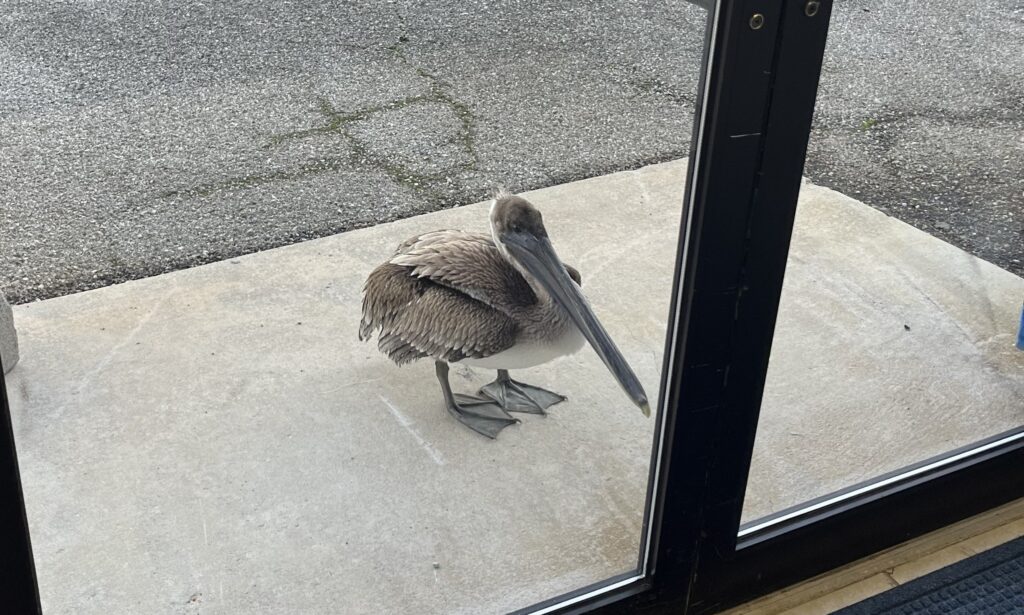
A recent quiet morning at a Florida marine research facility was interrupted by tapping at the back door.
A biologist walked over to investigate and found a brown pelican standing on the stoop and pecking at the glass with its long beak. It stood there patiently, as if waiting for help. A quick inspection revealed the pelican was injured.
Fishing line was wrapped around the pelican’s right wing, and a double-barbed treble hook was stuck in the wing, restricting the bird’s ability to fly. About a dozen cactus spines were lodged in its left foot.
When Annsli Hilton, a University of Miami research associate who works at the National Oceanic and Atmospheric Administration (NOAA) research facility, heard the commotion, she figured someone had brought in the injured bird. She was shocked to hear the pelican came on its own to the lab in Panama City.
“I always kind of thought in my head — and liked to think that — animals would know to either come to me for help or to come to the lab for help,” Hilton said. “… But I never thought it would happen.”
Hilton said the pelican might have walked about a quarter-mile from a basin on St. Andrew Bay — where pelicans are common — to the NOAA laboratory.
Scientists at the facility study fish and sharks, but they quickly helped the pelican after discovering it on Sept. 8. One biologist picked up the pelican by its abdomen and held its beak, so researchers could treat it without hurting the bird or getting bitten themselves.
While another biologist held the pelican’s right wing, Hilton cut the roughly 6-foot-long fishing line with scissors. Her co-worker then snapped the fish hook with wire cutters. The hook’s small barb was still lodged in the pelican’s bone; Hilton carefully removed it with forceps.
She also removed the cactus spines, which she said the pelican probably picked up from cacti near the facility.
Hilton, 26, said she had never treated a pelican before but relied on techniques she uses while inserting tags into smalltooth sawfish, the fish she primarily studies. The pelican was calm throughout the procedure, which Hilton said took about five minutes but felt like an hour because of the unusual nature of the situation.
Her co-worker then carried the pelican to the basin, where the bird stretched and flapped its wings for a few minutes before flying away.
Without the biologists’ help, the pelican probably would have starved or been eaten by a predator, said Deborah Jaques, founder of Pelican Science, a nonprofit that focuses on pelican research and conservation. Brown pelicans dive from as high as 65 feet to hunt fish in the ocean.
“A pelican that couldn’t fly probably wouldn’t live very long,” Jaques said.
After the procedure, Hilton said she started the work she had planned for that morning: unloading and cleaning gear from a recent research trip in South Florida. But she was left wondering how the pelican found its way to the laboratory.
Hilton said it’s unlikely someone took the pelican to the facility because the laboratory is gated from the road.
Some scientists have theories as to why the bird knew who to ask for help. Gerald Hough, a professor who studies bird behavior at Rowan University in New Jersey, said the pelican might have previously seen researchers carrying fish in and out of the facility. In its desperation, Hough said, the pelican might have visited in hopes of finding food.
Pelicans associate people and docks with food, Hough said, so when they’re hungry, they sometimes spend time near people.
“They are pretty good at taking advantage of their environments,” Hough said. “So if they got in trouble, they probably went where they knew people were in the hopes that somebody might be able to help them.”
Young pelicans are often less fearful of people than their elders who might have been chased or hurt by humans, said Juliet Lamb, a marine scientist who studies seabirds. The pelican at NOAA’s lab appeared to be born this past spring or summer due to its brown plumage, Lamb said.
Even if the pelican was looking for people, how did the bird know to peck at the glass door? Hough said the pelican might have confused its reflection with another pelican that the bird was trying to engage with. Plus, the pelican might have stood near the door to escape the sun, Hough said.
Still, while pelicans aren’t known to be as intelligent as crows, parrots or ravens, this pelican might have known where to go for help, Hough said. Other injured wild animals — including a cormorant, a dolphin and a manta ray — have previously appeared to approach people for help.
Regardless of the pelican’s motives, Hilton said she was glad she was there for the pelican in its hour of need.
“This is kind of just a once-in a-lifetime experience,” Hilton said, “to have a bird knock at your door and ask for help.”
The post Scientists heard a knock at the door. It was a pelican in need of help. appeared first on Washington Post.