For more than 200 years, the question has nagged at the edges of American history: Did Thomas Jefferson father children by Sally Hemings, a woman he enslaved?
The claim that he did has prompted denials, polemics, scandalous best-sellers and sober historical scholarship, before settling in recent years into a widely, if not universally, accepted truth.
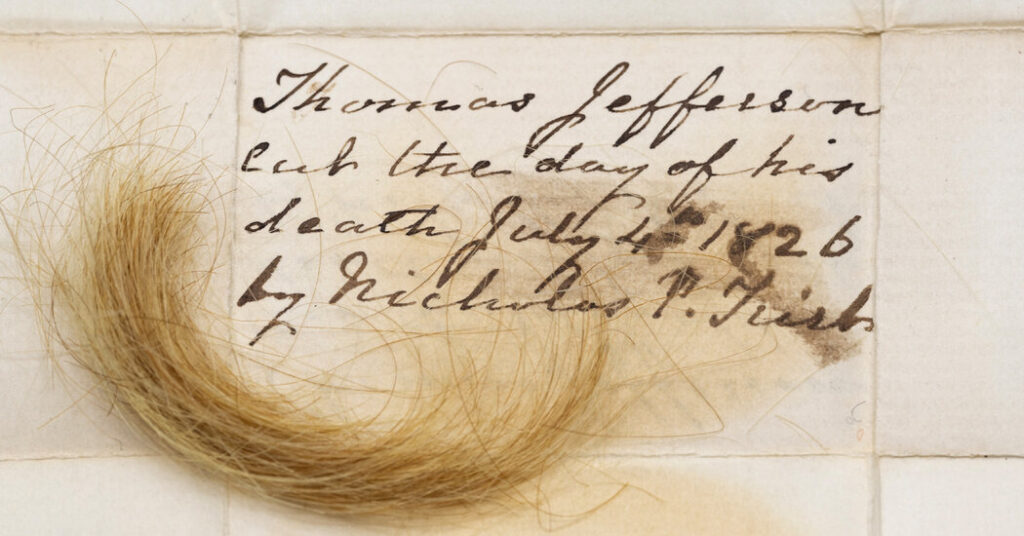
Now, the Smithsonian Institution is offering what it says is the most definitive evidence yet, based on an extraordinary piece of data: Thomas Jefferson’s genome, sequenced from samples culled from a few strands of his hair.
In a new book, Richard Kurin, the Smithsonian scholar who led the effort, describes how a team of researchers used cutting-edge techniques to extract and sequence Jefferson’s DNA. They then compared it with DNA samples obtained from 13 living Hemings and Jefferson family descendants.
It’s a 15-year detective story that involves archaeologists, genealogists, molecular geneticists and historians, stretching across multiple changes in Smithsonian leadership. Kurin, in a video interview this week, called it a “capstone” to decades of previous research, and “extraordinary proof” that Jefferson fathered Hemings’s children.
So is it absolutely certain?
“Other people may have other ideas, and I don’t think there’s necessarily an institution position,” Kurin said. “But I think it’s compelling.” He added: “It’s very clear.”
“History By a Hair,” publishing on Sept. 22 by Crown, a division of Penguin Random House, arrives with endorsements from prominent scholars.
But it is landing at an extraordinarily tense moment for the Smithsonian, which has been engaged in a standoff with the Trump administration. The president has accused the institution and its secretary, Lonnie G. Bunch III, of promoting a “divisive, race-centered ideology” that dishonors the nation’s founders and overemphasizes slavery and other negative parts of American history.
This month, Bunch, 73, who has led the Smithsonian since 2019, announced that he would depart by the end of the year. Last week, the administration outlined its plans to install signs outside the Smithsonian’s National Museum of American History, warning visitors of what it claims is inaccurate history.
While the Hemings issue has not figured into the controversy, the Smithsonian has adjusted the rollout of its research. An event on Sept. 22 announcing the findings has been moved from the American history museum to a less prominent Smithsonian location, limited to descendants and closed to the news media. An online public lecture by Kurin through the institution’s educational arm set for the next day was canceled.
Kurin acknowledged what he called the “unpredictability” of the moment. But for him, the research was just “doing my job.”
“This is a topic of interest to the American people,” he said. “I didn’t invent this question, and it wasn’t invented by the Smithsonian. It goes back to Hamilton and Jefferson and Adams. If we have evidence, scholarship and science that helps elucidate American history, I think we have a duty to pursue it.”
In a foreword to the book, Bunch strikes a similar note, linking the research to the museum’s truth-seeking mission.
The research, he writes, “helps resolve an issue that had divided us since the time of our national founding, and points to how science, scholarship and education can bring us together as people of one, albeit complicated, American family.”
A notion long discounted
The claim that Jefferson fathered children by Hemings goes back to the early days of the Republic, when Jefferson’s political opponents lobbed the scandalous charge that he had an enslaved Black mistress at Monticello, his estate in Virginia.
Jefferson’s paternity was also recorded in generations of Hemings family accounts, including an 1873 oral history given by her son Madison, who said that Hemings had become Jefferson’s “concubine,” bearing five children by him, including one who died in infancy.
Still, deep into the 20th century, the notion was discounted by most mainstream, white historians, who saw it as out of keeping with Jefferson’s character.
The 1990s saw a sea change, driven in part by a 1997 study by Annette Gordon-Reed, who analyzed the wealth of evidence in support of the claim, and the ways it had been systematically discounted by white scholars. In 1998, the geneticist Eugene Foster published a DNA study in the journal Nature, which indicated that Hemings’s son Eston was the son of a Jefferson male.
In a 2000 report, the Thomas Jefferson Memorial Foundation, the nonprofit group that owns and operates Monticello, concluded that multiple strands of evidence suggested a “high probability” that Jefferson was the father of Hemings’s son Eston, and that he was “most likely” the father of her other children.
In 2018, Monticello went further, declaring it a “settled historical matter.” Still, some skeptics have continued to advance other paternity candidates, including Jefferson’s brother, Randolph.
Kurin, a cultural anthropologist who joined the Smithsonian in 1976, has helped oversee many complex projects, including the development or renovation of most of its museums. The Jefferson effort, he says, began with a flash of simple intellectual curiosity.
In 2011, Kurin was previewing a Smithsonian documentary about Jefferson’s personal Bible, which he had created by cutting out passages containing Jesus’ moral teachings and pasting them into a new book.
Kurin wondered: Could Jefferson have cut himself in this process, leaving blood behind?
There was no blood. But conservators, he learned, had found something else: three strands of hair.
At that time, no one had reliably sequenced usable samples of nuclear DNA (the genetic material found in the nucleus of every cell) from follicle-less hair shafts, which these were. But after getting permission from the Smithsonian’s Board of Regents, Kurin started working with Beth Shapiro and Ed Green, two experts in ancient DNA at the University of California, Santa Cruz, who were pioneering new techniques for extracting and sequencing DNA from challenging sources.
Kurin was mindful that the research could yield clear evidence that Jefferson was not the father of Hemings’s children. He discussed that possibility with Bunch, who at the time was the director of the National Museum of African American History and Culture.
“The museum has to be on a foundation of truth,” Bunch said. “Whatever it is.”
‘We’re going to exhaust it’
The first task was simply to figure out if the Bible hairs were actually Jefferson’s, by comparing any DNA that could be extracted with samples taken from a known Jefferson descendant.
A genealogist started tracking down living fifth-generation descendants of Jefferson and of Hemings. (Fifth-generation descendants, some of whom were already in their 80s, would most likely be the last to have enough possible Jefferson DNA — an average of roughly 3.1 percent — to provide a clear match.)
Three years in, the team hit a possible dead end. The scientists had analyzed mitochondrial DNA, which passes unchanging through the female line, extracted from the Bible hairs. It didn’t match a sample obtained from a female-line descendant of Jefferson’s mother. So it couldn’t be Jefferson’s hair.
The team turned to another source that had emerged: strands from a lock at Monticello said to have been clipped from Jefferson’s head while he was on his deathbed in 1826.
That hair matched the DNA sample from the living maternal-line descendant. “We’re going to exhaust it and sequence the crap out of it,” Shapiro wrote to Kurin.
The team was ultimately able to sequence Jefferson’s entire genome, employing groundbreaking techniques that didn’t exist when the research started, but have since been used to solve criminal cases like the Gilgo Beach murders and the Golden State Killer, for which Green managed to recover and sequence DNA from rootless hairs.
Shapiro, whose research has also included recovering the DNA of extinct species like the dodo and the woolly mammoth, credited the Jefferson project with helping spur creative thinking about new ways to extract DNA from hair.
“It’s hard to say we ever would have gotten to this place, where all these tools were used to convict the Gilgo Beach serial killer, if it hadn’t been for starting this project,” she said.
Ultimately, the team was able to compare Jefferson’s DNA with that from samples obtained from nine fifth-generation descendants of Hemings via Madison and Eston. They shared between .5 and 5 percent of DNA with Jefferson, within the range of the expected average of 3.1 percent for a fifth-generation descendant.
The team also got data from two fifth-generation Jefferson descendants via his daughter Maria, who shared 2.4 and 2.6 percent of his DNA, and two descendants of Jefferson’s brother, Randolph.
Sam Vohr, a computational biologist working with the team, used the data to run 20,000 simulations of each paternity scenario involving Jefferson, Randolph or Randolph’s sons. The odds that Jefferson did not father either Madison or Eston were less than one in a thousand.
In an interview, Green said Jefferson’s being the father of both Eston and Madison is by far the most likely scenario. Strikingly, he noted, the person with the highest percentage of shared DNA with Jefferson — 5 percent — wasn’t a descendant of Jefferson and his wife, but a Hemings descendant.
“Any alternative paternity scenario is going to have to reconcile that,” Green said.
This month, one Hemings descendant who had given a sample in 2015 asked to withdraw her participation, saying she was dismayed that the book was appearing before a related article had been published in a scientific journal. The Smithsonian confirmed that the descendant’s sample and related data had been destroyed.
Shapiro said the descendant’s data had also been removed from the scientific article, which is under submission and awaiting completion of peer review. The team also reran its analysis. “It didn’t change the results,” Shapiro said.
Jefferson’s freckles
It remains to be seen how the research, which so far has been closely guarded, will be received.
Gordon-Reed, the historian, said she welcomed the findings, which she was briefed on several months ago, but confessed to “mixed feelings.” In her view, the historical evidence, bolstered by the 1998 DNA study, was enough. “But it’s always good to have more corroboration,” she said.
The most surprising thing about the research, Gordon-Reed said, was that it was possible at all.
“Now they have Jefferson’s genome,” she said, adding with a laugh: “Can they clone him?”
Views among Jefferson descendants vary, with some having long accepted that he fathered children with Hemings and others strongly rejecting the idea.
The Monticello Association, a Jefferson descendant group that owns the graveyard at Monticello, which does not admit Hemings descendants, did not respond to requests for comment.
David Miller, a sixth-generation Jefferson descendant whose mother, Sarah Coachman Miller, provided a DNA sample, said he welcomed the results, which confirmed what he already believed.
His mother died before the results came back. But through the project, Miller had connected with some Hemingses, whom he calls “cousins.”
“It’s positive the family now hopefully gets the recognition and acknowledgment and acceptance they deserve,” he said.
The person in the study who shares the most DNA with Jefferson is Clara Lee-Nutt, 64, who lives in Sharpsburg, Md. Along with 5 percent of his DNA, she also has what her father teasingly told her were Jefferson’s freckles.
Growing up, being descended from Jefferson wasn’t something that was shouted from the rooftops. It was the kind of claim, she once overheard her father say, that could “get you lynched.”
But now, Lee-Nutt embraces it. In January 2009, she published an open letter to Jefferson, whom she says she views “with reverence,” in Newsweek, telling him about the inauguration of Barack Obama and her hopes that Americans could move forward “as one people.”
Lately, Lee-Nutt said, she had thought often about her father, who died when she was 10. Before getting the Smithsonian’s results, she had braced herself for the possibility that the stories he had told her were wrong.
She said she understood how some Jefferson descendants might feel as if something were being taken away from them.
“But we’re not trying to diminish anyone,” she said. “We just want to be able to tell our children who they are.”
The post Two Centuries On, Smithsonian Connects Jefferson’s Hair to Hemings’s Children appeared first on New York Times.