Twentynine Palms — For decades, Mike Bradbury held out hope that his daughter was alive.
Even after search teams with bloodhounds, horses and helicopters failed to find her.
Even after investigators’ leads fizzled out. And even after Bradbury’s own hunt for suspects came up empty.
For many years, he even doubted the DNA tests performed on a small skull found a few miles from the desert campground where his little girl disappeared.
Then, a woman claiming to be Laura Bradbury showed up at his door. The shy 3-year-old with the blonde pageboy haircut and dark brown eyes would be 45 now.
She answers only to Laura. She refers to Mike as her dad. She keeps coming back, lingering in her cream-colored PT Cruiser with plates that read LANNB — Laura Ann Bradbury. She has the name tattooed on her calf along with Laura’s birth year, 1981.
She sends letters containing facts she claims only Laura would know. She mailed a photo of Laura’s mother, Patty, who died 25 years ago, captioning it, “Here is a picture of mom.”
For the Bradbury family, it’s yet another heartwrenching chapter in a tragedy that’s been unfolding for the better part of their lives.
“Every time I think it’s behind me,” said Laura’s sister Emily, “it keeps coming back up.”
::
On Oct. 18, 1984, seeking an escape from their cramped Huntington Beach condominium, the Bradbury family went camping in what was then Joshua Tree National Monument. As Mike set up their tent, his son, Travis, then 8, went to use a portable toilet. Laura followed her brother.
When Travis emerged, Laura was gone.
For weeks, the Bradburys lived in a borrowed RV at the campground. They set up a nonprofit called the Laura Center at a Huntington Beach strip mall, collecting tips and distributing millions of fliers and T-shirts with Laura’s image. She became one of the first missing children to be featured on milk cartons.
For Mike, who ran a furniture repair business, the search became all-consuming. Convinced that the San Bernardino County Sheriff’s Department wasn’t doing enough, he hired a private investigator, whom The Times described as a chain-smoking ex-Army Ranger with a Texas drawl. He bought an expensive computer, ran background checks on his own list of suspects and conducted independent surveillance stings.
In 1986, Mike told reporters he’d received information that Laura was taken by a bearded man driving a blue van and that she was later sold for about $75,000. Investigators had already searched unsuccessfully for a man in a Ford Econoline in the weeks after Laura’s disappearance, at one point releasing a sketch and describing him as a suspect in her kidnapping.
The lead, like many others, never panned out.
That spring, two hikers discovered remnants of a small skull in a remote area less than three miles from where Laura disappeared. More than 100 searchers hunted for more bone fragments as well as articles of clothing, but no additional evidence was found.
In 1989, a DNA analysis found the bones were consistent with Laura, although authorities described the results as inconclusive. Nearly two years later, more sophisticated DNA tests determined there was a greater than 99% chance that the remains were of a child of the Bradburys.
By then, the family had closed the Laura Center and moved to Grass Valley, seeking a fresh start. Patty died in 2001 after being diagnosed with bone cancer and amyloidosis. Although in life she’d remained stoic, Mike discovered years worth of letters she’d written to Laura hidden in a sock drawer.
“I want you to be a girl scout, I want to buy you dresses and take you to school and the beach and the cabin and sing happy birthday to you. How can you be 5? You are still my sweet 3 year old. You can’t have changed…Please hear me, baby. Please know we still love you and will always look for you…Please come home. Mommy,” Patty wrote on May 29, 1986 — Laura’s 5th birthday.
Travis was haunted by the guilt of being the last family member to see his sister alive. Court records document multiple convictions for controlled substance possession and driving under the influence.
Despite the evidence to the contrary, Mike held out a sliver of hope that the skull wasn’t Laura’s. In 2010, after yet another DNA test confirmed it was hers, he told a reporter that he’d finally reached something resembling acceptance.
Now 83, he is largely confined to his bed. Emily, who was about 4 months old when her older sister vanished, struggles with a heart condition that has her in and out of hospitals.
About a decade ago, father and daughter moved to Twentynine Palms, settling into a modest ranch-style house at the base of the Pinto Mountains, less than five miles from the campground.
The location was mere coincidence, a decision to move in with a family member after other living arrangements fell through.
“We expected one thing,” said Emily’s partner, Keith Hank. “Life handed us something different.”
::
The woman claiming to be Laura began contacting Mike and Emily on social media about three years ago, Hank said.
When she showed up at their home for the first time this spring, Hank told her to take a DNA test. If her claims proved true, the family would welcome her, he said. Instead, he said, she became angry and demanded to see Mike, whom she described as her father.
She continued to drop off items: a figurine with dangling limbs and a head shaped like a tulip. More than a dozen letters and photographs. One describes a campfire that was supposedly burning when Laura went missing. Another recalls Mike dancing to a certain song, said Hank, who insists there was no campfire and Mike never dances. He’s also quick to point out that the woman has blue eyes, while Laura’s were brown.
In a series of interviews, the woman, whose legal name is Cindy Rae Enders, denied she is inflicting pain on a family that has already suffered so much.
“I might drive by every day,” she said. “It’s my right. What do you expect me to do — sit on the other side of town knowing my father is so close?”
She asked Tony Campbell, a private investigator who specializes in missing persons cases, to help prove her identity. Although he initially found her convincing, her reluctance to take a DNA test gave him pause. Enders has said she will only submit to a court-admissible test performed at a laboratory, rather than the Ancestry.com test the Bradbury family requested.
“At some point, we say maybe she doesn’t want to know the truth, and she wants to continue living in that world,” Campbell said.
Julie Reeder, who publishes the community newspaper Valley News, wrote a three-part series highlighting the woman’s claims, which sparked much discussion on neighborhood Facebook pages and online sleuthing groups.
“She’s invested in this,” said Reeder, who often works with Campbell. “She definitely believes she is Laura Bradbury. She’s just trying to get someone else in the world to listen to her.”
::
Enders’ birth certificate states that she was born in Loma Linda in 1982.
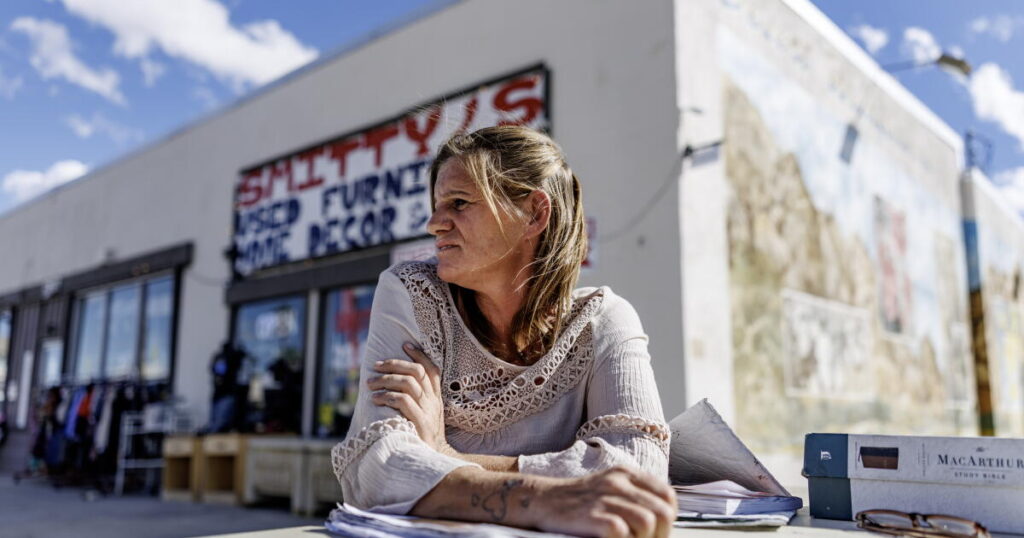
In an interview outside a Twentynine Palms thrift shop, she pulled the worn document from an envelope stuffed with other records, which she removed one by one and fanned out on a table: newspaper clippings in which Mike expressed skepticism about the authenticity of the skull. Photos of her own face, enlarged to show scars and imperfections, juxtaposed next to images of Laura with circles and arrows pointing out marks that are supposedly similar. A signed copy of Mike’s out-of-print book, “Laura Ann Bradbury — A Father’s Search.”
Her ice blue gaze was intense, her speech rapid-fire. She said her childhood was shaped by abuse and upheaval, with a stint in foster care and time spent in California, Oregon and Nevada. She estimated that by the time she finished fourth grade, she’d attended 14 different schools, at times under different names.
She claimed she never knew her legal name was Cindy Enders until she was sentenced to a youth facility as a teenager, when she went by the last name Colgin. She said she was accused of stealing but was only carrying the money for someone else.
Years ago, she said, the man she believed to be her biological father made a deathbed confession: she wasn’t his. He instructed her to ask about someone named Mike, she said.
She said she combed through databases of missing children and “found herself” in Laura Bradbury. The sketch of the kidnapping suspect resembled the man who had told her he wasn’t her father, and a blue Econoline van is parked outside one of her childhood homes in Wells, Nev., she said.
Her stepfather, James Hunt, said there is a blue Econoline in his yard, but it has nothing to do with the Bradbury case. Enders has been prone to fabulation since she was 16, he said, when she moved in with him along with her mother and twin brother.
“You couldn’t believe anything she said. Some of the stories she came up with were so wild, you wouldn’t pull them out of the best mystery novels,” he said.
Enders said she doesn’t claim Hunt as her relative and dismissed his allegations as “his word against mine.”
“I’m not going to talk about what Jim says,” she added. “He’s irrelevant to me.”
Court records indicate that Enders’ troubles persisted into adulthood. In 2019, in Elko, Nev., she pleaded guilty to conspiracy to commit burglary for breaking into a man’s car and rifling through his belongings.
At her sentencing hearing, the prosecutor acknowledged that she’d had a tough time, including at a homeless camp “where she was causing a lot of issues,” but that her history was characterized by repetitive minor criminal activity.
A judge sentenced her to 270 days in jail. “Petty larceny, battery, disturbing the peace. I mean, it goes on and on,” said the judge, according a court transcript.
That same year, Enders pleaded no contest to the unlawful taking of a motor vehicle, after she was found living in an RV that didn’t belong to her. She told the court that she wanted to get into a substance abuse treatment program in Minnesota, where her twin children lived.
Her attorney requested she receive no additional jail time, but the judge handed down an additional 180 days, pointing out that her criminal activity spanned at least 12 years and 10 misdemeanors, including charges of child endangerment and domestic battery.
In addition to the twins, Enders said she has seven other children, two of whom she adopted out in surrogate arrangements. Hunt said that he and Enders’ mother raised one of her sons after authorities threatened to put the boy in state custody.
“Everything possible was done to try to get her to reunite and settle down and raise her own kids,” but she rebuffed offers of help, Hunt said.
Enders declined to discuss her relationships with her children.
About three years ago, Enders nearly died in a car crash, and shortly after, she “up and disappeared,” Hunt said. Then, he heard she had resurfaced in Southern California and was claiming to be Laura Bradbury.
“I can’t really say why she’s doing it exactly,” he said. “My guess is that she’s fried her brain from alcohol and avid drug use — and I don’t mean just pot, I mean everything that she can get her hands on.”
When asked about her past, Enders’ demeanor darkened. She said she’s sober but declined to discuss her criminal history.
“I literally put all of that hell behind me,” she said.
She recently got a job at a dollar store in Twentynine Palms and moved in with an older woman, helping to care for her, she said.
She later wrote in a text message: “I know they scrutinize and nonstop make me look unstable [to] anyone and everyone.”
“I know my parents would have raised us right, knowing they both were older with their heads on their shoulders,” she continued, referring to Mike and Patty Bradbury. “I ought to have been with my Bradbury Family, not being abused and [pawned] around.”
The birth certificate puts her age close to Laura’s, and she points to inconsistencies: her mother’s last name is listed as Enders, but the signature says “Oliveira.” Her father’s name is withheld. She refers to them both as her kidnappers.
::
Hank has taken to leaving the blinds shut and staying away from the windows, he said in a recent interview outside the Bradbury home, continually glancing over his shoulder.
He said he’s called the Sheriff’s Department at least three times, but they said they could take no action unless Enders becomes violent. In response to one of Hank’s calls in late September, deputies checked the area, looking for Enders, according to dispatch records, but it’s not clear whether they made contact with her.
The last few months have been hard on the family, Hank said. Enders sometimes parks nearby for an hour at a time or drives by, playing music and whistling, he said. After a confrontation with Enders, Emily laid down on the couch, unable to breathe. Hank prepared to call 911, but her symptoms subsided.
“We’re struggling to barely get by,” he said. “The family’s just trying to live out the rest of their lives in peace.”
As he spoke, Emily emerged, holding a green velvet bag. She took out a little white box and held it up in the harsh desert sun. The label read, “Ocean View Crematory.”
“This is Laura,” she said. “This is my sister.”
The post She claims to be Joshua Tree’s most famous missing child. Is she a fake? appeared first on Los Angeles Times.