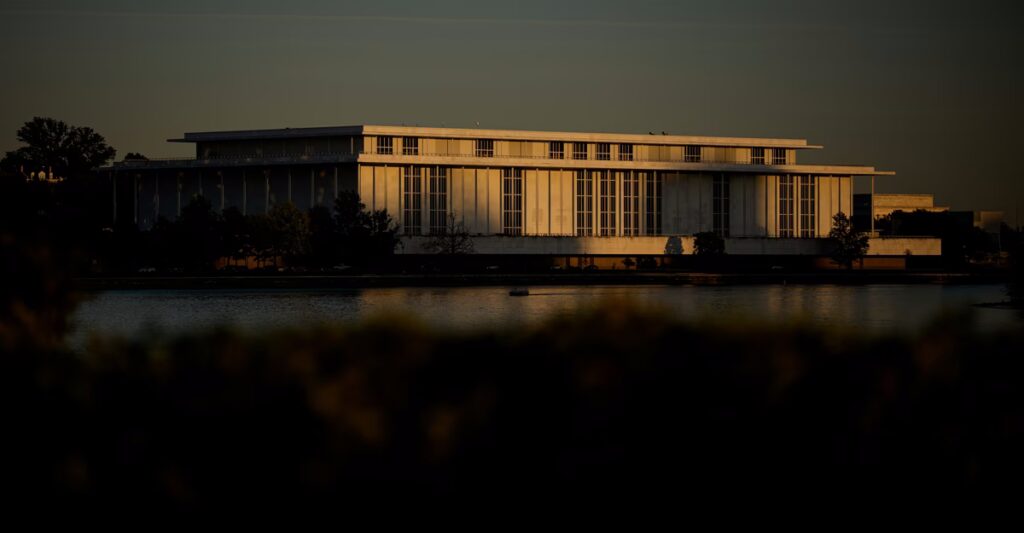
For 19 months, Donald Trump has portrayed himself as the Kennedy Center’s savior. He promised to root out “woke” programming at the arts complex. He claimed that past leaders had neglected dangerous conditions in the building—a structure that he now says might have to be “ripped down” if he can’t put his name on it. Throughout his tenure, he and his allies have accused former executives of financial mismanagement and even “fraud” that left the organization struggling.
Now there’s a fuller picture of the finances Trump inherited—and of what happened during his first months in charge. A previously unseen federal tax filing captures an institution in transition: It spans the final months of its previous leadership and roughly seven months under Trump, offering a baseline for understanding a financial crisis that has grown more severe over the year that has followed. (The Kennedy Center provided me with the filing because nonprofits are required to do so within 30 days of a request.)
On paper, the Kennedy Center had an extraordinary financial year. It reported more than $516 million in total revenue on its 990 form for the fiscal year that began in October 2024 and ended last September—a nearly $210 million increase from the previous year.
But that windfall appears to have been largely driven by a summer infusion of federal renovation money, which Trump had asked Congress to include in its One Big Beautiful Bill Act and is now threatening to withhold. If you subtract the $257 million in renovation funds from the revenue, the Kennedy Center appears to have spent nearly $47 million more than it took in that fiscal year, a precipitous drop compared with the funds reported on its previous 990. Notably, the new filing includes a $48 million “bad debt expense,” which is essentially a write-down of previously recorded revenue that an organization no longer expects to collect. In the fiscal year ending in 2024, when the center was led by President Deborah Rutter and a bipartisan board of trustees, it brought in about $40 million more than it spent. (The Kennedy Center and the White House did not immediately respond to questions about the return.)
Stripping out the renovation money does not necessarily mean the Kennedy Center ran a $47 million deficit last fiscal year. Two experts I spoke with cautioned that the tax return does not provide enough information to make that calculation cleanly. One of them, Michael Kaiser, an arts-management consultant and a former Kennedy Center president, told me that 990s combine operating revenue and expenses with capital funding and other sources of income, making it difficult to isolate the institution’s underlying financial performance from top-line figures. “It combines everything into one mush,” he said. The other expert, Cleopatra Charles, a Rutgers University professor whose research focuses on nonprofit organizations and financial management, reached a similar conclusion. Taken at face value, she told me, the filing depicts a “very financially healthy organization.” Total revenue increased by roughly 68 percent, and contributions and grants more than doubled, allowing the center to report that $210 million surplus. But much of that apparent improvement came from a one-off appropriation rather than the Kennedy Center’s own programming or fundraising efforts. The form noted $301.5 million in federal appropriations—a figure that includes both the money from the One Big Beautiful Bill Act and the roughly $45 million in annual funding the center typically receives.
The tax filing bolsters what reporting (and rows of empty seats at performances) over the past year and a half has shown. Program-service revenue, a category that includes ticket sales and other income generated by programming, fell from nearly $105 million the previous year to about $89 million. Kaiser cautioned that this figure can fluctuate considerably depending on the mix of productions. A blockbuster musical such as Hamilton, for instance, could bring a significant bump in ticket revenue that disappears the following year.
Other figures on the return raise more questions than answers. There was an unusual increase in net income from unrelated business activities, which rose from about $27,000 in 2023–24 to more than $517,000 in the latest year reported. But the filing does not make clear what generated this increase. Charles pointed out a roughly $43 million increase in “other expenses” that lacked a clear explanation of what they were—including nearly $35 million categorized as “other contracted services.” Taken together, she said, the line items lacked sufficient context about the center’s finances—and an independent audit would offer more clarity. But according to the 990 form, the annual audit was not completed by the time of filing. That’s “very unusual,” a former official with knowledge of Kennedy Center governance and financial practices told me, speaking on the condition of anonymity out of fear of professional repercussions. Audits are usually made available to the public by January or February each year.
The Kennedy Center that Trump took over was still recovering from the pandemic, during which it shut down entirely; it did not reopen fully until fall 2021. The center posted deficits during the pandemic but had surpluses in the two years before the Trump takeover. It draws revenue from ticket sales, charitable giving, government funding, campus rentals, and other sources. Trump’s putsch disrupted several of those streams: Many artists canceled performances, a segment of the audience began to boycott the center, and some donors pulled back on contributions. That included perhaps the center’s most important benefactor in recent years. To become the Kennedy Center’s chairman, Trump ousted the private-equity billionaire David Rubenstein, who had donated more than $100 million to the organization.
By last fall, ticket sales to classical-music and theater performances were in free fall and the center had taken on a more political flavor, hosting evangelical-Christian and conservative events as well as the World Cup draw, where Trump received the FIFA Peace Prize. But it’s unclear if the Kennedy Center was able to make up the ground it had lost in ticket sales by attracting more donors. The Washington Post reported last month that ticket sales and donations had plunged even further after last December, when a board largely composed of Trump allies voted to rename the Kennedy Center to honor the current president.
The ongoing legal battle over the future of the organization centers on two issues: the appropriateness of that board’s decision this March to shut down for the renovation, and whether Trump’s name can be added to a “living memorial” to a slain president. Center officials recently warned that the organization was nearing bankruptcy—confirming many observers’ suspicions. The board wants Trump’s help to raise the necessary funds, and to recognize his efforts by inscribing his name on the building, which a federal judge has rejected several times, saying Congress did not permit such a change when it established the venue.
The latest tax document arrives during an extraordinary week at the center. On Tuesday, the judge ruled—again—that the Kennedy Center cannot add Trump’s name. The same day, the board voted—again—for a full closure of the main building, a move that’s still being held up in court. At that meeting, the president upbraided the member of Congress who’s behind the legal fight to halt his efforts, and then went on Truth Social with an ultimatum: He would let a renovation proceed only if federal courts let the board inscribe his name on the building, potentially casting the entire arts complex into operational limbo. Still, even as Trump issued the threat, he also announced he would move $17 million he had raised into a Kennedy Center account to keep the institution afloat. The following day, the center barred the public from entering the building and directed all nonessential personnel to work from home, citing a recent collapse of a portion of the ceiling and other maintenance issues. Trump told reporters that day that in order for the center to be rescued, “I think that the Trump administration should be recognized.” That night, Trump was photographed on Air Force One holding a placard that appeared to read Kennedy Center DEMOLISHED, fueling speculation that a teardown, once seen as far-fetched, has been on his mind all along. Yesterday, the same federal judge issued another order barring the Kennedy Center’s demolition.
The financial consequences of those twists and turns won’t come into full view for a while. The latest tax return captures only seven months of Trump’s takeover. It was signed by the Kennedy Center’s chief financial officer, Donna Arduin Kauranen, one of the officials brought in after the transition. Kauranen had previously served as a budget director for several Republican governors, but like many of the new hires under Trump, she hadn’t worked in nonprofit arts management. Even seasoned arts managers would hardly have been prepared for the operational roller coaster that has been Trump’s run at the Kennedy Center.
On Tuesday, the same day that Trump made his latest demand, Kauranen resigned.
The post The Kennedy Center’s Tax Return appeared first on The Atlantic.