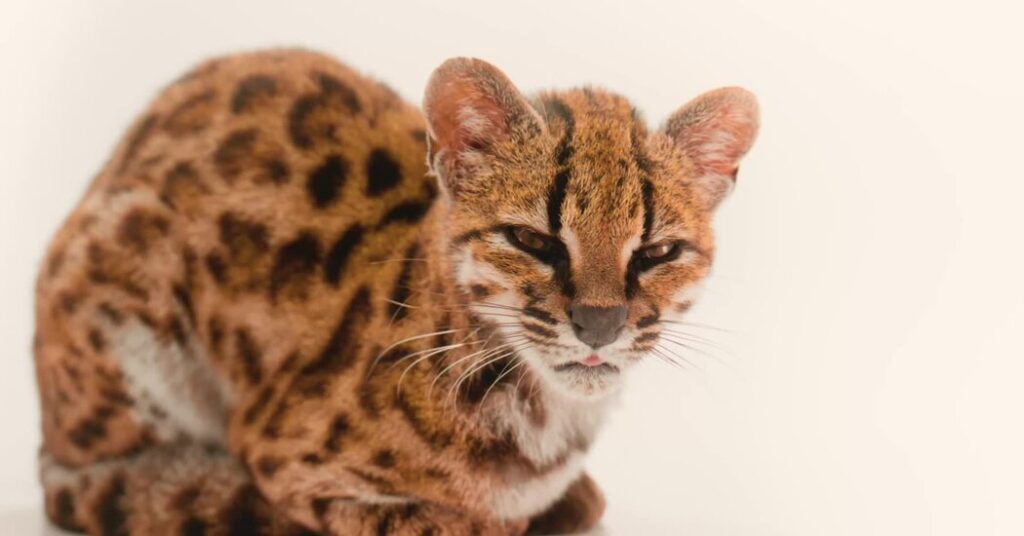
A three-pound wildcat with leopardlike spots from Bolivia who once lived briefly as a house pet isn’t just adorable. He is also, scientists say, the standard-bearer for the first new feline species discovered in a century.
The cat himself is named Tigrino, and his species is called tilcayo.
Several other cat species have gained official recognition after previously being considered subspecies. But the tilcayo, found in the cloud forests of the Andes Mountains in Bolivia, is the first brand-new feline species added to the cat family tree since the pampas cat was described in 1923.
The diminutive tilcayo, officially Leopardus tilcayo, resembles its closest relatives, the so-called tiger cats, found in Central and South America. After DNA analysis, the scientists whose study was published on Thursday in the journal Current Biology say the species split from its closest relatives 1.4 million years ago.
Still, little else is known about the new species, including its behavior and the number of cats in wild.
The biologist Paola Nogales Ascarrunz first met Tigrino nearly a decade ago at the Senda Verde Wildlife Sanctuary in Bolivia. The cat had been kept as a house pet for a year, before the family realized it was a wild animal, ill-suited for domestic life, and brought it to the sanctuary around 2017.
The sanctuary staff assumed that he was an oncilla, part of the species Leopardus tigrinus, and nicknamed him “Tigrino” based on the species name. But Dr. Nogales Ascarrunz, a National Geographic explorer and the founder of the conservation organization Programa de Investigación Félidos Bolivia, was struck by Tigrino’s size.
“I couldn’t believe how small it was,” Dr. Nogales Ascarrunz said. “I thought that this must be a young cat, or maybe a kitten.” At a year old, Tigrino was fully grown but smaller than a typical adult oncilla, which can weigh more than seven pounds. Initially, Dr. Nogales Ascarrunz did not think too much of the discrepancy, though.
That changed in 2019, when she was working on a guidebook of local Bolivian wildcats. She noticed subtle differences between a reference photo of an oncilla and her photos of Tigrino. In addition to being smaller than the oncilla, Tigrino’s spots were bigger. “It didn’t really match,” Dr. Nogales Ascarrunz said, so she began a study of Tigrino’s DNA, comparing it with other members of the Leopardus genus, colloquially known as “tiger cats.”
At the time, another team of scientists, Eduardo Eizirik and Jonas Lescroart, was studying other tiger cat species from elsewhere in South America, particularly drawing upon preserved specimens in museum collections. After discussing their shared research interests, Dr. Eizirik and Dr. Lescroart joined forces with Dr. Nogales Ascarrunz.
“There were assumed to be two to four species, but the exact number wasn’t really settled yet,” said Dr. Lescroart, a biologist at the University of Antwerp and a co-author of the study with Dr. Nogales Ascarrunz.
“We decided to join our two data sets together, analyze everything together, and it came out to be five different species of tiger cats, with this new Bolivian one being completely unexpected at the time.”
The differences among these five feline species are subtle and often difficult to discern without the help of DNA analysis. However, what might seem like academic hairsplitting about species delineations has real conservation implications. Tiger cats’ habitats are threatened by deforestation and fragmentation, and their populations are scattered by the illegal pet trade.
“If one supposedly widespread species is actually several more restricted lineages, each may have a much smaller geographic range,” said Samantha Zwicker, an ecologist and co-director of the conservation nonprofit Hoja Nueva, who was not involved with the study.
Dr. Eizirik, the study’s senior author and a researcher at the Pontifical Catholic University of Rio Grande do Sul, said the discovery of the tilcayo had resulted in the most attention to small cats that he has seen in the 30 years he has studied the group.
He expressed hopes that this attention would translate into conservation efforts that would help both the tilcayo and other less cuddly-looking species it lives alongside. “Who knows what else is undiscovered in those Bolivian jungles?” Dr. Eizirik said. “The tilcayo may actually save a lot of things.”
The post New Species of Cat Discovered for First Time in a Century appeared first on New York Times.