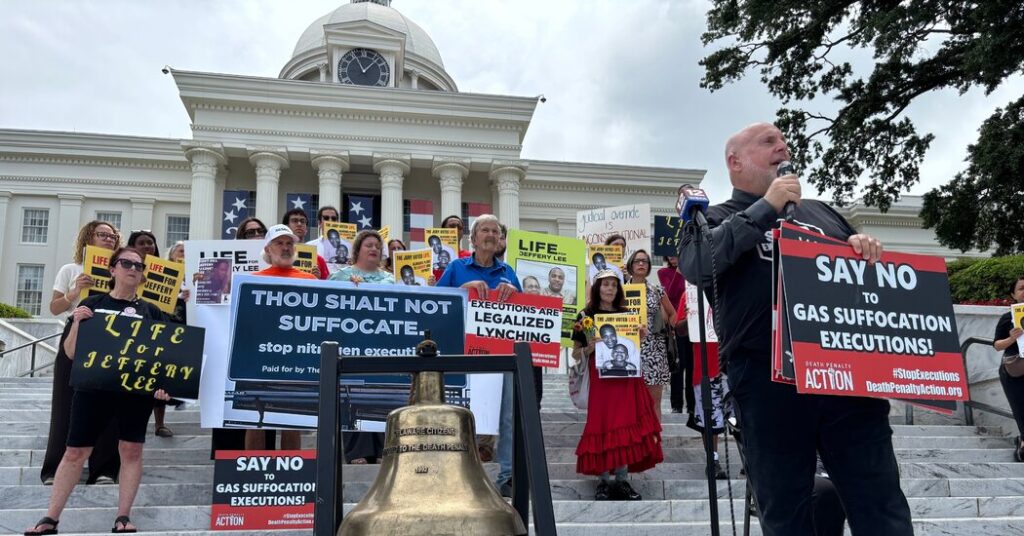
Alabama used lethal injection on Thursday to carry out the death sentence of a convicted murderer, three months after the U.S. Supreme Court blocked the state from executing the man with nitrogen gas.
Lawyers for the condemned man, Jeffery Lee, had succeeded in raising doubts about the constitutionality of using nitrogen gas in executions, a method that Alabama has been at the forefront of embracing as lethal injection drugs have become harder to obtain. The Supreme Court stopped the execution in a rare intervention on June 11, just as the state was prepared to put Mr. Lee, 49, to death that day using the gas.
The court order did not undermine his death sentence, leaving an opening for the state to try again using another method. State officials quickly rescheduled Mr. Lee’s execution, this time turning to lethal injection. Mr. Lee died just after 6 p.m. Central time at Holman Correctional Facility in Atmore, Ala., state officials said.
“In June, after Mr. Lee attempted to avoid his deserved death sentence, I reaffirmed my commitment that justice would ultimately be served,” Gov. Kay Ivey of Alabama said in a statement on Thursday evening.
Mr. Lee’s death sentence in 2000 came after he tried two years earlier to rob a pawnshop just outside of Selma armed with a sawed-off shotgun. He opened fire inside, killing two people — the owner, a well-known Elvis impersonator named Jimmy Ellis Sr.; and his ex-wife and business partner, Elaine Thompson. A third person, an employee named Helen King, was wounded.
A jury convicted Mr. Lee in the murders and voted to sentence him to life in prison without parole. The trial judge overrode that decision and sentenced him to death, a practice that was outlawed in 2017 but did not apply retroactively.
Alabama was the last state to prohibit the practice. The state still has about two dozen other inmates on death row who, like Mr. Lee, were sent there by judges.
Prominent legal and political figures in the state, including some supporters of the death penalty, had called on Ms. Ivey, a Republican, to spare his life, rather than continue what they cast as an alarming imbalance.
In a statement on Thursday, Mr. Lee’s lawyers condemned the state for moving forward. “That is a moral failure, not just a legal formality,” they said.
“A state that no longer stands behind the rule that condemned a man, but kills him under it anyway, has not delivered justice,” his lawyers said. “It has revealed how little its own standards constrain it when it is determined to carry out an execution.”
But Ms. Ivey defended the executions of Mr. Lee and the other inmates who had been sent to death row under similar circumstances, saying the state was carrying out a punishment that was brought a measure of justice to victims’ families and survivors.
“These victims have waited long enough,” she said, “and I pray they can feel peace and have closure.”
Alabama is among the states that have pressed ahead with executions even as legal and logistical challenges have mounted.
Texas put 40-year-old LeJames Norman to death on Wednesday; he was convicted of fatally shooting three people in 2005 while robbing a home in rural Jackson County, near the Gulf Coast.
Georgia had been set this week to execute Stacey Humphreys, who was convicted of strangling and shooting two real estate agents in a sales office in the Atlanta suburbs in 2003. But his execution was delayed at the last minute as his lawyers sought to have his life spared using a new state law that allows for leniency in sentencing for abuse victims. They argued that Mr. Humphreys, 53, had “suffered extreme violence and abuse as a child.”
For much of his time on death row in Alabama, Mr. Lee had been set to be executed using lethal injection, the state’s primary method for roughly two decades. But that method fell out of favor after botched attempts led the state to pause executions for three months in 2022 and after pharmaceutical companies restricted sales of the drugs.
Alabama introduced the execution method of nitrogen hypoxia, where a person is forced to breathe in only nitrogen gas, asphyxiating them. Mr. Lee was among the condemned inmates who opted for the new method, which had been portrayed by its supporters as efficient and potentially painless. But after the method was introduced in 2024, witnesses described inmates writhing and gasping for air for 10 minutes or longer.
Those accounts led Mr. Lee and other inmates to challenge its constitutionality. In his case, Mr. Lee proposed that he die by firing squad. A federal judge agreed with his argument that marksmen firing directly at his heart would provide a quicker death with a lesser likelihood for pain.
Mr. Lee has acknowledged his guilt, going as far back as the sentencing portion of his trial in 2000. But he has argued that his punishment should be the one the jury wanted.
State officials contend that the execution was a measure of justice for the lives lost and upended after Mr. Lee opened fire in the pawnshop.
In the 26 years that he has been on death row, Mr. Lee has become involved in prison ministry. In an interview this month with The New York Times, as his execution loomed, he reflected on how he had wanted to prove to others, as well as himself, that his life was defined by more than his worst sins.
“Being a good friend, being a good mentor, being a good teacher and preacher of the word of God, being an OK barber,” he said. “I know I am who I’m supposed to be now, and I know what I’m supposed to be doing, and I’m doing it.”
The post Alabama Executes Inmate After Supreme Court Blocked Last Attempt appeared first on New York Times.