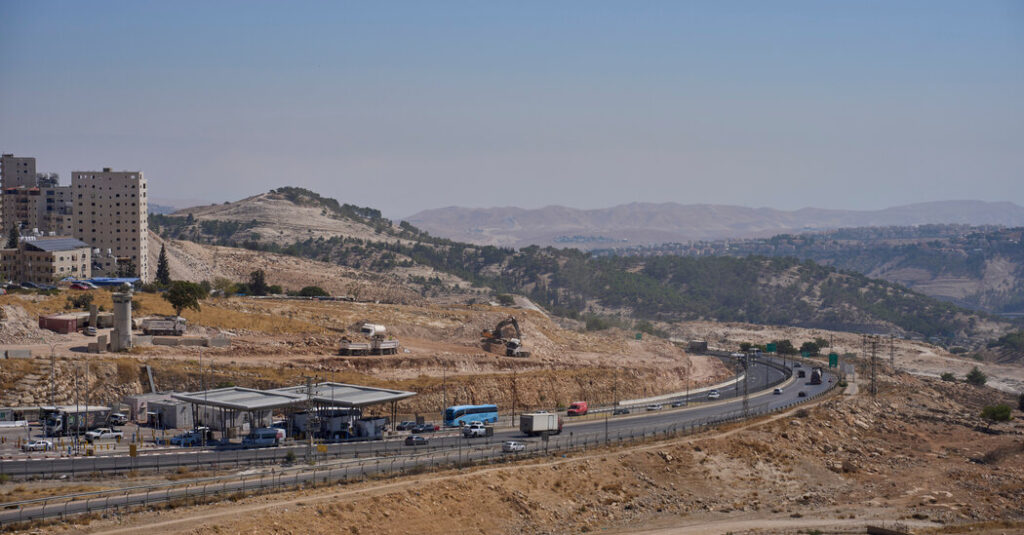
Israel’s hard-line government is pushing forward contentious plans for construction in a strategically significant area of the occupied West Bank. Critics say the effort, which defies international censure, aims to lock in the plans on the ground before elections next month.
Previous American administrations vehemently opposed Israeli housing construction in the area, a patch of land east of Jerusalem that is about 4.5 square miles and is known as E1.
But Israel’s current right-wing government, led by Prime Minister Benjamin Netanyahu, has made moves suggesting construction there may begin soon, bucking the internationally accepted parameters for resolving the Israeli-Palestinian conflict.
Here’s what to know about E1.
Where does the project stand?
The settlement project, which plans for about 3,400 housing units, stalled for years under international pressure. But the Israeli government granted final approval for it about a year ago.
This month, weeks after publishing an initial tender for the construction of more than 1,234 settler housing units in the area, the government said that it would open bidding on Oct. 25 for another 2,167 units.
Ir Amim, an Israeli group that advocates a Jerusalem shared by Israelis and Palestinians and that opposes settlement in the West Bank, publicized the new tender this week, after it was issued by a government office. The move underscores “the limits of domestic avenues in preventing the advancement of E1 and reinforces the urgency of international intervention and accountability,” the group said in a statement.
Why is it so opposed?
Most of the world considers settlement in the occupied territories to be a violation of international law and sees the West Bank as a core part of any future Palestinian state. Plans for Israeli settlement construction in E1 were first laid decades ago, but Israeli governments held off building there because of sensitivities about the location.
E1 is small but strategic. Building there would largely sever the northern half of the West Bank from the southern half, complicating the prospect of a viable, contiguous Palestinian heartland. The project would link Jerusalem with Maale Adumim, a large, urban Israeli settlement east of the city.
The name E1 refers to a bureaucratic designation for planning and zoning purposes, with the “E” standing for “east of Jerusalem.”
Bezalel Smotrich, the Israeli finance minister and the government’s chief promoter of settlements, has prioritized the development of E1, saying it “buries the idea of a Palestinian state.”
The Israeli prime minister’s office and several other government agencies did not immediately respond to a request for comment about the latest developments regarding E1.
The Trump administration has so far avoided openly condemning the E1 project, though it has opposed Israeli annexation of the West Bank.
Why advance building now?
The bidding for the first 1,234 housing units opened in mid-August and is due to close on Oct. 19, just a week before national elections scheduled for Oct. 27. The latest tender is expected to open for bids two days before the election and to close on Dec. 21, by which time a new government might be in place.
Opponents of the settlement say the current government is trying to curry favor with right-wing voters and to lock in as many bureaucratic moves as possible regarding E1 while it still can.
The Israel Land Authority, a government agency, posted an online announcement about the upcoming tender on Sept. 7, a day before Britain, Canada and France — once staunch allies of Israel — announced sanctions on Israeli settlements in the occupied West Bank.
That step illustrated Israel’s deepening isolation after the devastating war in Gaza, set off by the Hamas-led attack on Israel in October 2023, and during intensifying settlement building and settler violence in the West Bank.
In a speech announcing the sanctions, Ed Miliband, the British foreign secretary, described the issuing of the E1 tender in August as “the crossing of a longstanding red line.”
“Let us be absolutely clear what this means: the creation of a set of facts on the ground to make the two-state solution unviable,” he added.
Daniel Seidemann, an Israeli lawyer who opposes settlement and who founded Ir Amim, said that announcing the tenders reflected “a clear decision to move ahead” and would not have been done without Mr. Netanyahu’s knowledge and consent. Mr. Netanyahu, he said, was in “defiant mode,” flouting international criticism, and is “going places he didn’t dare go in the past.”
The post What Is E1, Where Israel Is Pushing a Disputed Settlement Plan? appeared first on New York Times.