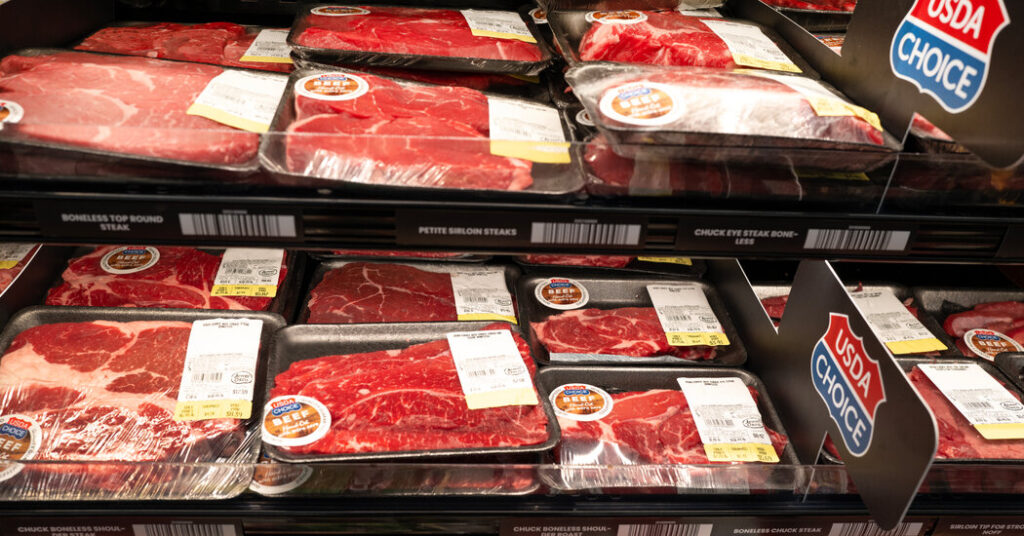
The Trump administration is hoping mandatory country-of-origin labeling will help alleviate its beef problem.
Ranchers are upset over President Trump’s plan to import more than 660 million pounds of lean beef trimmings, which are mixed with fat trimmings to make ground beef, under reduced tariffs. Greater competition with foreign beef would lower the price they receive for their own cattle.
The administration wants to give shoppers a choice while trying to assuage ranchers: Seek out all American beef and potentially pay a premium for it, or opt for the cheaper, imported alternative.
“My goal and top priority in bringing this labeling back is No. 1, to protect the American rancher and No. 2, to protect the American consumer,” Brooke Rollins, the agriculture secretary, said in an interview.
The new effort faces some resistance, as the cattle industry is split on whether mandatory labeling would be helpful. Retailers, meatpackers, feedlot owners and ranchers with large herds argue it imposes too many costs, while independent ranchers and those with smaller herds say it can be done cheaply and will benefit their bottom line.
This month, the president signed an executive order applying a number of new rules to the beef and cattle industries. The labeling section orders the agriculture secretary and U.S. trade representative to review regulations and provide an economic analysis of mandatory country-of-origin labeling within 90 days. They can then either issue new regulations, if legally allowed, or make recommendations to Congress about laws they think should be passed on the issue.
Any changes to rules on labeling would not take place until 2027 at the earliest. Most fresh fruit, vegetables, fish and some meats sold in U.S. grocery stores already require a country-of-origin label. Beef and pork do not, however, because of a convoluted history of legislation and trade disputes.
The 2002 Farm Bill required retailers to put origin labels on fresh beef and a number of meats, fruits and vegetables. An expansion passed in 2008 added chicken to the list and modified rules on beef labels. Canada and Mexico complained to the World Trade Organization, arguing those requirements violated their trade agreements because it forced them to spend millions of dollars to comply with the rules.
The W.T.O. agreed and allowed Canada and Mexico to impose over $1 billion in retaliatory tariffs on the United States. To avoid those tariffs, Congress repealed the labeling rules for beef and pork in 2015 but left them in place for other products like chicken, fresh fruits and vegetables.
Any formal re-implementation of mandatory labeling is likely to have to be passed by Congress and tackle the previous W.T.O. ruling. “If Congress isn’t willing to act, there are other things we can do,” Ms. Rollins said. For instance, she suggested, beef from other countries could get a label that said: “Not product of the U.S.A.”
Cattle typically passes through a number of hands before getting to supermarkets. It can go from pasture to auction barn to backgrounder to feedlot to slaughterhouse to retailer, with each step along the way adding costs to track and certify where the animal came from.
The United States Cattlemen’s Association supports mandatory country-of-origin labeling, but only if it can be done in a way that adheres to W.T.O. rules. “They shouldn’t be able to ride our coattails just because they get to bring beef in and mix it with ours,” Justin Tupper, the organization’s president, said about foreign beef producers.
Even some supporters, however, acknowledge research that shows mandatory labeling would not be a panacea.
In 2015, the Agriculture Department’s chief economist found that the economic benefits of putting in place country-of-origin labels “would be insufficient to offset the costs of the requirements.” And there was little evidence that consumers changed their shopping habits when origin information was provided.
Beef has also become more expensive. The price of a pound of ground beef is up 64 percent since the report was written, and 16 percent after adjusting for inflation, according to the Bureau of Labor Statistics.
“We are all proud Americans, and we want to put a flag on there and have people consume our product,” said Craig Uden, the president of the Nebraska Cattlemen, which supports voluntary, but not mandatory, labeling. “But we also know that people are going to buy what they are going to buy.”
Glynn Tonsor, a livestock economist at Kansas State University, runs a monthly survey called the meat demand monitor. Place of origin regularly finishes second to last, only ahead of environmental impact, in a ranking of attributes respondents consider important when buying meat. Taste and freshness top the list.
“That tells me the average Joe, average Jane in the U.S. does not prioritize it as much as they do taste, freshness, safety, price, nutrition, go down the line,” Mr. Tonsor said. Mr. Tonsor and other economists also found that the 2008 rules for country-of-origin labeling would have cost the beef and cattle industry more than $8 billion over a decade. Most of that cost would have fallen on retailers, but ranchers would have had to pay hundreds of millions of dollars to track and provide origin information to cattle buyers.
Proponents said that improvements in technology could make tracing beef less costly today, and rules around what products have to bare the label and how could be modified. Ms. Rollins said the Make America Healthy Again movement and the emphasis of red meat in new dietary guidelines were signs that Americans cared about protein and its origin.
But any changes will come too late to impact the immediate finances of small ranchers. Fall is when most cattle are sold — six months after calves are born in the spring — and live cattle prices have dropped 14 percent since late June. Some ranchers blame that on increased imports and uncertainty in the cattle industry.
“We don’t need more policy,” Mr. Uden said. “We need the market to be the market. I really don’t want the government marketing my product.”
The post Trump Administration Wants ‘Made in the U.S.A.’ Labels on Beef appeared first on New York Times.