The first fence to slice through the Tohono O’odham Nation was simple barbed wire meant to keep cows from roaming south into Mexico. The second, which rose nearly a century later, was a sturdier steel barricade that stopped smuggler trucks from barreling north into the United States.
The binational tribe, whose land stretches from modern-day Arizona into the Mexican state of Sonora, has long been caught in the middle of disputes over a border between two countries that did not exist when the O’odham’s ancestors first settled here thousands of years ago.
The tribe’s leaders have adapted, working with the American government as it ratcheted up immigration security on their territory. But now they are facing the biggest wall yet, and they are drawing a line.
The Trump administration wants to build a towering 62-mile barrier that would bisect the Tohono O’odham homeland along the international boundary with Mexico, and construction could begin as soon as October. Leaders of the Native American nation say it will restrict member movement, endanger wildlife, destroy sacred burial sites and undermine tribal sovereignty while doing little to tamp down illegal activity.
“It’s like me bulldozing right through the Arlington Cemetery,” said Verlon Jose, the chairman of the Tohono O’odham Nation. “We don’t matter to the U.S. government. They want to erase us. They want to take our land, they want to desecrate it, they want to hit us where it hurts.”
The tribe has sued to prevent construction, but the federal government is pushing ahead as it seeks to wall off most of the southern frontier. Last month, masked and armed Border Patrol agents escorted a group of contractors through the reservation to do survey work at the planned wall site. O’odham leaders accused the workers of trespassing.
It is one of many battles simmering along the southern border, where President Trump’s wall has drawn bipartisan outrage in national parks, on private ranches and among environmentalists and Catholic priests. But this escalating confrontation on Native land southwest of Tucson stands out because it upends decades of uneasy cooperation between the tribe and the United States.
The Tohono O’odham Nation, which occupies a reservation roughly the size of Connecticut, has for years allowed federal immigration authorities to operate bases and surveillance towers on its land. The tribe spends $3 million a year on border security, and its police force works closely with Border Patrol agents.
“We’ve bent over backwards to work with the federal government,” Mr. Jose said. “But we will never agree to a wall.”
During Mr. Trump’s first term, the tribe successfully lobbied against a wall. But since Mr. Trump’s re-election, O’odham leaders say they have found federal officials unwilling to compromise.
The administration, which has waived environmental reviews to speed wall construction, has argued that the tribe’s vast and varied territory is a hot spot for cartel-sponsored crime.
“The project will close one of the most dangerous smuggling and trafficking corridors on the Southwest border,” Rodney Scott, the U.S. Customs and Border Protection commissioner, said in a statement.
The Tohono O’odham, whose enrolled members number near 40,000, have long moved freely among the Sonoran Desert’s sky-scraping saguaros, Seussian ocotillos, herds of javelina and packs of coyotes.
In the 1850s, the Gadsden Purchase divided O’odham land nearly in half as a new boundary was drawn between the United States and Mexico. Today, Mexico is home to some 2,000 tribal members, as well as ancestral cemeteries and ceremony sites. But to cross, the O’odham must call a Border Patrol agent, who then checks documentation and unlocks one of three gates along the existing barrier.
Illegal immigration and drug smuggling through the reservation surged in the 1990s, raising fears among tribal members and prompting O’odham leaders to increase collaboration with Border Patrol.
“We’ve been homeland security,” Mr. Jose said. “We care about who’s coming through our borders.”
The tribe now says the federal government has betrayed that partnership. If the C.B.P. proceeds, Mr. Jose said the O’odham could seek to cancel leases allowing the agency’s offices and towers on the reservation.
The tribe sued in June, claiming the wall would illegally reduce the size of its reservation without congressional approval. Its lawyers asked for an emergency court order to stop construction. Last month, a federal judge denied the request, writing that the government’s security needs outweighed the O’odham’s concerns. The tribe is appealing.
Critical to the court challenge is a 60-foot-wide ribbon of federal land that runs along the border from California to New Mexico, known as the Roosevelt Reservation, where the Trump administration has claimed broad authority to build walls.
The tribe argues both that its borderland is exempt from the Roosevelt Reservation and that wall construction would inevitably spill beyond the strip.
A few feet from the border fence, a group of O’odham members has been tending a fire of creosote branches for weeks while praying for a halt to the wall construction. Tribal members at the prayer camp said the idea that C.B.P. would listen to them was far-fetched.
“We don’t trust the government,” said Wynona P. Larson Yazzie, a Marine Corps veteran who lives a few miles from the border.
Some see the dispute as a continuation of abuse and exploitation that dates back to Spanish colonization of the area.
“It’s just opening old wounds again,” said Samuel Fayuant, a cultural affairs specialist with the tribe. “They have never healed. It just continues and continues, and I don’t know if it’s ever going to stop.”
If the tribe loses in court, many members have said they would put their bodies on the line to stop a wall, citing the massive protests in support of the Standing Rock Sioux’s fight against an oil pipeline in 2016.
The tribe also has concerns about construction outside the reservation. In nearby Organ Pipe Cactus National Monument, where C.B.P. built a wall during the last Trump administration, it is now building a second barrier that will run parallel to the first.
Bulldozers have already begun clearing miles of desert to make way for construction, and the tribe is worried the work will wreak havoc on a sacred site known as Quitobaquito Springs.
The spring, a rare desert oasis, hosts three endangered species — a fish, a turtle and a snail — and was long the site of religious rites for the Hia-C’ed O’odham, a band of Tohono O’odham.
“Quitobaquito is the aquatic, biological gem of that broader desert landscape,” said Russ McSpadden, a conservation advocate with the Center for Biological Diversity. Because the Trump administration waived environmental laws, “contractors are pretty much working blind,” he said.
C.B.P. conducts cultural and environmental reviews before construction and hires monitors to oversee the contractors, said Hilton Beckham, an assistant commissioner at the agency.
Illegal immigration also threatens the environment, she said, when border crossers leave “trash, pollution and damage to natural resources.” Ms. Beckham said construction would “avoid Quitobaquito Springs and minimize impacts to sensitive resources.”
But activists and tribe members say the government has a poor track record. Six years ago, border wall construction in the area unearthed human remains and destroyed protected saguaros. In April, contractors plowed through a 1,000-year-old O’odham archaeological site.
Lorraine Marquez Eiler, whose great-grandparents lived near Quitobaquito Springs, fears the cherished place will not survive a second wall. “How much more damage can it take?” she said.
The atmosphere around the reservation is tense these days. On a recent afternoon, Mr. Jose was driving along the planned wall site to monitor construction preparation when a Border Patrol agent flashed his lights and swerved his truck in front of the chairman’s S.U.V.
“Why are you stopping me?” Mr. Jose demanded.
“I’m trying to get your attention,” the agent replied. He asked Mr. Jose to roll down his windows and identify the passengers in his car, saying he was checking for smugglers. “We don’t normally have a lot of vehicles coming down this way.”
Mr. Jose refused, saying: “This is my territory.”
The chairman fumed as he drove on, angry that a federal agent would accuse an O’odham leader of wrongdoing on his own land. Mr. Jose continued his survey until he reached a hill on the reservation’s eastern boundary.
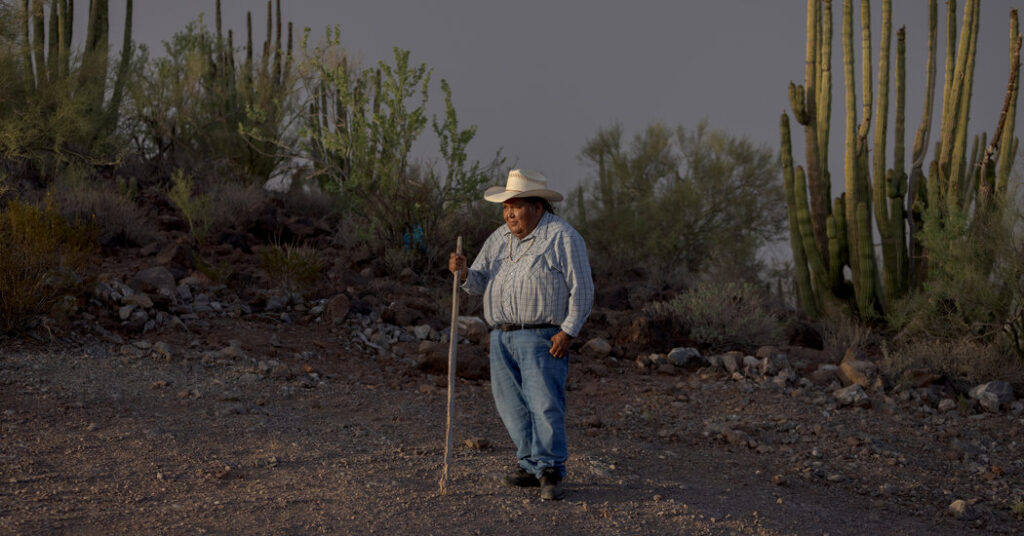
Leaning on a dried saguaro rib for support, Mr. Jose walked to an overlook and gazed out. Far below, the old steel border fence faded into desert scrub, almost out of sight.
Bora Erden contributed reporting.
The post To a Binational Tribe, Trump’s Border Wall Feels Like Betrayal appeared first on New York Times.