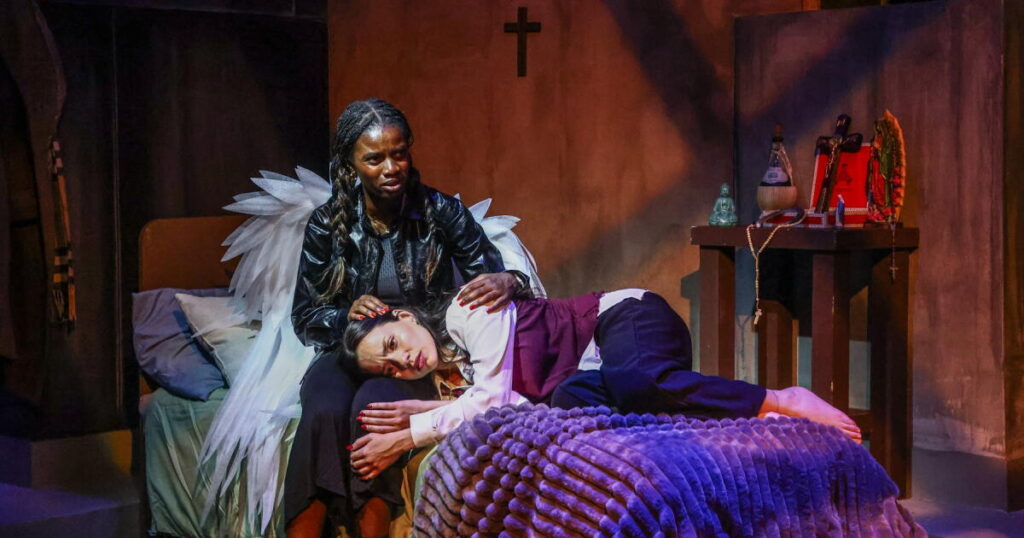
José Rivera’s “Marisol” came out around the same time as Tony Kushner’s “Angels in America,” and both plays, vibrating with millennial anxieties, carry the earthly battle for human survival up to the heavens.
There’s a dramatically prominent Angel (Taylor Scott) as well in Rivera’s drama, now in an Open Fist Theater Company revival at Atwater Village Theatre. This celestial warrior has been protecting Marisol (Jade Santana) without her knowing it throughout her life. Marisol, referred to by a publishing colleague as “Miss Puerto Rican Yuppy Princess of the Universe,” still lives in the Bronx and is assailed by dangers just getting to and from work every day.
After an incident on the subway with a deranged man threatening her with a golf club, Marisol returns to her cramped, noisy apartment to learn that her guardian angel is abandoning her to enlist in the battle to replace a senile God, who (to judge by the ailing state of the universe) has grown too old for the job.
Marisol will have to fend for herself in New York, a dystopian landscape where crime is rampant, poverty is pervasive and the unhoused are threatened by roving gangs of Nazi skinheads who set them on fire for kicks.
What follows is a modern picaresque journey, in which a clever underdog has to rely on her wit and wiles to survive a corrupt and perilous world. Rivera’s play, which won an Obie Award, caught fire in its 1993 New York premiere at the Public Theater with its theatrical street sense, savage imagery and Puerto Rican-inflected magical realism.
The apocalyptic fears boiling up in the play are perhaps even more acutely felt today, with the ravages of climate change compounding each year and the threat of AI hanging an existential cloud over our heads.
But what’s most satisfying about this reencounter with “Marisol” is seeing a new generation embrace the play’s kinetic freedom. Rivera, who received an Oscar nomination for his adapted screenplay for the 2004 film “The Motorcycle Diaries,” solidified his reputation with this play after his breakthrough work “The House of Ramón Iglesia.”
Director Amanda Weier and her company approach “Marisol” as though it were a new play. The quicksilver changes of scene in this urban hellscape are handled with crisp dispatch. Subway cars and burned-out streets don’t require much in the way of elaborate illustration for the overhang of menace to be felt.
Occasionally, particularly in the early going, the blocking and Christopher Moscatiello’s sound design seemed to be working at cross-purposes. The production’s adventurousness, traversing every corner of Brad Bentz’s scenic design, can have a diffuse effect.
But the clever props design (Bruce Dickinson and Anna Krause) fills in any shoestring gaps. And Mylette Nora’s costumes artfully conjure both the underworld and the spiritual realm.
Santana’s Marisol, likable yet spiky, anchors the revival. Her interactions with the golf club maniac (Matthew Goodrich) and the scarred homeless man (Hutchins Foster) are fearfully intense, as they should be.
Grace Soens, who plays June, Marisol’s confederate at work, and Jack Sharpe, who takes on the role of Lenny, June’s mentally disturbed brother, expand this unstable world, where it’s hard to know who to trust.
“Marisol” is rife with ambiguity. One of the biggest questions is whether Marisol is dead or alive. But the surreal reality extends to the map of New York. Marisol can no longer tell if she is heading north or south. And the number of characters wielding golf clubs as deadly weapons raises the concern that the villains are interchangeable — and that the good guys have all fled.
One thing that’s certain is that Marisol will have to take up the fight for her own future. With no one left to protect her, she’s learning to look after herself and those she cares about. To become, in other words, the hero that’s needed to turn this momentous struggle around.
The post José Rivera’s ‘Marisol’ brings the apocalyptic fight to a new generation in Open Fist’s revival appeared first on Los Angeles Times.