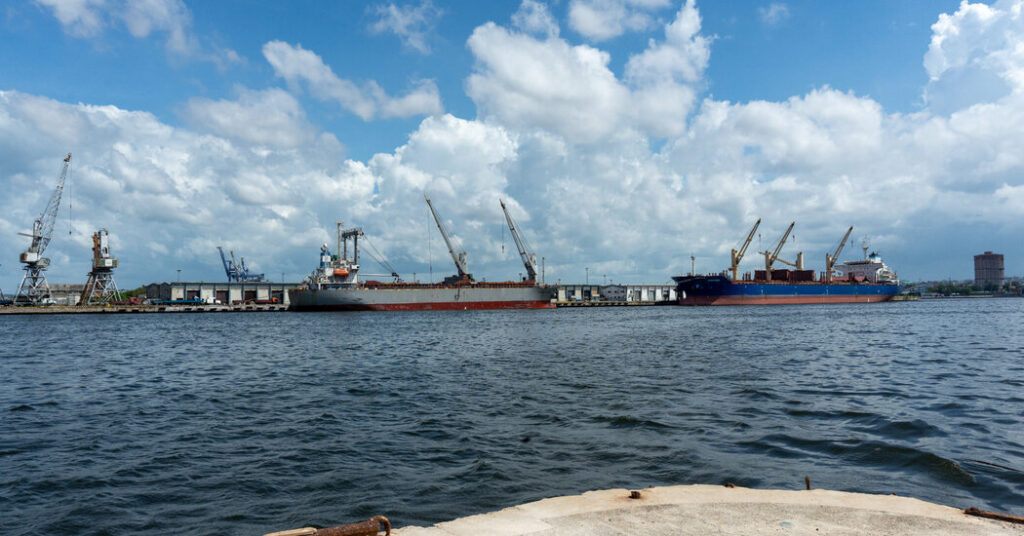
Thousands of containers filled with food, medicine and other goods bound for Cuba have been stranded throughout the Caribbean since two shipping giants stopped deliveries to avoid tough U.S. sanctions, according to diplomats, Cuban officials, merchants and others involved in the imports.
The containers stranded in various ports include humanitarian aid, from solar panels to medication to colostomy bags. Dozens of containers of aid purchased by different United Nations agencies are among them.
U.S. sanctions have also hobbled shipments by air, and forced the World Health Organization to scrap planned deliveries of cancer drugs.
The challenges of delivering vital materials have sharply aggravated longstanding shortages, added to an enormous backlog of patients awaiting surgery and sent grocery prices soaring as Cubans live through the island’s worst humanitarian crisis since the 1959 revolution. With food becoming prohibitively expensive, hunger is rising and soup kitchens are struggling to fill the gap.
The Trump administration has imposed an economic vise on Cuba and its ruling communist party to try to force political and economic change.
In January, the administration imposed an oil blockade on the island. Then in May, it cranked up the pressure by announcing that foreign companies working with certain Cuban state entities risked having their assets frozen and being locked out of doing business with U.S. companies and banks.
Shortly after, Hapag-Lloyd, a German shipping company, and CMA CGM, a French one — which experts say together delivered at least half of Cuba’s imports, including most of its food — quit delivering to the island.
The development adds another layer of misery for Cubans already struggling under daily blackouts, fuel and food shortages and a collapsing health system. It also puts more pressure on the Cuban government as it tries to survive the Trump administration’s pressure campaign.
Dr. Valia Rodríguez, a Cuban doctor in Britain who runs a charity called Aid for the Caribbean, said a Hapag-Lloyd container her organization filled with more than $500,000 worth of resuscitation kits, colostomy bags and intravenous tubes left Northern Ireland in April. It arrived at the Port of Mariel in Cuba on June 4, a day before the new sanctions aimed at foreign companies went into full effect.
“They decided to stop unloading the containers,” said Dr. Rodríguez, referring to Hapag-Lloyd.
The containers were instead sent to Panama, where the charity says it has had to pay more than $6,000 in storage fees, as patients who have had colon surgery turn to desperate measures. “Right now, people in Cuba are using shopping bags, because there are no colostomy bags,” Dr. Rodríguez said.
Spare parts from a dismantled power plant in Uruguay, donated to Cuba by the South American nation’s state-owned power company, have been unable to leave because no shipping line will take them to the island, according to diplomats. Cuba has suffered at least five nationwide blackouts this year as its aging power grid repeatedly collapses.
Though the U.S. government has explicitly stated that its sanctions are not intended to prohibit the delivery of food and medical supplies, Francisco Pichón, the U.N. coordinator in Cuba who runs its humanitarian response, said sanctions were jamming up the organization’s relief effort because shippers were wary of taking any chances.
“We are facing something very real, which is a phenomenon called ‘overcompliance,’” Mr. Pichón said. “Overcompliance is a really excessive precaution from companies to not expose themselves to sanctions.”
As of last week, the U.N. humanitarian relief effort was still awaiting delivery of 30 containers holding water treatment kits, antibiotics, contraceptives and pregnancy tests.
A lack of jet fuel has also decimated air traffic to Cuba, shutting off another cargo delivery route.
Despite months of attempts, thousands of donated vials of a cancer drug called doxorubicin failed to reach the island after several airlines stopped flying to Cuba, according to the Pan American Health Organization.
The World Health Organization said tuberculosis medication it purchased from an Indian pharmaceutical firm meant to leave by air via D.H.L. was returned to the manufacturer in May without explanation. Other humanitarian aid shipments had to be airlifted on special charter flights, U.N. agencies said.
Businesses have considered routing their cargo through the United States because shipments are still coming from there. But the cost of the extra shipping more than doubled the price of cheaper products like rice, making much of it too expensive to sell in Cuba, a person involved in Cuba business trade said, speaking on the condition of anonymity to protect business operations.
Business owners have been debating whether to abandon their cargo in foreign ports, the person said.
The State Department, has said that sanctions hold the “corrupt” Cuban regime and its financial backers to account, including GAESA, the military conglomerate that controls large parts of the island’s economy.
In a statement to The New York Times, the State Department said the government’s “blatant kleptocracy” and its economic mismanagement directed scarce resources for the benefit of officials, the military and the intelligence apparatus rather than the Cuban people.
“Our tough Cuba policy restricts financial transactions with entities owned or controlled by Cuban security services in order to cut the regime off from resources used to line its pockets and violently oppress the Cuban people,” the statement said.
Secretary of State Marco Rubio told reporters in September that “if Cuba is a humanitarian disaster, it is because their regime is a disaster, because the economic model they follow doesn’t work.”
Rodolfo Benítez Verson, Cuba’s ambassador to the United Nations in Geneva, told the U.N. Human Rights Council last week that more than 7,000 containers bound for Cuba were stranded.
“The cruelty knows no bounds,” Mr. Benítez said. “They will have to answer to the Cuban people, and they will not be forgiven.”
Hapag-Lloyd, the German shipping line, said in a statement that it had made a “business decision” not to continue the Cuba maritime route and that it was working toward a “swift and practical solution” for the cargo.
CMA CGM, the French company, said in a statement that it had resumed limited services of “compliant cargo” to the island, such as agricultural products, medicines and medical devices.
Given the scale of the backlog it would take months for all the containers to reach the island, businesspeople, diplomats and humanitarian workers said.
The People’s Forum, a left-wing organization based in New York, said it had three containers stranded with roughly 1,000 solar panels costing over $750,000 meant to power hospital intensive care units. Purchased in Mexico, they are now stuck there, said Manolo De Los Santos, an organizer with the group.
“The bigger thing for us is the anguish of knowing there are literally surgical rooms without electricity and 100,000 patients waiting for surgeries,” he said.
The Cuban government, in a new report detailing the effects of the U.S. oil blockade, said 100,000 patients were awaiting operations, including 12,000 children.
With few viable commercial shipping routes available, exports to Cuba have plummeted.
Brazilian and Mexican exports to Cuba were both down over 90 percent in July compared with the same month last year, according to Brazilian and Mexican government official statistics.
“Up to two-thirds of the overall container shipping capacity has disappeared,” said Gordon Wilmsmeier, a professor of shipping and global logistics at Universidad de los Andes in Colombia.
It has become so difficult to ship supplies to Cuba that some sympathetic nations have turned to their militaries. Mexico, which stopped shipping oil to Cuba in January after President Trump threatened tariffs, used Navy ships to deliver items like thousands of tons of rice and beans, as well as bags of powdered milk. The Brazilian Air Force flew in shipments of powdered milk.
Celso Amorim, a top foreign policy adviser to President Luiz Inácio Lula da Silva of Brazil, said in an interview that Brazil would like to provide Cuba with fuel and more aid, but is wary of Washington’s reaction.
“This is part of the reality of the present world,” he said. “It’s complicated. Every company here — even state companies or quasi-state companies — have interests in the United States, and they are afraid of being affected.”
At markets in Havana, the price of frozen chicken has doubled in recent months, while the price of a carton of 30 eggs has tripled to $11 — higher than the average monthly salary.
Food prices increased 60 percent from January to August, according to Omar Everleny Pérez Villanueva, a Cuban economist.
Soup kitchens have proliferated in Havana, the capital, but are running short of goods.
Quisicuaba, a state-linked religious nonprofit that, said it was waiting for five food containers. The quantity of chicken and eggs has dwindled, said Luis Enrique Alemán, who is in charge of Quisicuaba’s kitchen supplies.
“Such a drastic reduction in supplies forces us to work miracles and rethink our recipes,” he said.
Amid hundreds of people waiting to fill plastic tubs with food, Carmen Carballo García, 66, sat on a bench while her 5-year-old granddaughter, Yaquelin, sucked her thumb.
“The doctors tell me she is underweight,” Ms. Carballo said. “She needs milk, but she doesn’t have any.”
Jack Nicas contributed reporting from Brasília.
The post Trump’s Economic Vise Leaves Cubans Desperate for Food and Medicine appeared first on New York Times.