Gustavo Dudamel has been conducting the New York Philharmonic for just a week, and it already feels like a different orchestra.
The players look as if they’re having more fun, and they’re performing with an excitement that the audience seems to share. The vibe is good; this is a refreshed Philharmonic for New York in the year of a spirited young mayor and the Knicks in five.
For weeks, ads on the street and in the subway have declared “OUR NEW ERA STARTS NOW.” Dudamel’s face is all over them, but now that he has arrived as the orchestra’s music and artistic director, he is also all over town himself, with a barnstorming Philharmonic tour of Manhattan.
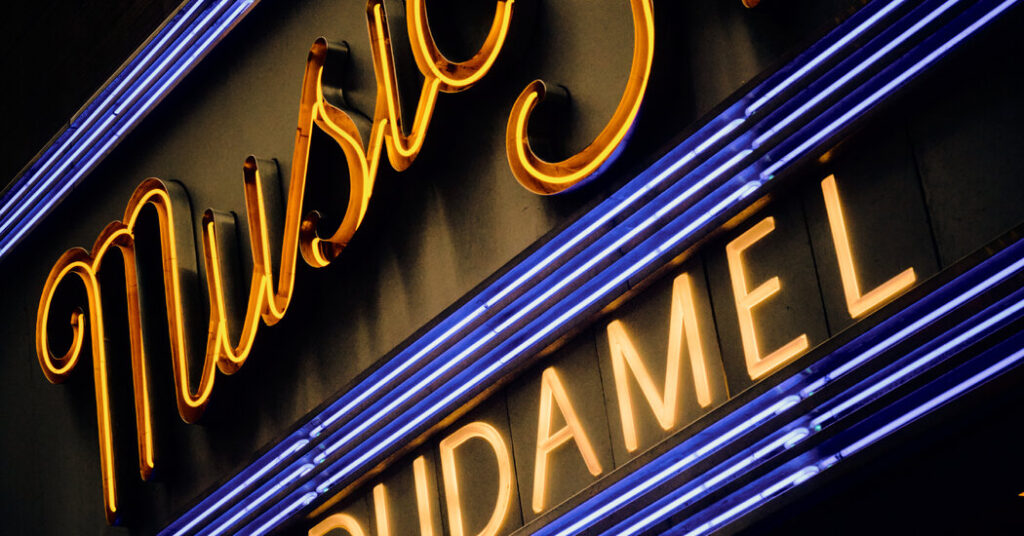
He started at Radio City Music Hall last Thursday with an audience of about 6,000. The next afternoon, he led an intimate, commemorative concert at the World Trade Center for the 25th anniversary of Sept. 11. You would be forgiven for thinking the Philharmonic had no home if it hadn’t arrived, finally, at Lincoln Center on Wednesday for its first Geffen Hall concert of the season.
That’s three distinct programs, in the time an orchestra would usually perform one. And there are several more to come in the next two weeks. Try to keep up.
Each concert has sent its own message about the Philharmonic’s future under Dudamel. At Radio City, symphonic music shared the stage with pop singers; at the Perelman Performing Arts Center, the orchestra served as a solemn civic ensemble; at Geffen Hall, the program was equal parts contemporary and classic.
In other words, don’t expect business as usual. And think of orchestral music more as a medium than a genre. That belief defined Dudamel’s tenure at the Los Angeles Philharmonic, his last ensemble, where he built his reputation as a superstar conductor with joyous charisma but also with a real vision for how, and for whom, music is made.
His celebrity side, fittingly, was the focus at Radio City. The actor Liev Schreiber, hosting the event, paid tribute to the Philharmonic’s rich lineage of music directors, invoking Gustav Mahler and Leonard Bernstein but, tellingly for the orchestra’s bland recent history, stopping at Zubin Mehta, who left in 1991.
Radio City is a fun place to hear the Philharmonic, but not a good one. Amplified, the orchestra sounds more like a Broadway pit band, with tinny strings and extremely bright percussion. The less complex and subtle the music, the better for this hall, and Dudamel programmed accordingly: a yo-yo of alternating symphonic pieces and miniature pop sets by St. Vincent, Joaquina and Lizzo. (Aaron Tveit also joined for a few show tunes, starting with a rhythmically derailed “Something’s Coming,” from “West Side Story.”)
Dudamel was very much the main attraction. He received a standing ovation the moment he stepped out onstage, and each singer shared congratulations with him. He mostly stayed quiet, though, but through Radio City’s large screens you could see his conducting up close: the pleasure with which he channeled a score, without overdoing it, regardless of whether it was Philip Glass’s Concert Overture or Lizzo’s “Cuz I Love You.”
He was more subdued at the World Trade Center, leading Philharmonic string players in a program shared with the Soldiers’ Chorus of the U.S. Army Field Band. Dudamel is often animated, but here he also showed how minimal and efficient he can be; in Barber’s Adagio for Strings, he held all the music’s tension in his left hand, which trembled minutely like a tuning fork as he gestured to the players. The two ensembles came together for the premiere of Julia Adolphe’s “We the Living,” a lyrically simple and moving setting of a libretto by Safiya Sinclair, as well as Bernstein’s inspirational crowd favorite “Make Our Garden Grow.”
The Sept. 11 commemorations continued at Wednesday’s concert, which opened with John Adams’s “On the Transmigration of Souls,” written for the first anniversary of the attacks. Today, the piece is a bit of a time capsule. Hearing its fragments of text and recorded names and messages is like exploring a shoe box of old photos and newspaper clippings. But overall, it has aged well; always restrained, with a vertical score of harmonic space from which shards of memory emerge, it belongs firmly in the lineage of Charles Ives’s American collages.
Dudamel has a lot of experience with Adams and other living composers, too. You could tell from the premiere of Zosha di Castri’s “Invisible House” why he is one of the most vital custodians of contemporary works in mainstream orchestral music. “Invisible House,” inspired by Ukrainian folk songs and the poetry of Ilya Kaminsky, is intricate yet full of freedom, with instructions to the players like “don’t be shy,” “doesn’t have to be perfectly synchronized” and “not too perfect.” Dudamel encouraged a controlled cacophony, but also an exhilarating groove that gave way, by the end, to prayerful intimacy. At every turn, though, the music felt truly alive, organic and unpredictable.
To close, Dudamel led Prokofiev’s Fifth Symphony, with which he made his Philharmonic debut in 2007. Back then, he hadn’t started in Los Angeles but was already referred to as “the most talked about conductor in classical music.” That’s still the same, given his pop star status, but his ability at the podium has evolved. Certainly the orchestra performed the symphony better than it had in recent years, with satisfying unity in the strings and thrillingly shaped phrases that formed from the ground up and then burst and evaporated like a geyser. Dudamel’s sense of each movement’s broad architecture, not always a given with him, sensitively dosed tension and release, explosion and retreat.
The Philharmonic plays for Dudamel with visible investment and enthusiasm. Its members haven’t looked this happy onstage in years. Either he inspires them, or his starry arrival has lifted their morale. Or both. Whatever is going on, it works.
This month’s parade of programs isn’t realistic or sustainable for the coming months and years. But as the season settles into something more normal, even a fraction of this energy would be a welcome, heartening change for the Philharmonic.
The post Gustavo Dudamel’s New York Era Has Begun. Try to Keep Up. appeared first on New York Times.