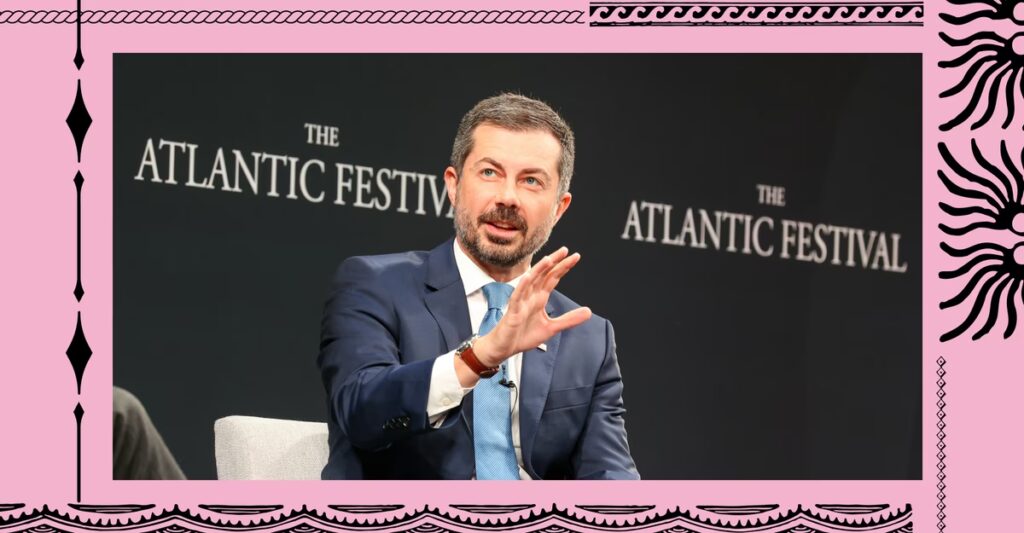
In a conversation at The Atlantic Festival with The Atlantic’s editor in chief, Jeffrey Goldberg, former Secretary of Transportation Pete Buttigieg warned fellow members of the Democratic Party to resist the urge to revert to “the previous status quo” if they regain power in the midterms.
It would be a mistake, Buttigieg argued, for Democrats to try to reverse “the damage” of the past two years of the Trump presidency by trying to restore the country to how it looked in 2022 or “whenever we think that America was great.” He said that Democrats instead need to build for the idea that “the next quarter century between here and 2050, which is kind of a make-or-break quarter century for the whole American project, is subject to very different conditions and problems than the ones that we inherited.”
Buttigieg—whom many analysts see as a potential 2028 presidential contender—offered examples of what that vision might look like. He called for banning gerrymandering and passing a constitutional amendment to address the deluge of money in politics. “This idea that it is somehow beyond our power to use what is probably the single most elegant feature of the Constitution, which is its capacity to be amended—right?—is a complete failure of ambition and imagination,” Buttigieg said.
When asked by Goldberg about the Democratic Socialists of America, Buttigieg responded that he thinks “there’s a temptation to imagine that being bold is the same thing as being kind of maximally ideological.” Sometimes it is the case, Buttigieg said, that the leftmost idea is the boldest. But other, more ideologically moderate projects may require “radical reform to our institutions,” he noted.
“I know the commentariat wants to get it all fixed on some left-to-center-to-right spectrum,” Buttigieg continued. “To me, what’s more interesting is: Do we have the right package of base hits and big swings, and are we going after both of them, at the same time, all the time?”
The following is an edited transcript of the conversation:
Jeffrey Goldberg: I want to get to the state of our civilization, but there’s this thing—and we’ve talked about this already—there’s this thing that’s been bothering me more than most things bothering me in the last few days. The fact that a Putin-aligned oligarch, extremely dubious past—as opposed to the oligarchs with a wholesome past—
(Laughter)
Extremely dubious past, funded openly—or not openly, it was discovered, but there’s no secret—funded a two-day celebration for the president of the United States’ son. And we were talking a little bit about how that seems fairly normal in our new reality, but if you actually step back a few years ago, in a Bush presidency, Obama presidency, and told somebody, Oh, yeah, the president of the United States’ kid’s wedding is being underwritten by a Russian oligarch, no one would believe that we’ve entered that level of dystopic reality. So my question is: How screwed are we?
Pete Buttigieg: Well, if I thought we were altogether screwed, I wouldn’t be doing this.
Goldberg: What would you be doing? Moving to Canada?
(Laughter)
Buttigieg: I guess.
Goldberg: I just want to know; he’s got access to different forms of transportation.
Buttigieg: Is that what giving up looks like now? Moving to Canada? No, I think it’s symptomatic of this bigger pattern we’ve been in where we stare down something that is completely unacceptable and then just move on. And in some ways, the big thing, the spectacular corruption, actually is harder to face. It’s like if you’re in Washington, D.C., and you walk up to the Washington Monument and you stick your hand on it and you look up—which, by the way, is a fascinating experience if you ever get the chance, because you can walk right up to it—but once you do that, you cannot make out the shape or even the size of the Washington Monument, right? Because it’s right there.
And when we have monumental corruption or monumental systemic breakdowns, I think it can have the same effect. Part of what I’m trying to do, as I travel the country, is insist that we’ve got to deal with a whole set of things that we’ve just been talking about being wrong for a long time. I’m not just talking about the near term, the recent shocking, spectacular forms of corruption, like what you mentioned about the wedding or the sentences that are coming out of our mouth, right? Half a billion dollars of crypto money from a foreign prince going to the first family, or the jumbo jet—I mean, we all know this list of things, right?
Goldberg: Or renaming a cultural center named after a martyred president for yourself.
Buttigieg: For example, and then shutting it down because—
Goldberg: Because you ran out of money.
Buttigieg: You couldn’t get your way. I mean, even that, right? He becomes chairman of the premier cultural institution in the country, and within two years it’s shutting down, right? But my point is there’s something broader, bigger, and longer in the making than even Trump and Trumpism itself. Like, if I said the system is broken, that’ll be the least memorable thing I said all day, right? “The system is broken” is a cliché. Everybody says it. Certainly every politician says it because it’s true. The weird thing is, we say the system is broken, and then we act as if it wasn’t. We go right back to normal and—
Goldberg: The system is broken. What’s for lunch?
Buttigieg: Yeah, right? Like, if you’re getting ready for a flight and the captain comes on and mentions in passing that the airplane is broken—
(Laughter)
You’re not going to stay on the plane, right?
Goldberg: So that’s one of the things you worked on as secretary of transportation, right?
(Laughter)
Was that a bigger problem than we know about? Because that would be really useful.
Buttigieg: No, but that’s the point, right? When lots of planes were crashing in the ’60s and ’70s and ’80s, we did something about it and developed this incredible, civilizational achievement of aviation safety, because we didn’t think it was acceptable to have that happen. And here we are in this political system where everybody knows that the role of money in politics, the unrepresentative nature of Congress, what the Supreme Court has turned into, is a huge problem. And eight years ago, when I was talking about things like Supreme Court reform—pretty lonely position—everybody was looking at me funny. Part of why I was doing that was not only because I believe in Supreme Court reform, but because I believe in elevating our ambition as a country when it comes to reforming things that are obviously broken.
And look, at a political level, most of the time, most of what people like me should be talking about is the fact that diesel is at the highest price ever recorded, and the fact that interest rates are higher because of the policies of this administration, and the fact that most of us are paying higher health-insurance premiums because of what the Republicans are doing. But the reality is, those kitchen-table issues have become intractable, because you’ve got this political system kicking the legs out from under the kitchen table. And when people see that day after day after day, then when they see some cases of spectacular corruption by the first family, it’s just all part of that wash of low expectations that we’ve come to have for our politics and our system.
Goldberg: Is the system broken, or are people broken?
Buttigieg: The system is more broken than people.
Goldberg: But when I say people, I mean specific people, like the members of Congress.
Buttigieg: Okay, well, some of them. But here’s the thing.
Goldberg: I don’t mean our audience. They’re not broken. They look great.
Buttigieg: It would be an extraordinary run of bad luck if all of the people that we have elected to Congress over the last few years just randomly turned out to be terrible people, right? That would be just statistically—
Goldberg: You say that like that’s science fiction, but I don’t know, I mean, but it doesn’t sound that incredible to me either.
Buttigieg: Either something about the system makes people worse, or something about the system is actively selecting worse people, right? It’s not just bad luck, right? And I say this having dealt with the United States Congress quite a bit, and you can see how even people who start out good are incentivized to become less so over time. You sit in a committee hearing and it’s basically a content farm now. You go in hoping to have some legislative progress, and they look at you and tell you you’re right, and then explain why it’s never going to happen. So we can keep wondering why the people who our system produces and pushes into leadership are deeply flawed, or we can do something to create a system where it’s better than that.
Goldberg: I’m focusing on Congress because Congress has abdicated its oversight responsibility to a large degree. The judiciary is—put aside the Supreme Court for a second; you do have federal judges checking executive power. But Congress, in its current form, ain’t. So what do you do?
Buttigieg: Get a better Congress.
(Applause)
Goldberg: If you were king.
Buttigieg: Let me explain what I mean. Yeah, obviously, in the near term, what I mean is elect better people to Congress, which is why I’ve been to most U.S. states at least once in the last year and a half, trying to campaign for people who I think would make better representatives in Congress than the ones that we’ve got. So there’s that. But what I really mean is: Design a better Congress. For example, one way to make sure that you get better and not worse people in a job is to have a very competitive hiring process. We have 435 seats in the House. Roughly 40 of them are competitive, which means nine out of 10 congressional races are races where you pretty much know who’s going to win before the first vote is even cast. In a 50/50 country, right? Which means it is not an authentic, competitive process.
Goldberg: It is the most cost-effective job-protection system ever devised.
Buttigieg: Yeah. So we ought to ban gerrymandering nationally. We ought to ban gerrymandering.
(Applause)
And the last reason to have any hesitation about doing that fell when they gutted the Voting Rights Act in the Callais decision, because there was, up until then, an argument that, Look, because these states are badly gerrymandered anyway, the only way we’re getting minority representation is to protect minority districts. Now the Supreme Court has basically established a de facto right to partisan gerrymandering. We can have a law that changes that, right? The role of money in politics, obviously part of the problem here. These are not things that are completely beyond our power to deal with.
Goldberg: Well, the Supreme Court has basically said it’s beyond your power, on the role of money in politics.
Buttigieg: Right. So we should have a constitutional amendment on that.
Goldberg: And is that realistic?
Buttigieg: We’ve had 27.
(Laughter)
Goldberg: Not lately, though.
Buttigieg: We had a—
Goldberg: Stopped doing it.
Buttigieg: We had a constitutional amendment so that you couldn’t have a drink. And then, like, 10 years later, we thought that was dumb. And we changed it with another constitutional amendment. So this idea that it is somehow beyond our power to use what is probably the single most elegant feature of the Constitution, which is its capacity to be amended, is a complete failure of ambition and imagination.
(Applause)
There are some other things we can do in the meantime. I was in Montana helping gather signatures for an effort called the Montana Plan, which is using, because of what the Supreme Court has said, instead of setting it up as a regulation on speech—since the Supreme Court has said that, you know, money is speech and corporations are people—you go to the fact that corporations only exist as a function of state law, and corporations actually in state law don’t have rights; they have powers, and those powers are enumerated.
And so in the law that makes corporations exist, you just have a feature in there that basically says, You don’t get to be a corporation if you are using your Treasury dollars to manipulate elections. That’s one example of something that is designed to have an effect while we don’t yet have a constitutional amendment. Think of it this way: Citizens United came down, I believe, in 2010. So if the counter to a constitutional-amendment process is That could take 15 years, well, if we’d started in 2010, we’d be there, right? This is a level of ambition I think we need to have, or else every time we’re trying to make sure that more people can get health insurance or the minimum wage, which hasn’t been raised, I think, since 2009 or 2007, actually goes up—or any other outcome which a majority of Americans already agree—we’re going to keep getting frustrated.
Goldberg: I want to ask you something about an even deeper structure. You know, James Madison had a lot of fears, which is why he designed the system we have. James Madison feared that the rise of the daily newspaper would sink democracy, because the once-a-day addition of new information into the human brain was too much for people. You couldn’t go from emotion to reason before new information came the next day. We’re beyond that now.
(Laughter)
We’re well beyond that. And so the question is—it’s a cognitive question. One of the tricks of the Trump administration is to do so much so quickly that you reach overload. The other part of this is, in the social-media environment in which we have, is it irrational or a sign of poor character for a member of Congress to say, You know what, I’m not going out on a limb, because I’m going to get 10,000 death threats a day on social media, and I exist in that content farm, in another form of that content farm. So what do you do to reintroduce the possibility, the space for reason, logic, contemplation?
Buttigieg: I’ve come to realize that we have different levels within us of thinking, of consciousness. And part of the problem with social media is that it speaks to the lizard brain, right? Kind of the least contemplative of our levels of thinking. And there’s no question that the system of rewards and punishments that is kind of dominant in the digital world is not healthy for politics. But that is not the only realm where we can practice politics. So one thing that we can do more of is engage in actual spaces—real, physical spaces where people are actually in a room. And politics is often at its best when the public square is physical. I think about it in terms of how I travel, just when I’m walking around town or going through an airport. And 99.9 percent of people who come up to me are very positive. And that includes some people who say, I don’t agree with you politically, but it’s nice to see you. They’re just kind of excited to see somebody they recognize.
Goldberg: Having a human interaction.
Buttigieg: Yeah. And it’s not because obviously I have 99 percent support. I know this is a divided country. What that tells me is most people in an actual 3-D interaction aren’t assholes, right?
(Laughter)
Very different from how it is online. So I think one very simple thing is to try to cultivate and create more spaces and environments where those interactions happen. That’s in-person convenings, that’s the public square, that’s third spaces, that’s building social capital around existing physical spaces that bring people together, like schools.
It’s also something that is part of why I believe in ideas like national service, creating more opportunities for service. Because when I was in the military, that was definitely an environment where I was side by side with people that I had wildly different political values from, and we quickly learned to trust each other with our lives. And part of that had to do with the extreme pressure of being in a war zone. But part of that just had to do with the fact that this group of people was thrown together and tasked with doing something hard. You know, not everybody needs to be in the military for that to be available to more people. It’s why I think a voluntary but ultimately universal opportunity for service would do a lot of good. It would just rewire our brains in a healthier fashion.
Goldberg: The answer to Is Donald Trump a symptom or a cause? is both. Yeah, obviously. The question is what percentage is symptom and what percentage is cause? Is it possible to disaggregate that?
Buttigieg: I think of it in terms of the broad symptoms and then the cause of some acute problems. So the symptom stuff—this is what I’m getting at with my systems and reform talk: that if the economic and political and social systems in this country were working, we wouldn’t be here. You don’t get a guy like Trump just out of nowhere, right? So, that’s the evidence.
Goldberg: Let’s pause on that. What system in particular, or what aspect of the system would have—I don’t mean the cultural system, rise of reality TV and social media—but what part of the system would have stopped this?
Buttigieg: The part I think is worst is the part where in a supposedly representative system of government, people reach consensus, or at least overwhelming majority, that certain things should happen, and then they don’t. That is lethal to people’s confidence in their political system, and it leads, sooner or later, to a pattern where they say, You know what? I’m just going to vote to burn the house down because none of this is working. By the way, just a quick political digression here—it is really interesting that most of those big kind of two-to-one things are actually things that are Democratic positions in Washington. So if I think about, like I mentioned earlier, raising the minimum wage—raising the minimum wage at least to $12 is something a majority of Republicans believe we should do. Background checks on guns: 70, 80, 90 percent. Eighty percent of Republicans, gun owners, think we ought to at least do that. Tax fairness, where the wealthiest people are paying at least as much in their taxes as a percentage as a firefighter—overwhelming majority.
And what I’ve realized is we’re actually—Democrats are still getting used to being on the right side of the American public on a lot of issues. Because when I came of age, right—like now, everybody’s pretty much with us on taxes and health care—you know, when I came of age, we were on defense about things like the death tax and welfare reform and all of that. And my first time ever on the ballot was 2010, when Obamacare was the toxic issue that killed the Democrats, right? Now it is the winning issue for Democrats. So some of this is new, and I think Democrats aren’t used to that. But my bigger point is you have all these things where there’s actually two-to-one agreement among the American people on what to do. By the way, even immigration—this is true—the broad framework of a grand bargain on immigration that’s been there the whole time, and then nothing like that happens in Washington. That breeds a kind of cynicism that I think leads you to a guy like Trump.
But then back to the cause part. Even a guy like that didn’t have to do things like this. Like, you could imagine some disagreeable populist leader who is presented with the possibility that AI may threaten the continued existence of the human species and does not decide to call that a hoax. It really matters that we happen to have a president who does. Or if you think about what’s happening, if you’re imagining the calculations that are going on in Beijing right now, or Moscow, obviously they are preparing to take advantage of some specific issues that are attached to having a specifically unstable person running the United States of America. And that’s not just some, you know, world historical force. That’s the particular misfortune we have of being led by this particular man at this particular moment.
(Applause)
Goldberg: Right. They’re clapping for instability.
(Laughter)
I want to come back to the global picture in a second, but stay on this interesting subject of the Democrats. There’s been a switch, you’re right. Mainstream Democratic positions are, generally speaking, the more popular positions. How are the Democrats going to mess up in the next two months so that they don’t take Congress back?
(Laughter)
Buttigieg: Look, I feel really good about the tailwind that we have in the next two months. I was just in Tucson, Arizona, where I think JoAnna Mendoza, who’s a Marine drill instructor and a mom, is going to defeat the Republican congressman there. Then we were in southern New Mexico, where we have Gabe Vasquez, extraordinary frontline Democrat. I think he’s going to earn reelection. Just last night, I was up in Tarrytown with Cait Conley, West Pointer, [who] I think is going to defeat Mike Lawler. We have great candidates running great campaigns. What could go wrong? Two things. Well, lots of things could go wrong between now and the election. I’m mostly trying to make sure—obviously I spend all day, pretty much, when I’m campaigning, trying to make sure things go right at the election.
What about after the election? Two things I think would be a terrible mistake. One is to revert to the status quo, the previous status quo. I really think that’s going to be a strong temptation to say, Okay, we’re in; we’re going to reverse the damage. You hear the phrase reverse the damage, right? Which is understandable because the damage has been horrific. But the implication of reverse the damage, if that’s going to be our mantra, is, Okay, we’re going to put all these things back just the way they were, and we’re going to give you the world the way it looked in 2022 or 2012 or 1994, or whenever we think America was great. And that’s not going to work. So we’ve got to make sure we resist the temptation to be restoring some previous status quo and build for the new reality that we’re in, with the next quarter century between here in 2050, which is kind of a make-or-break quarter century for the whole American project, is subject to very different conditions and problems than the ones that we inherited. The other thing that I think we need to do is keep it simple in terms of a legislative agenda. So I’ve been thinking a lot about these.
For example, one thing that the chattering class will get into right away as soon as there’s hopefully a Democratic victory, is what’s going to be H.R. 1? What’s going to be the big, telltale, Christmas-tree, signature bill that you put all your hopes and dreams in that signifies the priorities of the party and of the new Congress, right? To me, I would like to see, like an H.R. 1, 2, 3, 4, 5—like 10 or 12 dozen things. Stand-alone bills, clean bills, not this ponderous 2,000-page thing that tries to take care of every single thing, but a set of things that are needed, popular, and wise, and will make a difference to people, especially in being able to afford everyday life.
So, what does that look like? Restoring the child-tax-credit extension. That puts money back in the pockets of lower-income families trying to raise kids. Obviously, getting us out of a war in Iran that has everybody paying more for gas and diesel. Restoring the help on health care. By the way, also, on the tax side—so usually the revenue part’s unpopular, so you have to tuck that in with the spending part that’s popular. Right now, fixing the tax code so that wealthy tax cheats couldn’t get away with it or even truing up the rates to be a little more normal for wealthy individuals or for corporations—those things are popular on their own. Even if you didn’t staple it to how you’re going to spend the money, just the tax side alone is popular because it’s the right thing to do, and because everybody can tell there’s something wrong with the way things are going.
So to me, a rapid fire of clean bills to do these things that everybody—raise the minimum wage, right—these things that everybody knows we ought to do, that’s how we move forward. How do we go wrong? We get tangled up, get in our own way, make it super complicated, and people don’t feel like we’re doing what we actually, hopefully will have gotten elected on, which is making everyday life better, and in particular, making everyday life more affordable.
Goldberg: Talk about the DSA temptation.
Buttigieg: I mean, look, I think there’s a temptation to imagine that being bold is the same thing as being kind of maximally ideological. To me, sometimes that might be true; sometimes the boldest idea maybe is the leftmost idea. Sometimes I think we’ve reached a point where actually, what I would consider to be kind of ideologically moderate projects—like everything I mentioned, is kind of moderate by definition because two-thirds of Americans want to do it—requires some radical reform to our institutions. And so there are big swings we need to be taking with some of the ones I talked about on reform in the Supreme Court and money and politics and gerrymandering, but also big policy swings, right?
I mean, eight years ago, the whole Democratic primary fight in the debates that I was in was about was universal health care going to become mandatory or was universal health care just going to be optional? And not much has changed since then, right? So we also just need to have a higher level of ambition. To me that’s the most interesting thing. I know the commentariat wants to get it all fixed on some left-to-center-to-right spectrum. To me, what’s more interesting is do we have the right package of base hits and big swings, and are we going after both of them at the same time all the time?
Goldberg: In the few minutes we have left, talk about the fact that we’re already in World War III and don’t even know it, and while we’re in World War III, the president of the United States is making enemies out of our allies.
Buttigieg: Yeah.
Goldberg: Discuss.
(Laughter)
Buttigieg: Another essay question.
Goldberg: Yeah, you have four minutes—I mean, because this is the Alice in Wonderland cut. We’re trying to have a rational conversation about all the things that you could do to make the lives of Americans somewhat better, you know? And, we have a president right now who seems to want to go to war against Canada, which is a South Park episode.
I mean, the question is like, we’re having this conversation, but we’re living in a reality that is South Park.
Buttigieg: First of all, every time we see one of these things, we have to remember it doesn’t have to be this way. It doesn’t have to be this way. And politically, what I’m trying to do is connect these things that are happening around the world to issues at home. Because foreign policy always codes as this kind of high-minded, kind of elite concern. But the reality is, foreign policy and what’s going on in the world hits us at home in a million different ways. Like my neighbors in Michigan, you know, a year ago, nobody filling up the pump necessarily had to know or care what was going on in the Strait of Hormuz. It’s not your problem. Now you’ve got gas closer to $5 than $4 in Michigan. Diesel’s through the roof. This is a direct relationship right between what’s going on in the world and what’s going on at home.
I was talking with union members in the hospitality industry in Las Vegas, cocktail servers getting fewer hours. Las Vegas has one of the highest unemployment rates in Nevada; generally, in the U.S. Why? Well, one of the reasons is, pissing off Canada meant that Canadians who normally come to southern Nevada, especially in the wintertime, decided to take their money elsewhere, right? So there are these very direct effects on working Americans that happen when you have an absurd foreign policy, like we do. And the result is that it leaves us worse off in the near term economically at home, as well as, of course, the bigger, longer-term picture, which is, we don’t know exactly how and when we’ll need our allies next, but we know that we’ll need our allies. And having alienated them, it’s realistically going to take a generation to have the right level of credibility.
Goldberg: This is the question. I mean, let’s assume for a minute that, you know, there’s a Democratic president in the beginning of 2029. How much of what’s happened overseas is reversible and how much is just—I guess the biggest question is, are we, right now, undergoing a midlife crisis, a nervous breakdown, or are we facing a terminal illness? And if you’re sitting in Canada, Paris, London, South Korea, Japan, you’re asking yourself, I don’t know anymore about these people.
Buttigieg: Yeah, no, that’s definitely what’s happening. I’ve talked to leaders who—one, who just looked at me and said, “Look, the first time you guys did this, it was,”—this is of a U.S. ally,—“it was a blip. I thought of it as a blip. Now it’s a pattern and our country has to prepare.” And obviously, this scenario where you have a Democratic president next, everybody’s going to be saying, Okay, that’s great, you’re saying all the right things now. But, you know. what’s going to happen in four years? Which is exactly why reversible is not the word on my mind. I’m trying to purge my vocabulary of just about anything with the prefix re in it.
But, again, this doesn’t have to be 100 percent negative, because we’re entering into a world where the old patterns and institutions are not coming back. And a lot of those institutions were pretty rickety to begin with. The UN Security Council was set up at a time when the vast majority of people in China were impoverished rural peasants, right? Now, a middle-class city dweller in China arguably has a more technologically sophisticated everyday life than a middle-class city dweller in America. We’re in a very different world in terms of technology, in terms of competition, in terms of the security balance. And so we’re going to need to revamp—there I go, re again. We’re going to need to—I think reimagine is okay.
Goldberg: What about refried beans? How do you feel?
(Laughter)
Buttigieg: Ambivalent.
Goldberg: Just going out for fried beans from now on.
Buttigieg: But I think there’s an opportunity, so it comes back to what I was saying earlier. You know, interpersonally, my experience is you can build trust in a hurry if you are working together on something hard and important. That’s true for people. That’s true for countries. So in addition to the generational project of earning trust and credibility by just consistently doing the right thing and being a dependable friend and ally and a sober voice in the world, there’s also no shortage of very difficult things that we need to be, starting with the response to AI—no shortage of very difficult things where we need to be working with friends, allies, partners, and, in some cases, the whole world. And I think we can quickly earn trust, in the same way that the entire pattern of the U.S. being the most respected and indispensable partner—that was kind of the pattern of the second half of the 20th century—really was built up in a matter of just a few years of doing the right thing when it was really hard. I actually see in that an opportunity, precisely because of how bad it is. I see an opportunity to build something that is going to serve us well for the balance of this century.
Goldberg: We’ll find out.
Pete, we can do this all day, but we can’t, unfortunately. So, thank you very much for coming.
The post Buttigieg: Democrats Need to Get Serious About Amending the Constitution appeared first on The Atlantic.