The inside of an armored sarcophagus smells of gunpowder, gasoline, and gangrene. Remotely operated, unmanned ground vehicles, nicknamed MAULs, are revolutionizing casualty evacuations along the most dangerous sections of the Ukrainian front lines. They bristle with drone-jamming antennae and carry bulletproof black pods for carrying wounded soldiers to safety.
The MAUL goes in when other options have failed. After every rescue, it is cleaned and disinfected. Vitaly, call sign “Ash,” is a medical-evacuation coordinator with the 1st Separate Medical Battalion. (He asked to be identified only by his first name and call sign for security reasons.)
“You scrub and scrub,” he told me, “but the smell—it never goes away.”
I asked Ash what MAUL stands for. “It’s not initials,” he explained. “It’s a Star Wars thing—you know, Darth Maul? We’ve got a few nerds here.” The name is in all caps because the battalion’s stencil kit has only capital letters.
[Read: Ukraine’s short-lived comeback]
On the battlefield, these new machines have become priority targets for Russia’s drone pilots. They know that, for the morale of the Ukrainian crews coordinating rescues, losing a comrade in vivid detail on the monitors tracking the mission can be devastating. Russian operators wait until the wounded are loaded, then strike.
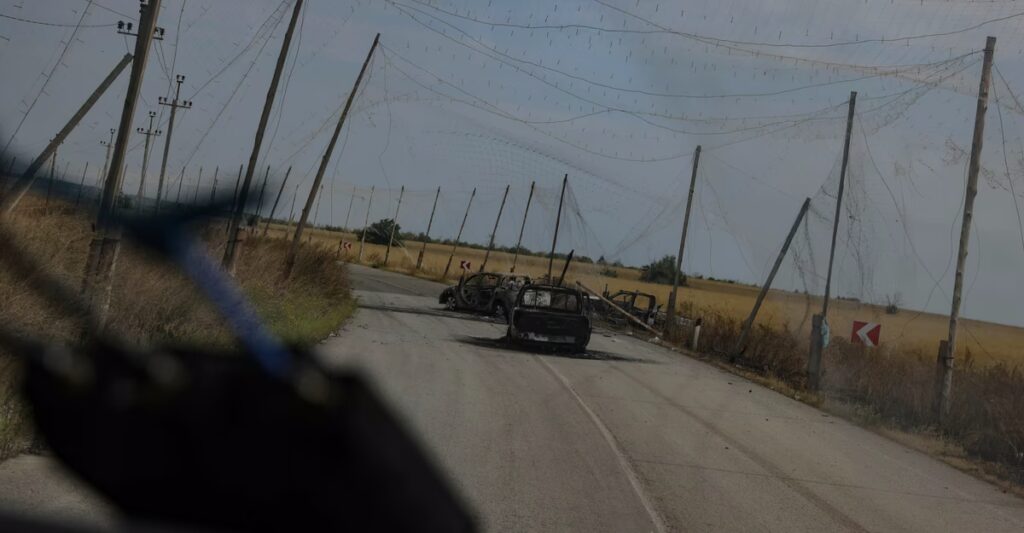
Aerial drones have created a death zone on the front lines, up to 20 miles wide, where anything caught in the open is likely to be struck. Unmanned ground vehicles began arriving in late 2024, mostly running resupply routes parallel to the front. But a mission in early 2025 proved that they could do more than this—that they were capable of reaching deep into the death zone to remove personnel. That mission began with a Facebook post.
In February 2025, near Kupiansk, Ukraine, a Russian advance trapped three Ukrainian soldiers from the 154th Mechanized Brigade behind enemy lines. All were wounded, two severely. For weeks, unit commanders attempted to pull them out. “We tried everything,” Kseniya Vynohradova, a veteran of the 154th who now leads an online support group for the unit, told me. Every effort failed.
“The brigade dropped supplies by drone,” Vynohradova told me, “but there was no way to get the guys out.” After a month of fending off Russian attacks and surviving on airdropped rations, the soldiers were ready to give up. Their wounds had turned gangrenous, and their chance of survival was near zero. “I did not know what else to do,” Vynohradova said, “so I turned to Facebook.”
The first person to offer hope was Viktor Dolhopyatov. In a secret facility in central Ukraine, he runs Burevii, one of the country’s most innovative defense-tech companies. Russian bombardments have shattered most of the windows, but this superficial damage, common to thousands of buildings across the region, offers a kind of camouflage. From here, Burevii has transformed the modern battlefield. When Dolhopyatov read Vynohradova’s Facebook post, he answered immediately: “Tell us more, we want to help.”
Burevii’s engineers were developing a ground drone at the time. It would need a few modifications for a mission deep into the death zone—anti-drone netting, software updates, and a trailer attachment to carry three soldiers at once—but it could be ready within days. Olha Garbovskaya had joined the company two weeks prior and threw herself into the mission. “We called our machine Ardal,” she told me, after a son of the Greek god of craftsmen and technology. With engineers still attaching its final pieces, Ardal was rushed to the front.
The rescue began at dusk, with daylight fading but temperatures warm enough to partially mask Ardal’s heat signature. From a command bunker, Burevii’s engineers watched the mission unfold. High-definition screens displayed a ground’s-eye view from the drone. Overhead feeds tracked Ardal’s route to the stranded soldiers, who followed its progress over their radio. Without warning, a massive heat bloom filled the infrared monitors in the bunker. Ardal had struck a mine.
“Our hearts sank,” Garbovskaya said. “The commanders told us we had less than a 1 percent chance of succeeding, and we feared they were right.” Over the radio, the stranded men responded stoically: “We can’t take any more—just finish us off.” They begged to be bombed by Ukrainian drones. The team from Burevii asked them to hold out a little longer.
“Give us 48 hours,” Dolhopyatov said. “We have another machine.”
The second Ardal followed a different path through the minefield, and overhead bomber drones scoured the route to clear suspected mines. Ardal finally reached the men’s trench. They emerged ragged and wounded, but alive. Overhead, Russian drones closed in. From the command bunker, medics offered encouragement over the radio: “Climb in fast—we’re getting you out.”
Ardal carried them to safety, under the watchful eye of Ukrainian aerial drones. In the command bunker, Garbovskaya surveyed the scene. More than 50 people—pilots, medics, electronic warfare crews, engineers—had all assembled to save three men.
For most of history, recovering injured personnel from an active battlefield has not been a military priority. If the wounded could not make their way to safety, they were left until the fighting stopped. Serious injuries almost always ended in death, and the ratio of wounded to killed was about 3 to 1.
During the First World War, evacuating wounded soldiers became its own professionalized combat discipline. Many injuries were still fatal, but the ratio of wounded to killed began to improve. By the time of the Vietnam War, the widespread adoption of helicopters and the doctrine of the “golden hour”—the narrow window in which medical intervention is most likely to save a life—drove the survival ratio to 5 wounded for every soldier killed.
During America’s wars in Iraq and Afghanistan, rapid evacuation and advanced medical interventions brought survivability to historic highs. For every American soldier killed in those wars, approximately 10 survived their injuries. But in Ukraine, the death zone has made rapid evacuation all but impossible. Survivability has fallen, with a wounded-to-killed ratio of about 5 to 1.
Units such as the 1st Medical Battalion are trying to change that. The old battlefield math held that in many instances, rescuing a wounded soldier required more resources and risk than could be justified for a single life. But Ukraine has opted for a different way of calculating.
[Read: Ukraine may be just the ally America needs]
The military has introduced a points system that assigns varying values to different missions, rewarding units with credits that can be traded for new gear and supplies. Under the “ePoints” scheme, a routine resupply run earns two to three points; a casualty evacuation earns upwards of 70. On today’s battlefield, saving a single Ukrainian soldier is worth more than destroying a Russian tank.
Inside the death zone, Ukraine’s trenches are so difficult to reach that medics have had to reimagine the golden hour. Wound treatment must be provided on-site, by fellow soldiers. There simply are not enough medics for every trench.
Andrii Fedoryshyn, call sign “Jared,” is a trainer with the 1st Med. “The best thing we can teach a soldier is combat first aid,” he told me. “It’s more important than knowing how to shoot.”
The numbers bear this out. Less than 1 percent of the injuries seen by the 1st Med are gunshot wounds, and a soldier is far more likely to be called on to aid a buddy than to engage with the enemy. Everyone near the death zone, even journalists, carries a tourniquet. Many soldiers carry two or more, in the event that shrapnel severs multiple arteries. Once immediate care is provided, the waiting begins.
“For a front-line soldier, evacuation can take weeks,” the deputy commander of the 1st Med, who asked to be identified by only his first name, Igor, told me. “We once evac’d a patient who had a tourniquet on for 33 days.” That soldier’s unit tried everything to get him out: six attempts, six failures, and multiple armored vehicles lost in the process. The decision was made to send in a MAUL. “He lost the limb,” Igor said. “But we saved his life.”
As battlefield resources, MAULs are severely limited. Still, they are treated as expendable. Soldiers’ lives matter more. On average, two MAULs are lost for every five lives saved. I asked Ash, the battalion’s evacuation coordinator, if he ever got sentimental about the machines. “They’re tools,” he answered. “We don’t get attached.”
The platoon commander, call sign “Devi,” interrupted. “Except for this one,” he said, pulling up a video on his phone. It showed a MAUL that had lasted 10 missions, surviving drones and mines and saving the lives of 11 soldiers. After it was finally destroyed, its operators compiled a tribute video and posted it online, endowing the dead MAUL with a small but devoted fan club.
Officially, the logo of the 1st Med is a coiled snake, the ancient Greek symbol for medicine. The MAUL drivers have an unofficial logo of their own: a coffin overlaid with a progress indicator. They call themselves the “Tomb Raiders,” because, as Devi explained, “we bring people back from the dead.” Hence the movie posters plastered around the bunker, featuring Angelina Jolie in her Tomb Raider role. Opposite a wall of monitors, a scantily clad Jolie is covered in stickers featuring the coffin-and-timer logo. Each one represents a life saved. “When we fill the whole poster,” Igor explained, “we’ll auction it off to buy more machines.”
As much as medics value their MAULs, the soldiers I spoke with hated them. “No windows, no ports,” one told me. “I would rather have less protection and see what’s coming at me.” Once sealed in, a patient’s only link to the outside is a single ray of light streaming through the hinge seam and an intercom connected to the medic.
On a range far from the front, I rode inside a new MAUL undergoing testing. The coffin-like pod was stifling, and the bumpy ride nearly shook the bones out of my body. “I understand why soldiers hate it,” I told Devi. He received the feedback like a bad Yelp review. “Fair enough,” he said, “but a soldier able to complain is a soldier who survived.” The overwhelming majority of those rescued by a MAUL live to talk about it.
In the command bunker, a casualty call came in: severe internal bleeding, with developing sepsis. A MAUL set off. Overhead surveillance drones tracked its progress as the bombers scanned the route for potential mines. Ash checked in via radio about the soldier’s condition.
From the overhead feed, we saw the MAUL stop at a tree line. Two Ukrainian soldiers emerged from the foliage. One helped load the other into the sarcophagus, sealed the lid, and disappeared into the woods. Inside the command bunker, a calm professionalism prevailed. No voices were raised, except for Ash’s; he spoke loudly into his headset so that the patient could hear him over the noise of the machine.
Midway through the eight-mile return journey, the electronic-warfare team detected a heavy Russian suicide drone, a Molniya, lurking overhead. The MAUL took cover, let the Molniya pass, then continued to the transfer point where a medical team awaited. As it approached the rendezvous, the Ukrainians spotted another approaching drone. “Three kilometers, closing,” came the call. The patient was quickly lifted into an armored vehicle, which sped off toward the field hospital.
Ash’s job was done. He took off his headset and slumped into a couch. In the dim light, I noticed for the first time that he was wearing Crocs. His T-shirt, a Polish streetwear brand, said Ghosh. I sat next to him, somehow exhausted even though I had done nothing but observe. Through the walls I felt the thump of nearby drone strikes. No one else in the bunker seemed to notice them.
I asked Ash what he did before the war. “Musical theater,” he said. “I was a performer.” I asked about his greatest fear as a combat medic. “Losing one of our guys en route,” he answered. Not seeing the gore of injuries, or wondering whether his bunker would be hit. His heaviest burden was the thought of a disabled MAUL, one of his patients trapped inside, unable to make it home.
“Has this ever happened?” I asked.
“Yes,” he said. “Twice.”
In the Russian military, by contrast, being wounded and abandoned is the norm. At a POW camp in western Ukraine, I spoke with several Russian prisoners of war. “I was wounded in the legs,” one prisoner, who asked that I withhold his name for fear of reprisal, told me. “There was no rescue—my own guys left me to die.”
The first medical attention he received was from the Ukrainian military. Reliable figures for Russia’s wounded-to-killed ratio are difficult to pin down, but conservative estimates place it at about 2 to 1, worse than the survival ratio of Russian soldiers during World War I.
At the foothills of Ukraine’s Carpathian Mountains, far from the front lines, lies a rehab facility for injured soldiers. I met Pavlo there, four months into his recovery from injuries sustained trying to rescue another soldier. He had successfully driven his truck to the pickup point for his wounded comrade when he was struck by a Russian drone. Shrapnel entered his abdomen, tore through his bladder, and broke his pelvis. Someone dragged him into a trench. Pavlo begged to stay there, remembering the wrecked and burning vehicles littering the road he drove in on. Over the radio, the medics insisted, “If you do not leave, you will die for sure.”
[Read: Ukraine planned to swarm Moscow airports with AI-guided drones]
At dusk, the unmanned ground vehicle came. Over the next three hours, the teams behind it—medics, ground-drone operators, bomber- and aerial-surveillance-drone pilots, and electronic-warfare crews—performed the intricate choreography needed to carry Pavlo to safety.
From the top of a Carpathian ski resort, under a cloud-dappled sky, Pavlo recounted every detail, from his failed attempt to rescue his fellow soldier to the moment he went into surgery. Every few minutes, we glanced skyward to scan for threats. We were safe, but such habits die hard. Pavlo would soon return to his new wife, and he knew that this would have been impossible without the ground drone and the humans who operated it, all working together to save this one soldier.
“I never met them,” Pavlo said. “A robot carried me, but people saved me. So many, just for me.”
He looked up again. “I don’t even know their names.”
The post The Armored Sarcophagus Saving Ukrainian Soldiers appeared first on The Atlantic.