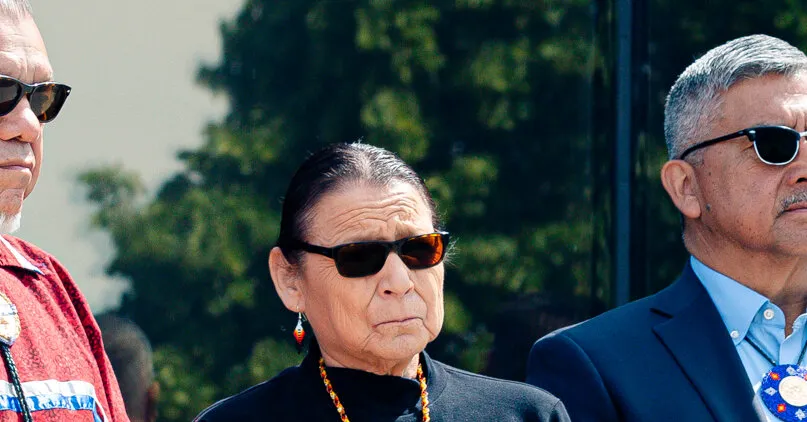
Tina Abrams was elected president of the Seneca Nation of Indians on Tuesday, becoming the first woman to be chosen as chief executive in the modern history of the largest tribe in New York State.
The election of Ms. Abrams was notable not just for the barrier it broke — one that has existed since at least 1848 — but for its larger symbolic significance to the Seneca Nation, a matrilineal society where women have wielded vast political power for centuries.
It also presents an opportunity to reset the often toxic dealings the nation has had with Gov. Kathy Hochul and other New York State officials, who have sparred for years with the Senecas over gambling revenue generated by the tribe’s casinos.
“It’s going to be one woman from western New York negotiating with another woman from western New York,” said Lori Quigley, an enrolled Seneca and professor of leadership and policy at Niagara University. “I think it will go an awful long way.”
Ms. Abrams, who has been an elected member of the tribe’s 16-member governing council since 2001, will be formally sworn in on Nov. 10, replacing outgoing President J.C. Seneca, officials said. The nation’s presidents must leave office when their two-year terms end but can run again in subsequent, nonconsecutive elections.
In a Facebook post from her campaign after she won the Seneca Party’s nomination in September, Ms. Abrams called for unity and said she would “move forward with communication and transparency.”
The message was widely interpreted as a reference to the previous administration’s penchant for secrecy, including in its often contentious dealings with state officials over the tribal casinos.
Politically, Ms. Abrams benefited from roots in the two main territories of the Seneca Nation — Cattaraugus, where she grew up, and Allegany, where she and her husband raised three children and have lived for 40 years. She is seen as pragmatic but media shy, and deeply experienced in Seneca government after a quarter century on the council.
Ms. Abrams did not immediately respond to requests for comment about the election, which coincided on Tuesday with the U.S. midterm elections.
She now leads a Native nation that has long placed women at the center of its identity. Clan affiliation is passed down from mothers to their sons and daughters, and only those children born to Seneca mothers can become enrolled tribal members.
Even so, women were not allowed to participate directly in elections until relatively recently. The were barred from voting and holding public office when the Seneca Nation adopted a constitution in 1848. After gaining those rights in the mid-1960s, they have held every elected position except the presidency, according to Rebecca Bowen, the Seneca Nation’s archives manager.
Leslie Logan, an enrolled Seneca and co-host of the “Seneca Citizens Podcast,” said Ms. Abrams’s ascent to the Seneca Nation presidency “just feels like a long time coming.”
As president, Ms. Abrams will be tasked with addressing a range of issues, such as directing more resources into traditional cultural education and language instruction, dealing with substance abuse in the territories and meeting a soaring demand for housing.
But it will be her relations with Ms. Hochul that will be the biggest test of Ms. Abrams’s administration.
Ms. Hochul grew up in the Buffalo suburb of Hamburg — about a half-hour drive from the Senecas’ Cattaraugus Territory — and was herself the first woman to become governor of New York, after Gov. Andrew Cuomo resigned in disgrace in 2021. She was elected to a four-year term in 2022 and was expected to be re-elected to a second term on Tuesday.
Ms. Hochul infuriated the Seneca Nation when she forced the tribe to hand over more than $500 million in disputed gambling revenues by freezing their bank accounts early in her tenure as governor. The bulk of the money was used to help build a new stadium for the billionaire owners of the Buffalo Bills.
The essential terms of the Seneca gambling compact, which gives the tribe territorial exclusivity for Las Vegas-style slot machines across a large swath of western New York in exchange for a quarter of the revenue the casinos pull in from the devices, have not been changed since 2002.
Tribal leaders say the terms of the compact are overly onerous, and have been pressing Ms. Hochul for an updated compact for three years, to no avail.
Ross John, an incoming member of the governing council who served in previous terms alongside Ms. Abrams, said the new president would be no “wallflower” but would seek to find common ground with Ms. Hochul and other interlocutors.
“She has an open mind,” Mr. John said. “Even if you have a disagreement with her, you can find your way to her door and talk to her about it.”
The post For the First Time, Seneca Nation Elects a Woman as Its President appeared first on New York Times.