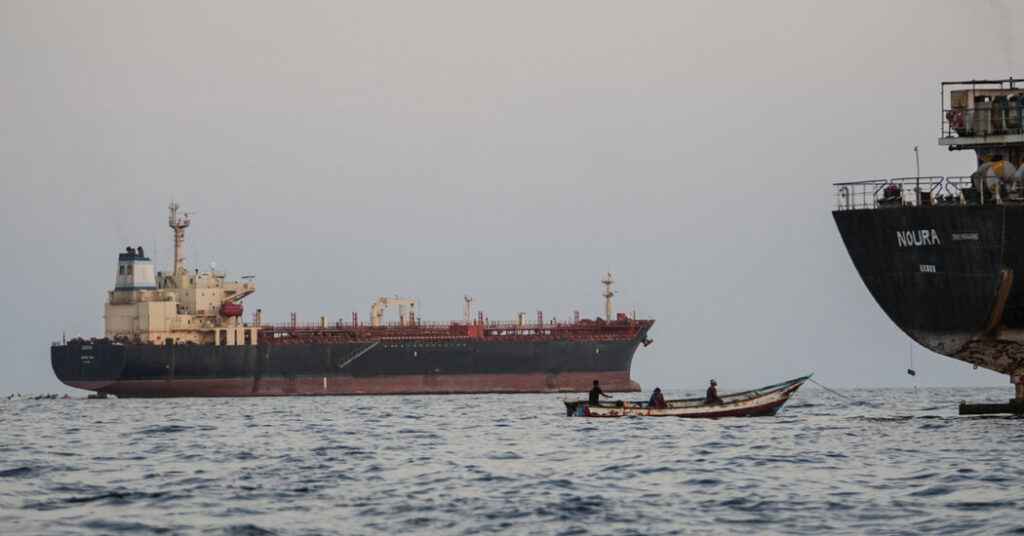
As Iran and its allies tightened their grip on shipping lanes in the Persian Gulf, Saudi Arabia scrambled this week to reroute millions of barrels of oil after being forced to close a critical pipeline damaged in an attack.
The shutdown of the East-West pipeline risks keeping 4 percent of the world’s oil supply from reaching international markets and driving energy prices even higher.
Saudi Arabia on Friday said it had temporarily shut the pipeline after it was struck by an Iran-backed militia. The pipeline, a 750-mile network that transports crude across Saudi Arabia to ports on the Red Sea, had been the kingdom’s primary way of exporting oil since the war in Iran began in February.
On Wednesday, Saudi Arabia and the Houthi militia in Yemen exchanged fresh claims of attacks on one another. In what would be a sharp escalation in their fighting, the Houthis said they had downed a Saudi fighter jet, as Saudi Arabia said the Houthis fired a drone near the Muslim holy city of Mecca.
The Houthis last week gained control of a strategic Red Sea port and hit energy facilities in Saudi Arabia, exacerbating the squeeze on Saudi oil exports.
Now, Saudi Arabia, running out of options and under pressure to rapidly restore supply lines, is facing the prospect of a severe energy crisis with global implications, analysts said.
“It is unprecedented,” said Amena Bakr, head of Middle East & OPEC+ Insights at Kpler, a maritime data firm.
“We have two major waterways obstructed, active attacks, Iran escalating attacks, proxies being active and no signs of diplomatic talks,” Ms. Bakr said. “It’s a disastrous situation when you’re looking at it from an energy security angle.”
Any extended disruption to the pipeline network of Saudi Arabia, long the world’s biggest oil exporter, would send shock waves through the global energy market. Brent crude, the global benchmark for oil, hovered around $107 per barrel on Wednesday, up 50 percent from its prewar level.
The world could lose 120 million barrels of crude if the East-West Pipeline is offline for a month, according to estimates from Kpler.
Goldman Sachs warned that global oil prices could rise as high as $120 a barrel if attacks in the Persian Gulf and the Red Sea continue.
The precise amount of oil not making it to the global market will depend largely on the severity of the damage to the East-West pipeline. Neither the Saudi government nor Saudi Aramco, the national oil company, responded to requests for comment.
Saudi officials previously said only that the pipeline was shut as a precaution but have not disclosed the extent of the damage or a timetable for how long it might take to restart it. Satellite images taken on Sept. 10 and 11, reviewed by The New York Times, show damage at two pumping stations on the pipeline.
Estimates for how long it might take to get the pipeline running again vary widely.
Ms. Bakr, the Kpler analyst, said she believed it could take five to six weeks, but that partial repairs could be completed far sooner.
She and others noted that the kingdom has extensive experience dealing with attacks on infrastructure. In 2019, Aramco suffered a major Houthi attack on its facilities and was able to restart pumping operations within a few days. And in April, when a pumping station was attacked shortly after the war in Iran began, full capacity was restored within seven days.
Robin Brooks, a senior fellow at the Brookings Institution, a Washington think tank, said he did not believe the “nightmare scenarios” that the pipeline could be offline for months.
“This attack has again raised in markets the fear that we could be on the cusp of another big spike,” Mr. Brooks said. But, he said, “The track record is that these things get repaired within weeks, and there’s already indications from satellite imagery that repairs are happening.”
Chris Wright, the U.S. energy secretary, said he believed oil flows through the pipeline would resume soon. “This will be a brief and temporary interruption,” Mr. Wright told CNBC on Tuesday.
Saudi Arabia has oil stored across the country, including the capacity for about 24 million barrels at its Red Sea port at Yanbu, creating a cushion. But those storage tanks are unlikely to be full, according to Rystad Energy, a consulting firm that estimated the port has about three to six days’ worth of crude.
The East-West pipeline was Saudi Arabia’s workaround when the war in Iran effectively shut the Strait of Hormuz. Stretching from Abqaiq in the east to the Red Sea oil terminal of Yanbu in the west, the pipeline bypasses the strait entirely. Oil could be transported through the Bab al-Mandab Strait on the southern end of the Red Sea or via the Suez Canal and a pipeline across Egypt at the northern end of the sea, headed primarily to customers in Asia.
Ship traffic in the Strait of Hormuz is a fraction of what it was before the war, when about 130 vessels moved through the waterway daily. An average of approximately 20 ships a day have passed through the strait over the past week, according to Kpler.
Yasir O. Al-Rumayyan, the chairman of Aramco, said in June that engineers had expanded the pipeline’s capacity to carry up to seven million barrels per day, nearly 30 percent more than before the war.
“We had a similar situation back in the ’80s, where the Strait of Hormuz was threatened to be blockaded by the Iranian regime,” Mr. Al-Rumayyan said. “It was decided since then that we will have a pipeline from east to west.”
With the Houthis now largely in control of the Bab al-Mandab Strait, Saudi Arabia is once again steering vessels through the Strait of Hormuz, analysts said. Since Sept. 7, just two Saudi vessels have traveled through the Red Sea, according to Kpler.
The U.S. Navy has been able to keep some oil flowing out of the Strait of Hormuz on sea paths close to the coast of Oman, the opposite side from Iran. But those efforts have required an extensive and dangerous operation.
Capital Economics, an economic research firm, said that every week the East-West pipeline is closed, while the Strait of Hormuz is off limits, will shave at least 0.2 percent off Saudi Arabia’s economic activity.
Josh Holder and Jenny Gross contributed reporting.
The post Saudi Pipeline Attack Risks ‘Disastrous’ Loss of Oil as Fighting Escalates appeared first on New York Times.