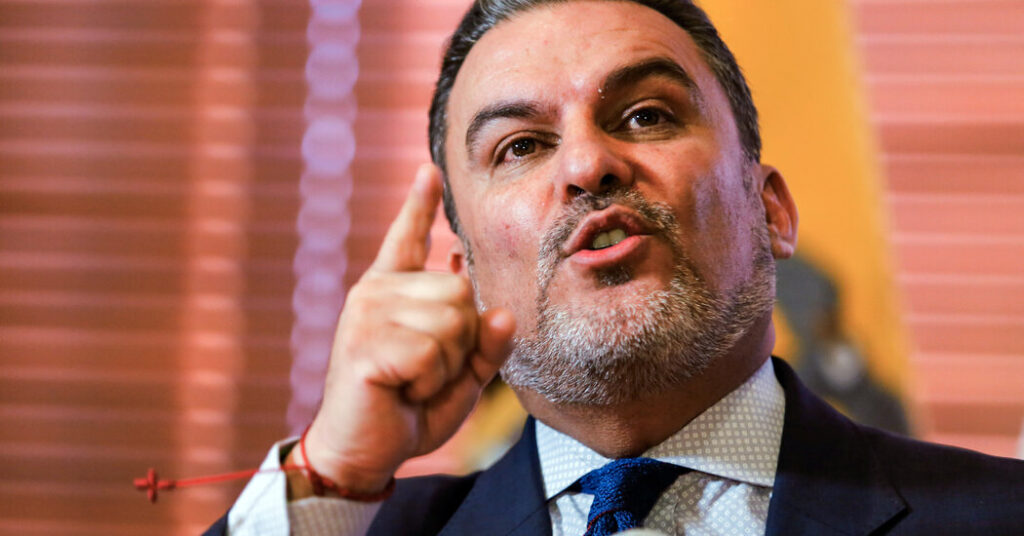
A prominent former government official from Ecuador was deported last month in an unusual move by U.S. immigration authorities, who reversed a ruling that had blocked his removal because he could face torture back home.
The former official, José Serrano, is being held in a maximum-security prison in Ecuador, where he was told that video of him stripped naked would be shared with the Ecuadorean president, Daniel Noboa, according to his lawyers.
Ecuadorean officials have denied that Mr. Serrano — charged with orchestrating the 2023 assassination of a presidential candidate — had been mistreated.
Mr. Noboa, a crucial ally in President Trump’s crackdown on drug trafficking, seemed to take credit on social media for Mr. Serrano’s Aug. 28 deportation almost in real time.
“We said it, we did it,” Mr. Noboa boasted in Spanish on social media just 15 minutes after records show U.S. officials had placed Mr. Serrano on a small charter plane bound for Ecuador. In his post, Mr. Noboa included a photo of Mr. Serrano shackled between two Immigration and Customs Enforcement agents.
A review by The New York Times of Mr. Serrano’s arrest and deportation underscores how the Trump administration has taken control of the nation’s immigration court system, reshaping it for its own political ends to carry out its hard-line policies.
Mr. Serrano had served as interior minister for Ecuador’s former president Rafael Correa, a bitter rival of Mr. Noboa. Mr. Serrano later sought political asylum in the United States. Although he denies that he played a role in the assassination, he admitted taking more than $500,000 in bribes in an unrelated matter.
ICE agents arrested Mr. Serrano in Miami last year, days after Mr. Noboa had privately met with Kristi Noem, then the homeland security secretary, in Ecuador.
The leftist former minister fought deportation from behind bars for months, eventually convincing a U.S. immigration judge that he could not be sent back to Ecuador because he was likely to be tortured.
But late last month, just a day after being briefed on the case, three immigration appeals judges appointed by the Trump administration overruled that decision — a stunning turnaround time for the logjammed immigration courts, where such appeals typically linger for months. Within hours, he had been deported.
Immigration judges work for the Justice Department, not the independent judicial branch, meaning they can be hired and fired by administration officials. By law they are required to decide cases using their “independent judgment and discretion.”
Former appellate immigration judges said that even if the Serrano case had been fast-tracked, a complex appeal like his would normally have taken weeks to decide, not a single day.
“I can’t recall a case ever moving that quickly,” said Charles Adkins-Blanch, who was appointed to the immigration appeals board under President George W. Bush and later served as its vice chairman. “It’s highly unusual.”
Kathryn Mattingly, a spokeswoman for the Justice Department, said she could not comment on individual cases but added that the Trump administration was “restoring integrity to the immigration adjudication system.”
Catherine Walker, an attorney for Mr. Serrano, said that a member of his Ecuadorean legal team had been able to reach him last week for the first time since his deportation but that “three unidentified masked guards” had monitored their video call.
“The little information Mr. Serrano could provide during the call was appalling,” Ms. Walker said in a statement. She said that guards took photographs and videos of Mr. Serrano while he was naked and told him that “the footage would be sent to President Daniel Noboa.”
Mr. Serrano’s deportation from the United States took place too quickly for his lawyers to challenge it in federal court, an avenue to appeal immigration court rulings. They have now asked a U.S. federal appeals court to order him returned.
Mr. Noboa, the Miami-born heir of a banana-exporting empire, has governed Ecuador since late 2023. He has become one of Mr. Trump’s closest allies in the Western Hemisphere, particularly in U.S. efforts to intercept vessels suspected of carrying drugs. In March, the United States helped Ecuador’s military destroy an alleged cartel training camp that residents said was actually a dairy farm.
For Mr. Noboa, the return of Mr. Serrano accomplished a long-sought political goal. Starting in 2009, Mr. Serrano held several high-ranking positions under Mr. Correa, a left-wing populist who presided over an economic boom that lifted millions out of poverty, but whose government was criticized over allegations of corruption and human rights abuses. He later became a vocal critic of Mr. Noboa.
Chandler Rebel, a spokesman for the Homeland Security Department, said it was “categorically false” that the agency had detained Mr. Serrano for political reasons. Mr. Rebel did not respond to questions about the conversation between Ms. Noem and Mr. Noboa, which took place in Quito, Ecuador’s capital, on July 31, 2025, shortly before Mr. Serrano’s arrest.
“The Department of Homeland Security does not conduct immigration enforcement on behalf of foreign political interests, nor does it target individuals for protected political speech,” Mr. Rebel said in a statement. “What makes someone a target of ICE is being in the country illegally.”
The State Department, where Ms. Noem now holds a position as a special envoy for Western Hemisphere security, did not respond to requests for comment. Neither did Mr. Noboa’s office.
The Trump administration has previously deployed immigration enforcement against a political opponent of a Trump-friendly leader in Latin America. In June, a Colombian activist who had protested against Abelardo De La Espriella, a Trump-endorsed candidate who is now Colombia’s president, was detained by U.S. immigration agents in Arizona. The Times reported that Secretary of State Marco Rubio had approved the detention; the activist, Beto Coral, later agreed to be deported.
As the administration has asserted its authority over the immigration courts, it has especially focused on the Board of Immigration Appeals, an influential if little-known body that reviews decisions from lower-level judges and can make binding policy rulings. The administration has reduced the size of the board to 15 members from 28 while removing Biden-era appointees. It has filled the gaps with replacements seen as ideologically aligned with the president. All three of the judges who heard Mr. Serrano’s case had worked for the Homeland Security Department earlier in their careers.
Even amid those changes, the board still takes months to decide appeals involving detained immigrants, although there have been exceptions. The board took just nine days this spring to rule that Mahmoud Khalil, a high-profile pro-Palestinian student activist targeted by the administration, could be deported.
A former human rights lawyer, Mr. Serrano was for many years one of Ecuador’s most powerful and feared figures. In 2011, he became interior minister, a position that gave him direct oversight of the country’s police and intelligence system.
“Serrano was the strongman of the strongman,” said Juan Carlos Calderón, an Ecuadorean investigative journalist, referring to his role under the domineering Mr. Correa.
During the Obama administration, Mr. Serrano received a commendation from the U.S. Drug Enforcement Administration for increasing drug seizures.
Mr. Serrano eventually became president of Ecuador’s National Assembly, but was forced out after audio recordings revealed that he had held secret discussions with a fugitive former government official to oust the nation’s attorney general.
He came to the United States in 2021, during the Biden administration, on a tourist visa and applied for asylum later that year, according to court records.
His daughter Paulina Serrano told The Times that crime bosses whom Mr. Serrano pursued as interior minister “had effectively placed a bounty on his head.”
From the United States, Mr. Serrano remained active on social media, frequently commenting on Ecuador’s worsening drug-cartel-related security problems and criticizing Mr. Noboa. His asylum case moved slowly through U.S. immigration courts, where a backlog of claims grew sharply during the Biden administration.
Back in Ecuador, prosecutors were building a criminal case against Mr. Serrano, saying that he had planned from afar the 2023 assassination of the presidential candidate Fernando Villavicencio, who was gunned down in Quito. Mr. Villavicencio had been a muckraking journalist, helping to expose a bribery scandal that led to the conviction of Mr. Correa.
After Mr. Serrano’s 2025 arrest by U.S. immigration agents in Florida, he was charged in Ecuador with masterminding the killing. He said the accusation was politically motivated.
Mr. Noboa soon called for his return to Ecuador. “He has to be held accountable before the Ecuadorean justice system,” he said in comments reported by the local media.
The charges heightened the stakes of Mr. Serrano’s already complex asylum claim.
Romy Lerner, the Miami immigration judge who heard his case, had been appointed by the Biden administration. In her time on the bench, Ms. Lerner had denied asylum to immigrants in 83 percent of cases, above the national average, according to a Times analysis of immigration court data.
After four days of hearings, she found that Mr. Serrano was not eligible for asylum because he had committed a “serious nonpolitical crime.” In court, Mr. Serrano acknowledged telling U.S. federal agents that he had taken roughly $575,000 in bribes from two government contractors as interior minister. He said he made the admission as a cooperating witness, according to court filings.
But Ms. Lerner also found that Mr. Serrano was likely to be detained and tortured if he were returned to Ecuador, noting that seven of 13 people arrested in the Villavicencio case had been found “dead or murdered” in Ecuadorean prisons.
In addition, the judge cited the case of Jorge Glas, a former high-ranking member of Mr. Correa’s government imprisoned in Ecuador. As the judge noted, the United Nations’ special rapporteur on torture said that Mr. Glas appeared to have been “subjected to torture, including dislocated thumbs, lacerations on his wrist from the overuse of handcuffs, and contusions and bruising on his arms, thighs and thorax indicative of physical beatings.”
As a result, on May 13, Ms. Lerner granted Mr. Serrano a form of protection from being deported to Ecuador known as deferral of removal. She said she found his testimony to be “credible” but made no finding about whether he had been involved in the assassination, as that was a matter for courts in Ecuador to decide.
Mr. Serrano stayed locked up in the United States while his immigration case went through appeals.
At one point in June, Mr. Serrano was taken from his cell and nearly put on a deportation flight to Ecuador, despite the judge’s order, according to court filings and internal government records reviewed by The Times. An ICE official acknowledged the error in a message to his lawyers, writing that Mr. Serrano had been “pulled from the flight manifest last night once our office was made aware.”
The episode happened just a day before Ms. Noem met again with Mr. Noboa, this time in New York, according to his social media. By this point, Ms. Noem had been dismissed as the head of the Homeland Security Department, having taken her new role at the State Department.
Then, at 4:06 p.m. on Aug. 27, the Homeland Security Department filed its written argument to the immigration appeals board, court records show.
At 3:12 p.m. the next day, a panel of three appellate immigration judges unanimously reversed the lower court, saying they did not find it likely that Mr. Serrano would be tortured in Ecuador.
The judges said that the physical harm suffered by Mr. Glas did not qualify as torture because it had not been shown to have been “intentionally inflicted with the specific intent to inflict severe pain or suffering.” They also noted that the Ecuadorean government had not been proven responsible for the deaths of the other suspects in Mr. Villavicencio’s assassination.
The judge who wrote the opinion, Keith Hunsucker, has close ties to the Trump administration. For several months, he served as the acting chief judge for the immigration court system.
Mr. Hunsucker did not respond to a request for comment.
Within five hours of the appeals board ruling, court records show, Mr. Serrano was on a plane back to Ecuador, where his arrival was broadcast online. Mr. Noboa said that Mr. Serrano was being held in El Encuentro, a prison modeled after El Salvador’s notorious CECOT detention center.
The Ecuadorean president then issued a warning to Mr. Correa, who lives in Belgium.
“You’re next,” he wrote in the post that showed Mr. Serrano shackled between ICE agents.
Steven Rich and Annie Correal contributed reporting. Research was contributed by Emily Powell, Kitty Bennett, Sheelagh McNeill and Susan C. Beachy.
The post U.S. Fast-Tracked Deportation of Ecuadorean Politician Despite Torture Fears appeared first on New York Times.