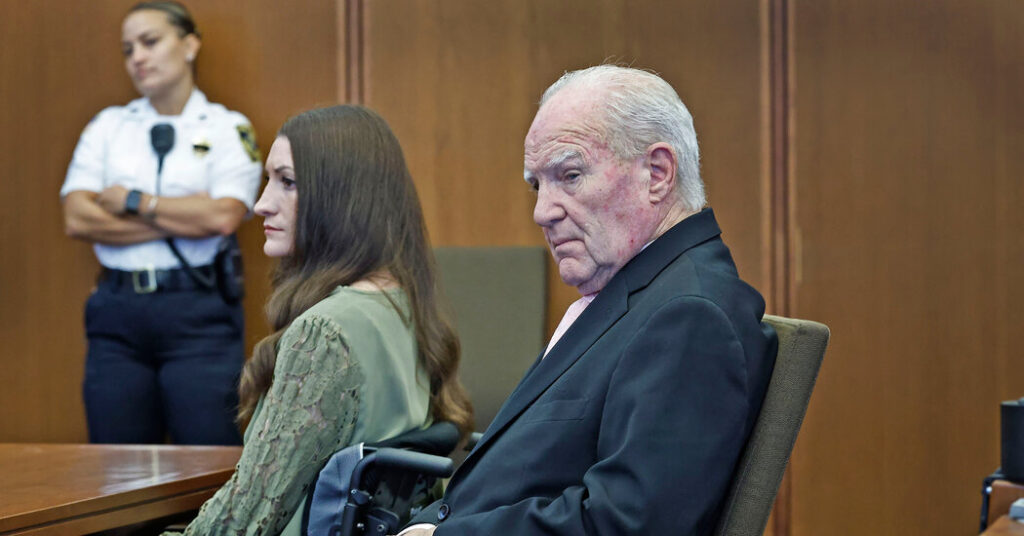
When several jurors from the murder trial of Lindsay Clancy spoke publicly last week about their deliberations, they probably did not imagine what would follow: Deep dives into their social media histories. Hateful memes depicting the women among them as crones. And excavation of two jurors’ past legal problems — none of which would have disqualified them from serving.
With a retrial of Ms. Clancy still possible, the intense scrutiny of the jurors whose deadlock led to a mistrial could complicate attempts to seat a new jury, from a pool of candidates who now have reason to fear a similar backlash.
The prosecutor in the case, Timothy J. Cruz, has not said if he intends to retry Ms. Clancy, 36, for the strangling deaths of her three children in January 2023. She has admitted to killing Cora, 5; Dawson, 3; and Callan, 8 months. But according to the defense, she was experiencing postpartum psychosis at the time.
As Mr. Cruz weighs his next step, Ms. Clancy’s lawyer, Kevin Reddington, could try to argue that the lone holdout juror would never have been seated if a past criminal accusation against him had been known.
The holdout — who voted for Ms. Clancy’s conviction while the other 11 jurors wanted to find her not guilty by reason of insanity — had been charged with misdemeanor domestic violence assault in 2021 after his wife at the time said he had grabbed her throat and thrown her against a dresser. That charge was later dismissed. Court records from the couple’s eventual divorce indicated that they had lived separately since the day of the arrest.
Then, last year, a teenage family member, who had called 911 during the 2021 incident, asked a judge for a restraining order against the man. The yearlong restraining order expired last month, during the trial.
Another juror identified the holdout in an interview with The Boston Globe, and The New York Times verified the holdout juror’s identity. Repeated efforts to reach the man, a 48-year-old resident of Plymouth County, Mass., were unsuccessful. Several of his relatives declined to comment on his background or his jury service.
Neither the restraining order nor the dropped misdemeanor assault charge would have disqualified the man from jury service under Massachusetts law, which bars only those with a pending felony charge or a felony conviction within seven years of their screening. Similarly, another Clancy juror — who was charged with misdemeanor assault more than 20 years ago, a charge that was also dismissed — was legally eligible to serve on the jury.
Unknown is whether the two jurors disclosed their past interactions with the law on the forms they filled out when they reported for jury duty. The Massachusetts form asks prospective jurors to “check all that apply” from a list that includes having ever been arrested, sued, served with a court order, charged with or convicted of a crime.
The form requires a signature from prospective jurors, acknowledging that “a willful misrepresentation or omission of a material fact on this form is a crime,” punishable by a fine.
In theory, lawyers on either side could have run background checks on prospective jurors, a review permitted until the jury is sworn in. But in reality, experts said, trial lawyers often lack the time and resources to independently scrutinize jury pools during the initial screening, known as voir dire, which tends to move quickly.
“They’re looking at the things that are immediately front and center, like race, youth, gender, occupation, and asking what they can glean there,” said Rosanna Cavallaro, a law professor at Suffolk University. Lawyers may challenge the other side’s choice of a juror for a range of reasons, and may also deploy a limited number of no-cause challenges.
She noted that questions on juror forms help guide lawyers in asking questions during jury selection that elicit candidates’ feelings about their past experiences, such as lingering animosity toward the police or the courts.
Defense lawyers often welcome jurors with past charges or convictions, experts said, because they may be more sympathetic toward defendants, or view prosecutors critically. The holdout juror in the Clancy case took the opposite stance, supporting the prosecution.
Even if a juror did fail to acknowledge being charged with or convicted of a crime , it wouldn’t necessarily be grounds for removal, Professor Cavallaro said. Such an omission could be accidental, and would likely be seen as less serious than “proactive” juror misconduct, she said, such as posting on social media about a trial while serving as a juror for it.
Because Ms. Clancy’s trial ended in a mistrial, effectively restarting the case, it is unclear whether, or how, the revelations about the jurors’ histories could be used by lawyers to affect what happens next. The same goes for the claim from other jurors that the holdout did not follow the judge’s instructions, or the law, in reaching his decision that Ms. Clancy should be held criminally responsible.
In the days after the mistrial was declared, every new bit of information about the jurors to emerge was seized on by many who had followed the trial closely.
Last week, one of the jurors in the majority revealed to Gayle King on CBS Mornings that the lone holdout was Black — and apparently the only Black person on the panel. That touched off a furor online from people who saw race as a pernicious factor in other jurors’ criticism of him. Conservative commentators, some of whom who had been portraying the holdout juror as a heroic white man, quickly pivoted to criticizing the optics of 11 white jurors trying to have a Black man removed.
Online sleuths also uncovered posts from a Facebook account that appears to belong to a juror who favored acquittal. They show her cheering on the acquittal of Karen Read, a defendant in another recent high-profile trial that, similar to the Clancy case, became a hotbed of conspiracy theories.
Jurors’ past conduct can have dramatic consequences. In another well-known Massachusetts case, a federal appeals court overturned the death penalty sentence of Dzhokhar Tsarnaev, the Boston Marathon bomber, in 2020, after finding that the judge in the case did not sufficiently screen jurors for bias.
Two jurors, it was later discovered, had posted comments on social media about Mr. Tsarnaev before the trial and failed to disclose them. The forewoman referred to him as “that piece of garbage”; another juror called him “scum.” (The Supreme Court later reinstated the death sentence.)
Ten days after the judge declared a mistrial in the Clancy case, the intense scrutiny of jurors prompted unusual action on Monday. Judge William Sullivan indefinitely shielded the names of the 12 jurors and six alternates, citing “real and present risk” of harm fueled by “daily, divisive attention” to the case.He also impounded for 10 days the names of every potential juror who was called to court the week that jurors were chosen, in late July.
Judge Sullivan’s attempt to lock their identities away from public view underscored the toxic new reality faced by jurors in high-profile trials, in an age of rampant, polarizing online discourse.
Alec Ewald, a professor of political science at the University of Vermont who has studied jury eligibility, said that excluding broad categories of prospective jurors with specific backgrounds — such as past criminal charges against them — could undermine the goal of assembling a true “jury of one’s peers.”
But he added that in a case involving disturbing, unimaginable crimes, and sharp national division over what the outcome should be, it seemed natural that a mistrial, with its lack of resolution, would trigger frustration with the jury.
“There’s a need to make sense of these awful events, and then, with a mistrial, the jury gets in the way of that,” he said. “The ambiguity and complexity of having regular people make these decisions really comes home to us when the results are unsatisfying.”
Sheelagh McNeill and Susan C. Beachy contributed research.
The post Scrutiny of Jury May Complicate Future of Lindsay Clancy Case appeared first on New York Times.