WICHITA — Three days after President Donald Trump threatened to ban sales from Canadian jet manufacturer Bombardier in the United States, an employee walked out of its U.S. headquarters and looked around to ensure no one was nearby before talking to a reporter.
”This is ridiculous,“ the employee said with a profanity, speaking on the condition of anonymity to avoid retaliation. “We have thousands of Americans working here, and I don’t want to be thinking about losing my job.”
Trump announced the threat to Quebec-based Bombardier in a Truth Social post last week describing its products as not “good enough” amid escalating trade disputes with Canada. “If they want our Market, they must build here, and stop treating America like a ‘piggybank,’” he wrote.
Trump has not taken any steps to enact restrictions on the company, which is also an aircraft supplier to the U.S. Air Force.
His threat represents a new escalation in Trump’s aggressive rhetoric toward Canada, calling to financially cripple a company that operates as a major employer in a red state key to Republicans holding the Senate.
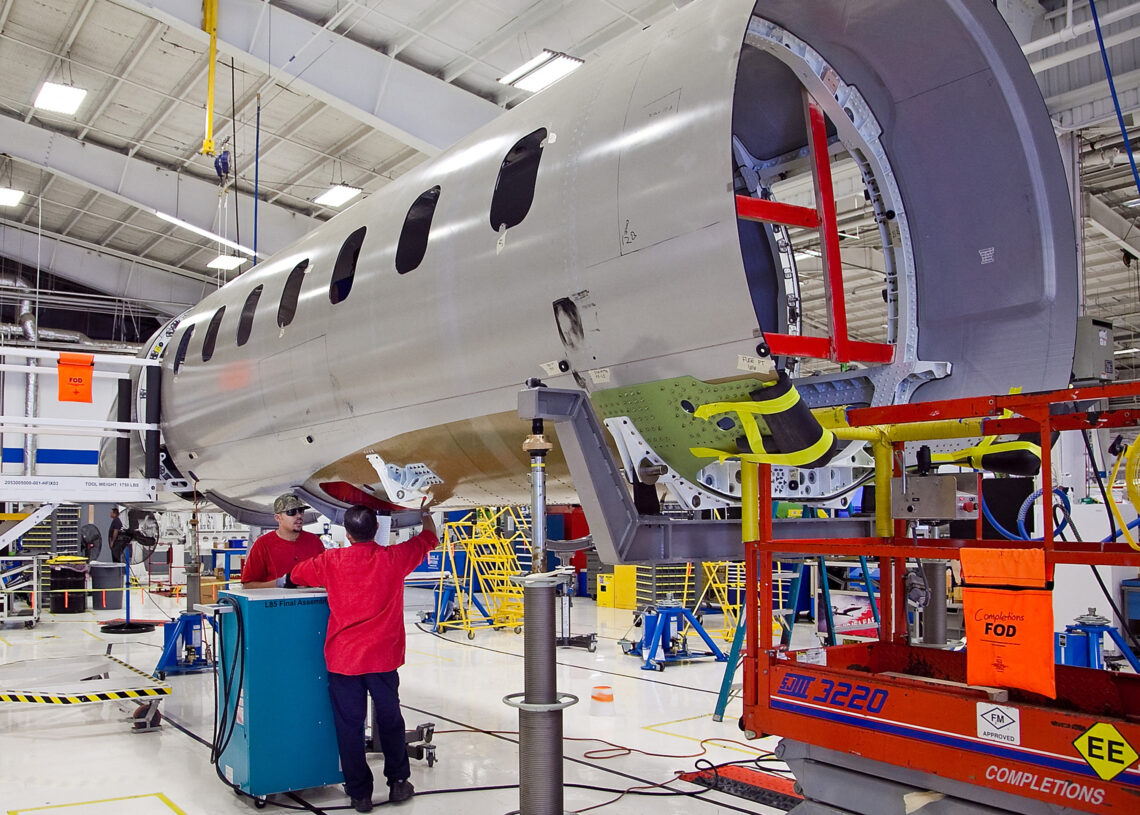
Bombardier’s workforce includes roughly 1,500 in Kansas, a state Trump carried comfortably during his three presidential bids. In addition to the Wichita headquarters where Bombardier services, tests, and modifies aircraft, the company employs another 2,000 elsewhere in the U.S., including at service centers in Arizona, Texas, Florida and Connecticut.
It makes jet wings in Texas and flight control components in California, with plans to open a new service center in Indiana. Final assembly of its jets takes place in Canada, highlighting the complex relationship between the two nations that developed over recent decades of mostly free trade.
In interviews, four current Wichita-based Bombardier employees, all of whom spoke on the condition of anonymity for fear of losing their jobs, saying the company directed them not to speak with the media, expressed anger and concern about what the threat could mean for their job security.
“I’m scared about what this might mean for my job and my family,” said one longtime engineer. “It’s tough to look at many other Americans working here who are also struggling and got caught up in this global mess.”
Bombardier, in a public statement released after the threat, sought to highlight its American footprint while avoiding explicitly responding to or criticizing the post. The company plans no changes to its operations “at this time,” a spokesperson told The Washington Post.
Trump has sharply targeted Canada, along with other nations, maintaining that high tariffs, including those on steel and aluminum, help U.S. companies and create more economic opportunities for U.S. businesses. The White House did not respond to questions about what a ban of Bombardier aircraft would look like or which of Bombardier’s operations should move back to the U.S.
However, many of Trump’s harshest tariffs and economic threats have been walked back as the administration has faced backlash from different business sectors because of the interconnectedness of U.S. and Canadian companies, where manufactured products are often shipped back and forth, as is the case with Bombardier.
“It’s certainly not a simple ‘Oh, that’s a Canadian aircraft,’” said Rolland Vincent, an aviation consultant who formerly led strategy for Learjet, a business jet manufacturer in Wichita acquired by Bombardier in 1990. “There’s no aircraft that’s built that has pure national origin.”
Kansas, which Trump carried by 16 points in 2024, has emerged as one of the midterm election’s unexpected battlegrounds as the president’s approval rating falls even in red states. Sen. Roger Marshall (R), who was long seen as a shoo-in for reelection, now faces a challenge that has prompted optimism from national Democrats even as Marshall remains favored. The governor’s race to replace Laura Kelly (D) is also competitive.
“Kansas exports $4 billion worth of goods to Canada, and so when we’re insulting the Canadians, when we’re imposing additional tariffs, it hurts the people of Kansas,” said Adam Hamilton, a Kansas pastor and Democrat facing Marshall in November.
Several Wichita-based Bombardier employees said Trump’s post felt to them as though the president was turning his back on American workers and neglecting the company’s domestic footprint.
While Bombardier employees continued to show up for work as normal, several said that workers have been chatting about Trump’s post and fearing the effects if he followed through.
Others, particularly those with a more favorable view of the president, believe that Trump is “bluffing” and using Bombardier as leverage in trade negotiations, one of the workers said. “I’ve talked with people who think this is all a game of some kind that he’s playing,” the worker said. “And that’s crazy to me. I don’t think he cares about us and our jobs versus using us as a pawn, and our lives should be treated with more respect than that.”
Aviation is central to Wichita’s local identity in a city of 400,000 that styles itself as the “Air Capital of the World” and traces its legacy to historic aviators including Walter Beech and Clyde Cessna. Bombardier no longer assembles civilian jets in Wichita, ending Learjet production in 2022.
U.S.-made components account for a significant share of the value of Bombardier aircraft, Vincent said. Vincent, while saying he expected the dispute to ultimately blow over, cautioned against dismissing Trump’s post as empty bluster.
“It’s a serious threat from a serious person,” he said. “Nobody wants to be on the headline when it comes to the anger of someone who’s got the power of the president.”
The engineer said he was considering putting off a planned move until he had more clarity. “No one really knows what’s going on with it,” he said. “Everyone aside from the president is just guessing.”
This isn’t the first time that Trump has targeted Bombardier. In late January, as tensions escalated between the U.S. and Canada, he threatened to revoke certifications for some Bombardier jets and impose a 50 percent tariff on Canadian planes but did not follow through.
Wichita Mayor Lily Wu, along with local and federal Republican lawmakers, issued statements that advocated for the Bombardier workers’ jobs to be protected but did not criticize Trump.
Jim Howell, a Republican commissioner of Sedgwick County, which includes Wichita, took on Trump more directly, warning a ban would “be devastating to Bombardier” and a “huge loss” to the region.
“It’s rare that I go against the president in my comments,” Howell, who previously worked in Bombardier’s Wichita flight-test operation, said. “But no, he’s not perfect. And I think that this is one of those things where I’m just shocked that he wanted to wade into this, because I don’t think it’s helping.”
Marshall, who said he had already contacted the White House about protecting Bombardier jobs, used Trump’s threat as an opportunity to push for the company to double the size of its Kansas workforce to more than 3,000, as Learjet formerly had in Wichita.
“America buys more than half of what Bombardier sells. If that’s the market, more of those planes should be built here,” Marshall (R) said in a Tuesday statement.
Hamilton, Marshall’s challenger, argued in an interview that Marshall’s response came too late and that he was unable to sufficiently stand up to Trump.
“Roger Marshall acts as though he’s paid by the White House to be their spokesperson,” Hamilton said. “He keeps saying that he’s speaking up to the White House … but I don’t see any evidence that the president’s actually listening to him.”
Spokespeople for Marshall did not respond to requests for comment.
To Bombardier’s Wichita employees, though, these political concerns are secondary to whether they will become collateral damage.
“I hope this blows over,” one said. “I just want to do my job.”
The post In this red state, backlash erupts over president’s threat to ban major employer appeared first on Washington Post.