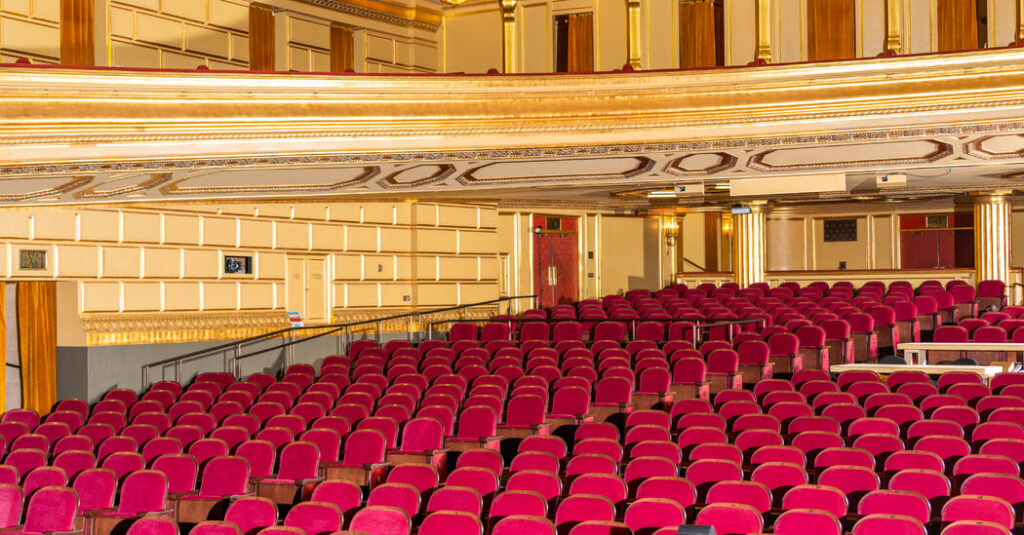
The San Francisco Opera was set to inaugurate its 104th season on Saturday with a performance of Verdi’s “Simon Boccanegra,” one of six productions the company has planned for its new season.
But the curtain never rose.
The union representing the opera’s orchestra announced shortly before the performance was to begin, at the War Memorial Opera House, that it was going on strike, fulfilling a pledge it made during months of deadlocked negotiations: It would not perform without a contract.
At 7:25 p.m., leaders of the opera walked onstage and told the patrons settling into their seats for an 8 p.m. performance that the opera had been canceled. An outdoor performance set for Sunday at Golden Gate Park, part of the opening festivities, was also called off.
Outside, a picket line of musicians hoisted placards with slogans including “World Class Orchestra/World Class Contract” and “Austerity is off-key.”
The events left the performance schedule of one of the nation’s premier opera companies in limbo, and underlined the financial forces buffeting classical music organizations across the country. It also cast a shadow over the company at a particularly high-profile moment: the start of a new season.
The San Francisco Opera has said it is struggling with a $15 million recurrent shortfall driven by rising costs, which has forced it to draw down its $300 million endowment, in defiance of customary accounting procedures.
The contract with the orchestra expired on July 31. The company initially said it wanted to cut the musicians’ salaries, though its latest proposal is an effective wage freeze for five years. The musicians, represented by the American Federation of Musicians Local 6, have firmly rejected that proposal.
”The orchestra is asking for a fair contract that gives the musicians stability and pay that keeps pace with the cost of living in San Francisco,” the musicians said in a statement announcing the strike. “This latest proposal does not take into account inflation and cost of living in the area, and is essentially a pay cut over the course of five years for the orchestra musicians.”
Matthew Shilvock, the general director of the San Francisco Opera, said in a statement that this was a “difficult time for the arts,” adding, “As with many organizations, we must adjust to the changing realities.”
One on hand, the San Francisco Opera, almost alone among opera companies, is enjoying robust philanthropic support — $49.5 million last year, which covered 89 percent of its revenue.
But the opera is a much different company than it once was, at least as measured by the ambition of its programming. The half-dozen productions the company mounted last season were less than half of the 16 it put on in 1981, part of an effort to constrain costs. Last season, the opera staged 42 performances, down from 98 in 1981.
Members of the company’s orchestra are now paid a base annual salary of $118,000 for 24 weeks of work, including performances and rehearsals (actual compensation can be twice that much, depending on seniority). But Shilvock said the company no longer had enough work to fill even that many hours. He said the company wanted to freeze pay while working through a restructuring to reflect the different demands on players.
“We cannot sustain a compensation structure that originated 45 years ago without bringing it into alignment with current reality,” he said in his statement.
Shilvock noted that ticket sales and donor engagement were strong. But, he added, “the fundamental economics underlying the organization have been straining for over 60 years as expense growth has, over decades, outpaced revenue growth.”
For their part, the musicians said they staged the last-minute walkout “with heavy hearts.”
“A strike is not something we take lightly, and we are deeply sorry to everyone who planned to spend this evening at the opera,” the union said in a statement. “We have been clear throughout these negotiations that management’s offers were insufficient, and that without a fair contract we would have no choice but to stop work. Management’s insistence on cuts has left us no other option.”
As it stands, the company’s next performance — once more, “Simon Boccanegra” — is scheduled for Sept. 16.
The post San Francisco Opera Cancels Opening Night After Musicians Strike appeared first on New York Times.