The milk truck would pull up to the house, and out would come the groceries — not just milk, but also eggs, cheese, juice, cereal and baby formula. It might have stopped at a rich family’s house, or a poor one. No one could tell the difference, which was precisely the point.
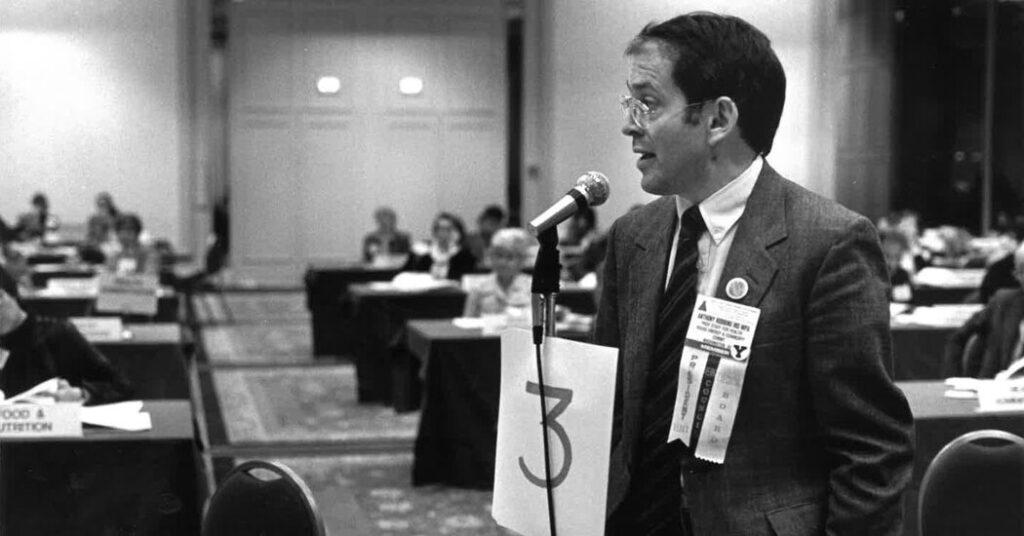
Vermont’s supplemental food program for low-income women, infants and children, the first in the nation to be implemented statewide, began in 1974. It was the brainchild in part of Dr. Anthony Robbins, then one of the country’s youngest state health commissioners, at 33; he had secured a federal grant to made the program possible.
Not only did the program provide much-needed supplies, but it also shielded families from the stigma of receiving public assistance.
“The milk truck was stopping at practically every house — high income, low income, whatever,” Donna Bister, a former director of the program, known widely as WIC, said in an interview. The program is now available in all 50 states.
During Dr. Robbins’s tenure as health commissioner, from 1973 to 1976, Vermont also became the first to provide state-financed dental care to children whose families could not afford it, known colloquially as the “Tooth Fairy Program.”
So severe was the crisis that dentists reported treating children who gargled with kerosene to numb their pain. The program, initially intended to provide dental care to 30,000 children, was created by Vermont legislators and activists, but Dr. Robbins’s support as health commissioner was critical, said Dr. Peter Galbraith, a retired dentist and a former Vermont state epidemiologist.
“It wouldn’t have happened without him,” he added in an interview.
Dr. Robbins died on July 5 at his home in Rockport, Mass. He was 85. His death, which was not widely reported at the time, was caused by complications of long Covid, heart disease and Parkinson’s disease, his wife, Phyllis Freeman, said.
“He was considered to be on the cutting edge of health care,” Madeleine Kunin, a former governor of Vermont, said in an interview. “He was a bright light.”
Over a career spanning roughly six decades, as a physician, professor, editor and health policy expert, Dr. Robbins was often willing to take controversial stands. In 1974, he hired an antiwar activist who had been a defendant in the infamous Chicago Seven trial to be the state’s director of occupational health. The appointment drew national attention and public blowback — as well as a supportive editorial in The New York Times.
The director, John Froines, had been acquitted of charges stemming from protests at the chaotic 1968 Democratic National Convention in Chicago, where he and six others had been accused of conspiring to incite a riot.
Vermont’s governor at the time, Thomas P. Salmon, fretted over what he called “bad, bad public reaction” to Mr. Froines being hired to, among other jobs, monitor emissions at the Vermont Yankee Nuclear Power Station. But Mr. Froines was a highly regarded chemist with a doctorate from Yale, and Dr. Robbins held his ground, saying Vermont had never had anyone so qualified for the job.
“Tony was willing to stick his neck out,” Jay Breines, who at the time was the health care director of the Vermont Public Interest Research Group, a nonprofit, said in an interview.
At the federal level, Dr. Robbins became the director of the National Institute for Occupational Safety and Health from 1978 to 1981, advising the White House on the government’s response to the Three Mile Island nuclear accident in Pennsylvania in 1979.
In 1981, he was accused by the Reagan administration of being too closely aligned with organized labor. He was given a day to clear out his office and was stripped of his commission in the Public Health Service. An editorial in The Times described the dismissals of Dr. Robbins and other officials as “bad manners and ideological vendettas.”
From 1981 to 1986, he worked on the senior health staff of the U.S. House Energy and Commerce Committee. He helped negotiate enhanced warning labels on cigarette packages. And he and his wife, who was on leave from her professorship of law and public policy at the University of Massachusetts, helped draft legislation that became the National Vaccine Program.
In 1993 and 1994, Dr. Robbins took leave from his own professorship, of public health at Boston University, to direct the first national vaccine plan for the Clinton administration. But a hopeful start to protect children against measles, mumps, diphtheria, polio, whooping cough and spinal meningitis devolved into recrimination.
President Clinton accused vaccine manufacturers of pursuing profits over children’s health. A proposal to distribute free vaccines to all children was downsized. The administration also abandoned plans for a national warehouse to store and distribute vaccines after the project was widely criticized as unworkable.
Dr. Robbins became so frustrated, Ms. Freeman, his wife, recalled, that she witnessed him tell a top drug company official at a meeting: “I bet there’s a memo in your desk that says somewhere, ‘There are more measles cases, up the price. There’s a dip in measles, up the price.’”
The official just smiled, she said. “He didn’t deny it.”
Anthony William Robbins was born on Jan. 9, 1941, in Manhattan. His father, I.D. Robbins, was a civic reformer and a builder who constructed low-cost homes in Brooklyn and the Bronx. His mother, Carolyn (Marx) Robbins was an editor and columnist.
Dr. Robbins received his bachelor’s degree in biochemical sciences in 1962 from Harvard University, graduated from the Yale School of Medicine in 1967 and received a master’s degree in public administration from the Harvard Kennedy School in 1969. He trained in internal medicine as an intern and resident but chose a career in progressive health policy.
After serving as Vermont’s health commissioner, he held a similar position in Colorado from 1976 to 1978. He barred smoking in the health department’s offices long before workplace bans extended nationwide. And he sought the end of the use of plutonium — and favored a shutdown — at the notorious Rocky Flats nuclear weapons plant outside Denver. It closed in 1992.
In addition to Ms. Freeman, whom he married in 1990, Dr. Robbins is survived by his sons Jack and Richard Robbins from his first marriage, in 1963, to Jennifer (Lauterbach) Robbins, an assistant attorney general of Maryland. That marriage ended with her death in 1987. He is also survived by a brother, John, and four grandchildren.
From 2003 to 2019, Dr. Robbins and Ms. Freeman coedited the Journal of Public Health Policy. In 2017, when The Washington Post reported that the first Trump administration barred the use of seven words by officials of the Centers for Disease Control and Prevention, Dr. Robbins devised a mischievous contest: Could any journal readers use all seven words — vulnerable, entitlement, diversity, transgender, fetus, evidence-based and science-based — in a single sentence?
They could. The journal received 130 entries from 10 countries on four continents.
The winner of the comic relief category was: “Vulnerable to temperature regarding sex selection, the embryo (a fetus in live-birth species) of the Olive Ridley sea turtle (Lepidochelys olivacea) shows a statistical science-based predilection for transgender fluctuations relative to egg temperature; evidence-based gender entitlement devolves to the female as sand and water temperatures rise and diversity declines.”
The post Dr. Anthony Robbins, Who Expanded Health Care for the Poor, Dies at 85 appeared first on New York Times.