As summer peaked, it felt like a good time to be a Southern California sports fan.
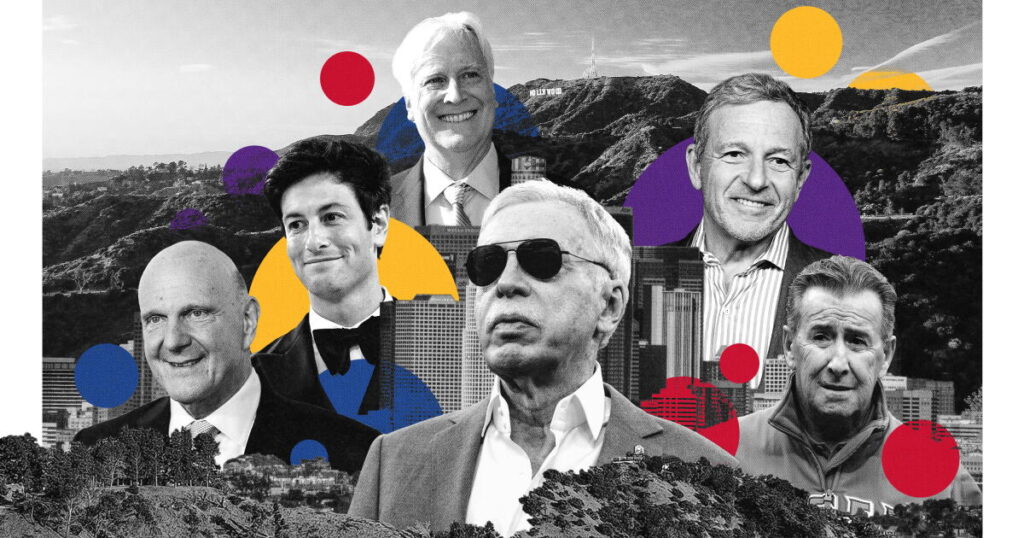
The Dodgers had won back-to-back World Series championships. The Lakers had a new billionaire owner, Mark Walter, who promised to usher in a new era. The Stan Kroenke-owned Rams were seen as Super Bowl LXI contenders. And the long-suffering Clippers had Steve Ballmer, the former Microsoft titan who built a new state-of-the-art arena and promised to take the team to the next level.
Then, in the course of two weeks, everything got turned upside down. Walter sold the Lakers but has vowed to keep the Dodgers. Kroenke bought the Angels. Ballmer was suspended after the NBA found he circumvented the league’s salary cap.
The whole series of events underscores how professional sports has become the domain of a billionaire class for whom the competition is about more than what happens on the field or the court. It’s big business, and championships are as much about monetizing investments as they are about bragging rights.
“It’s a wild and crazy time in sports,” said Patrick Rishe, executive director of the Sports Business Program at Washington University in St. Louis. “We live in an era where there is this push for greater revenue because there are more cost pressures of being in the game. All of these forces have conspired to occur at the same time here.”
The skyrocketing value of the best pro teams, the lucrative broadcast deals and extravagant stadiums are being felt across the leagues. But experts say that in Los Angeles, the stakes — and potential profits — are particularly high.
“L.A. is a front-runner city,” said Daniel Durbin, director of the Institute of Sports, Media and Society at USC Annenberg School for Communication and Journalism. “You have to do something interesting, no matter how big or important historically you’ve been, you have to keep doing something that grabs people’s attention.”
Can the Angels fly?
Consider the Angels.
Longtime owner Arte Moreno had been widely panned for his management of the team, to the point where lifelong fans protested inside and outside the Anaheim stadium.
Moreno is a billionaire, but his net worth pales in comparison to other Southern California franchise owners. He purchased the team in 2003 — the year after they won their first and only World Series title. Fans had high hopes at first.
The Angels remained a playoff team for a few years under Moreno. But after signing some expensive busts, he stopped spending big on the team.
Moreno’s new model seemed similar to the one former Clippers owner Donald Sterling employed, with less of a focus on winning and more emphasis on stadium atmosphere, Durbin said.
The news that Moreno was selling the team to Kroenke for an estimated $4 billion was met with celebration from fans who hope the Rams owner’s deep pockets and track record with winning teams — he also owns franchises that have won championships in the NBA and NHL, in MLS and the English Premier League — will improve the team’s fortunes.
“The Angels have to put up a competitive team against a team — the Dodgers — that has such deep pockets, it can spend twice as much as virtually any other team in Major League Baseball,” Durbin said.
But the Angels sale also could signal an end of an era for independent, albeit wealthy family dynasties owning teams for bragging rights or simply because they enjoy the sport.
Walter O’Malley and, later, his son owned the Dodgers from 1950 until the team was sold to Fox Entertainment Group in 1998 for more than $300 million. In 1979, Jerry Buss bought the Lakers, the Forum and the Los Angeles Kings for $67.5 million. The Lakers now are being sold for $12.5 billion, and the Dodgers are valued at between $7.8 billion and $9 billion.
“The value of these franchises has really kept pace with the most successful businesses in the country,” said Lee Ohanian, an economics professor at UCLA and a senior fellow at the Hoover Institution at Stanford University.
Ballmer once came to Clippers’ rescue
The Clippers have a story similar to the Angels’ — being eclipsed by a prosperous powerhouse franchise.
The team had experienced the allure of star power, particularly in the “Lob City” era in the 2010s with star trio Chris Paul, Blake Griffin and DeAndre Jordan. But a championship has remained elusive.
Ballmer purchased the Clippers in 2014 on the heels of a scandal in which Sterling was recorded making inflammatory statements about Black people. It was a spectacle that NBA Commissioner Adam Silver called an “unprecedented” crisis for the league.
Ballmer, invested handsomely in the team, moving it away from Crypto.com Arena — home of the Lakers — to his widely praised new arena, Intuit Dome in Inglewood. His team executives went after big names in the NBA, making a big splash in 2019 by acquiring a pair of perennial All-Stars, Kawhi Leonard and Paul George, then completing their new star trio by trading for another, James Harden, in 2023.
“Ballmer wants to have a championship team,” Durbin said. “He did not buy them to be the second team in Los Angeles. He wants to be the best team in Los Angeles.”
The Clippers failed to win even a conference title with Leonard & Co. George departed in 2024, and the team traded Harden last season after getting off to its worst start in franchise history. In the background, the NBA was engaged in a probe into whether the Clippers participated in arranging endorsement deals for Leonard, which would be a violation of the league’s collective bargaining agreement.
Last week, the NBA presented the results of its investigation, finding that Leonard received $66 million in endorsement pay and equity from four companies facilitated by Ballmer and Clippers executives at the behest of Leonard’s former business manager.
The NBA sanctioned the team, stripping the Clippers of five future first-round picks and imposing a $30-million fine. Ballmer was suspended from all league and team activities for one year; Clippers president of business operations Gillian Zucker was suspended without pay for one year; and Clippers president of basketball operations Lawrence Frank was suspended without pay for six months. Leonard was fined and his Clippers days appear over; the team arranged a trade in June.
The New York Times reportedon Thursday that federal prosecutors in Brooklyn opened a criminal investigation into the matter. The Times could not independently confirm the probe.
The Clippers have pushed back on the NBA’s findings, saying they will fight “to demonstrate our innocence.”
The Dodgers juggernaut
When Walter shockingly purchased the Lakers last year, there was the assumption he would do for basketball what he did for baseball.
Under his ownership, the Dodgers became the most exciting team in baseball, and he was willing to spend and spend to keep the wins coming. He brought on Shohei Ohtani, Mookie Betts, Freddie Freeman and Yoshinobu Yamamoto — and money seemed no object. Indeed, the contract to sign Ohtani away from the Angels was unprecedented (and unmatched by Moreno): $700 million over 10 years.
The Dodgers’ spending dwarfed that of other teams: They signed seven players to contracts worth more than $2 billion combined in the last six years alone.
When Walter purchased the Lakers for a $10-billion valuation, the storied team was at a crossroads. Megastar LeBron James was nearing the end of his tenure, and the team was not at its Showtime best. But it had swung a blockbuster deal for a new star, Luka Doncic, months earlier, and that, combined with the prospect of the Dodgers owner’s deep pockets, energized the fan base.
Then last month, another stunning sale. And this time the Lakers were being bought by owners with little to no track record of success in pro sports.
Walter did not explain the abrupt saleto former Disney boss Bob Iger and venture capitalist Joshua Kushner, who is the brother of President Trump’s son-in-law Jared Kushner.
But it comes as Walter’s companies face a federal inquiryregarding $16 billion to $21 billion in undisclosed loans. He has denied any wrongdoing. Walter made a profit off the Lakers deal, and there is speculation he needs the money to address the financial challenges facing his businesses.
“I think he saw an opportunity to sell a team that had appreciated in value by a considerable amount in a short period of time,” Washington University’s Rishe said.
Walter said the Dodgers are not for sale. But it’s unclear whether the free spending will, or can, continue.
And what about the Lakers?
Durbin expects them to be able to reload with star players, even if it means going through a weak transition period.
“To a certain degree this is cool L.A. drama,” Durbin said. “It’s like ‘The Big Lebowski’ — everybody in Los Angeles gets to fantasize they are whatever they want to be, even when they’re not.”
And for all the boardroom drama, experts say, L.A. sports fans might end up not feeling the upheaval all that much on the court or the field. All the owners spent a lot of money to acquire these gems, and now they just have to show what they can do.
The post Billionaires, rivalries, blockbuster sales: Two weeks that rocked L.A. sports appeared first on Los Angeles Times.