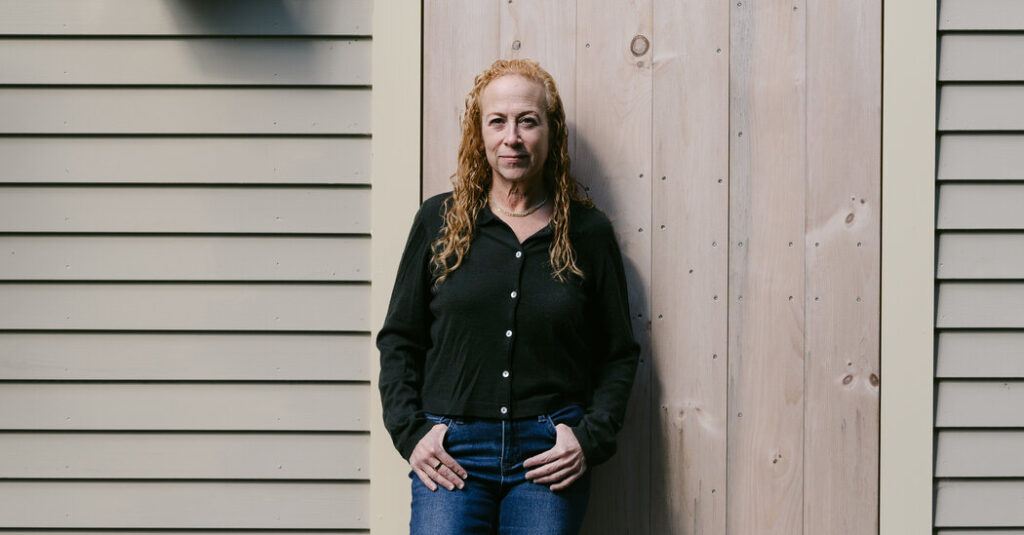
Jodi Picoult knew she wanted her 30th novel — landing in the same year as her 60th birthday — to be about the 25th anniversary of 9/11.
What she didn’t anticipate was the timeliness of the second story line in “Hollow Bones,” which comes out on Sept. 15.
Without spoiling a revelation that comes about a hundred pages in, let’s just say that a character who shall remain nameless suffers from postpartum psychosis. The condition has dominated headlines and TikTok algorithms since July thanks to the trial of Lindsay Clancy, who admitted to killing her three children — Cora, 5, Dawson, 3, and Callum, 8 months — with exercise bands in her Massachusetts home on Jan. 24, 2023.
When Picoult and I spoke by video, the jury was in its fifth day of deliberations over whether Clancy was not guilty by reason of insanity. The defense argued that she was suffering from postpartum psychosis, while the prosecution maintained that she had not reported hearing voices until after the killings. Two days later, the jury announced that it was deadlocked and the judge declared a mistrial.
Picoult answered questions from her purple-walled home office in Hanover, N.H. She talked about an unusual correspondence that fueled her curiosity about postpartum psychosis — and how she hopes the Clancy case (and perhaps “Hollow Bones”) will change thinking about postpartum care. The conversation has been edited for length and clarity,
How closely have you followed the trial?
I’ve been checking the Boston Globe at the end of the day. There’s no way I could have known this would be happening right now, but it gives us a chance to see that the system fails women, which is absolutely tragic and devastating.
You write in your author’s note about a woman who, after killing her three year-old daughter, sent you a letter from prison. Tell me about her.
In September 2023, I got an email from a mother who said, My daughter asked me to pass this note along to you. She is currently in jail awaiting trial. The daughter said, basically, I’ve read so many of your books and you’ve become a voice for people who are voiceless. Will you tell my story so this won’t happen to another woman?
Wow. How did you respond?
I wrote back immediately and said I was very moved and would love to speak with her. I tried to get an in person visit, tried to do Zoom, but that wasn’t possible. Ultimately, I wound up with this big thick file. [Picoult held up a sheaf of around 30 letters.] Reading these, you feel everything in you seize and sink.
Her name is Solange White. I can say that now because just last week she pleaded guilty but mentally ill and was sentenced to 16 to 40 years in a state prison. [In the author’s note, Picoult gave her a pseudonym.]
Solange did the same things that Lindsay Clancy did. She tried to get help. She talked to psychiatrists. She did inpatient stays and outpatient stays. She was given dozens of medications that interacted with each other and nobody diagnosed her properly until she was arrested and got the care that she needed. She is now on the right medication. She knows what she did, and she’s going to live with that for the rest of her life.
How did you incorporate Solange’s story into “Hollow Bones?”
A lot of [Name redacted]’s story is based on hers.
Where did the book title come from?
There’s a character who’s freaked out by a bird pushing its babies out of the nest. Her mother explains that birds have hollow bones, and the thing that makes them fragile is also what makes them able to fly.
How do you think the book connects to what’s happening in the world right now, specifically the Lindsay Clancy trial?
I don’t see this as a little blip of mental health issues for women. I see it as one chapter in an entire book of failures of women’s health care. It starts with puberty and conditions like endometriosis. Then you get to fertility issues. Then you get to perimenopause and menopause where the medical establishment’s advice is basically, Good luck with that.
We’re living in a country right now where you can’t even do research on women’s health because the word “woman” in your research grant will get you summarily dismissed. What is that telling you? It tells you that women don’t matter.
What do you hope will change?
If one woman reads this book, or her family reads it and thinks, Hmm, you know what, I’m going to try to make sure that this person gets help, then we’re a step ahead of where we were yesterday.
What was your experience postpartum?
I did not have any depression, but I distinctly remember feeling like I had been hit by a truck. With my firstborn, this was 35 years ago, there was no such thing as paternity leave, so my husband went back to work the next day. And I remember Kyle, my son, he had colic. He cried all the time. He nursed all the time. So I just stopped wearing a bra. I literally was like, What’s the point?
The only person I saw all day, ever, was the UPS driver. That was my only interaction.
There’s this belief that you’re supposed to be able to do it all. You’re supposed to immediately be in love with your baby and that’s supposed to carry you through the exhaustion and the physical pain and all that stuff. The reality is, motherhood is really hard. It’s probably the hardest thing you’re ever going to do. No one’s going to do it perfectly.
How did the 9/11 piece of the book begin to take shape?
My friend and fellow author Richard Kemmerer sent me a post from Post Secret [a global collection of secrets mailed anonymously to a P.O. box in Laguna Niguel, Calif., then shared on social media]. It was a picture of hand drawn Twin Towers with smoke coming out of it and a little line: “Everyone who knew me before 9/11 thinks I’m dead.”
I could not stop thinking about it. What makes you take a tragedy of that magnitude and use it to disappear. And what might make you come back?
You’ve never shied away from difficult subjects — school shootings in “Nineteen Minutes,” medical ethics in “My Sister’s Keeper.” How do you take care of yourself as you work?
Most people think I must be really depressing to be around. They meet me and say, You’re much funnier than I thought you were going to be!
I’ve lived a very charmed life. I live in a beautiful part of the country; I have the best husband in the world; I have three incredible children who all married great people; I have three grandchildren and one on the way.
This is my office and, at the end of the day when I leave it, I get to be someone totally different than I am on the page.
The post How Jodi Picoult’s New Novel Turned Out More Timely Than Planned appeared first on New York Times.