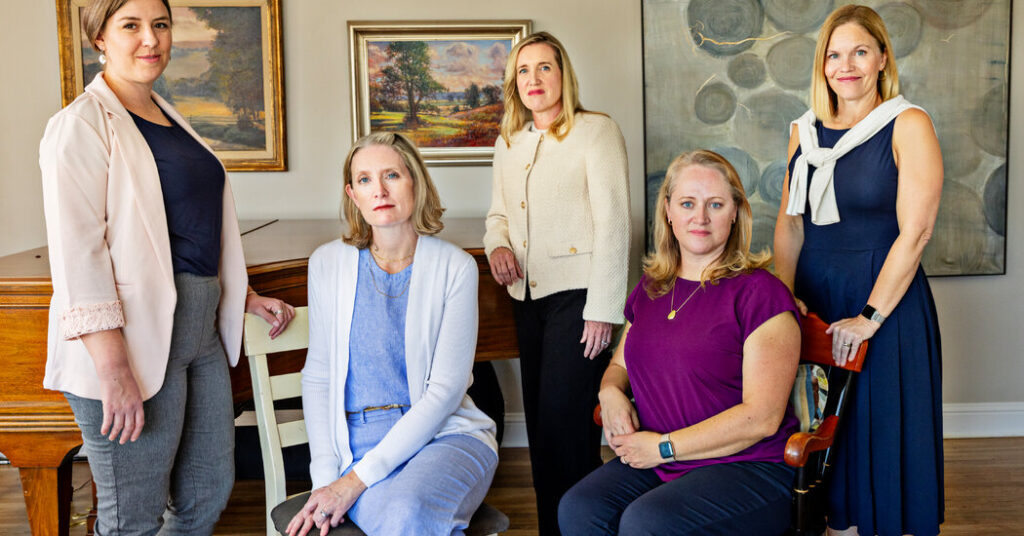
When Mormon Women for Ethical Government formed in the fractious days after Donald Trump’s first inauguration, its mission was peacemaking.
These women were not pink-pussy-hat-knitting lefties — most members were loyal Utah Republicans who saw their group as an extension of church teachings: Women take care of the community, and people learn and grow from conversations with those they disagree with.
Peacemaking has now led them into a war.
The conflict involves issues consuming many other states — the redrawing of congressional maps, abortion, and above all, the question of who gets to wield power: the courts, the people or their elected representatives.
But Utah is unique; the Church of Jesus Christ of Latter-day Saints is patriarchal and dominates state politics. And as Utah’s women have spoken up, its male politicians, including Gov. Spencer Cox, who has made a national reputation on “disagreeing better,” have punished them.
The women so far are unbowed. Emma Petty Addams, the co-executive director of Mormon Women for Ethical Government, quoted church doctrine on the proper exercise of power to explain her group’s mission: “We have learned by sad experience that it is the nature and disposition of almost all men, as soon as they get a little authority, as they suppose, they will immediately begin to exercise unrighteous dominion.”
For all the images of tradwives and momfluencers flooding television and social media from Utah, the reality playing out in the Beehive State is something quite different.
Four years ago, Mormon Women sued the Legislature for refusing to enact a law that voters had passed banning gerrymandering. As Salt Lake City grew bigger and bluer, that law was all but certain to yield a Democratic member in the state’s four-person House delegation. The state’s Supreme Court, with its first female majority, consistently and unanimously sided with the women.
Utah’s Republican leaders, who command every statewide office and a supermajority in the Legislature, responded first with threats, and then by remaking the court.
Over the past year, they expanded the Supreme Court by two seats, choosing new justices from a list of 12 nominees, all men. The Legislature then created a new “constitutional court” to hear lawsuits filed against it, including on gerrymandering and abortion.
For good measure, the state G.O.P. called on voters to reject two female high court justices who were up for retention elections this November, apparently the first time the party has campaigned in such elections.
The Legislature and Governor Cox then forced the resignation of one of those justices, Diana Hagen, after her ex-husband accused her of having an affair, even though the state board that investigates judicial misconduct dismissed the allegation as having “very little credibility.”
In an interview in Salt Lake City, her first since resigning, Justice Hagen allowed that the vitriol toward women may not have been about sexism. But, she noted, the court’s ruling against the Legislature on gerrymandering in 2024 was unanimous, and there was no campaign to reject the chief justice, a man, when he was up for retention that year.
“That,” Justice Hagen said, “is really hard for me to explain in any other way.”
To other women, there’s no debate.
“Utahns are not used to women having power,” said Susan Madsen, director of the women in leadership project at Utah State University and a member of both the Latter-day Saints church and the Republican Party. Now, she said, “it’s women who are using their voices.”
Republicans say gender had nothing to do with their decisions. Mr. Cox noted that he created the now-lost female Supreme Court majority when he appointed two women in 2023. In June, when he announced his next picks for the high court, he said only four of 25 applicants were women, and two of those “were not qualified at all.”
“If that makes me a misogynist, I guess I’ll own it,” he said. “But I think that’s an insane narrative.”
There is an irony in Governor Cox’s role in the battle convulsing Utah politics: He has just embarked on his latest bid for political civility, promoting a new book, “Off Ramp: How to Be a Peacemaker in an Age of Contempt.” That follows his signature initiative as chairman of the National Governors Association, “Disagree Better,” when he traveled the country speaking publicly with Democratic counterparts.
But in Utah, he removed a requirement for partisan balance on the commission that nominates judges, and gave himself sole power to appoint its members.
“They didn’t like the results of the game so they brought in referees midgame to make calls in their favor,” said Teneille Brown, a law professor at the University of Utah and a founder of Co-Equal Utah, a nonpartisan group started by lawyers concerned about political interference in the judiciary. “They not only picked the refs, they picked the people who picked the refs.”
The fight began in 2018, when Utah voters narrowly approved a citizen-sponsored ballot measure that created an independent redistricting commission, prohibited maps drawn to benefit any one party or candidate, and required geographically compact districts, without dividing municipalities between districts. The map at the time, drawn by the Legislature after the 2000 census, had cracked Salt Lake County, the state’s most populous and most Democratic, between the state’s four congressional districts.
The Legislature repealed the anti-gerrymandering proposition before it could take effect and approved a new map that again cracked Salt Lake County’s Democratic majority.
Mormon Women for Ethical Government joined the state’s League of Women Voters in suing. The group did not make the decision lightly; Mormon Women had grown nationally to around 7,000 members, but it had done nothing more political than issuing statements and organizing quilt-ins.
Joining the suit supported the group’s principles, Mrs. Addams said.
“Gerrymandering breaks things,” Mrs. Addams said. “It physically fractures communities. It breaks trust. If you look at the political situation and never see a chance to have someone that represents you, you lose faith in representative government.”
Republicans maintain that only the Legislature can draw electoral maps. The state Supreme Court unanimously disagreed in 2024, citing the Utah Constitution’s declaration that “the people are the source of all political power” and have “the right to alter or reform their government.”
Republican leaders immediately called the Legislature into special session to approve a ballot measure of their own, which would have amended the state Constitution to give the Legislature the right to repeal citizen-sponsored ballot measures.
The state Supreme Court struck down that measure, too.
The court had already irritated Republican lawmakers earlier that summer when it blocked the Legislature’s abortion ban as a violation of the state Constitution, which guarantees men and women equal rights.
By last November, as a female lower court judge, Dianna Gibson, prepared to consider proposed electoral maps, Republicans threatened to impeach her if she ruled against theirs. Judge Gibson chose the women’s groups’ map anyway.
Her decision was 91 pages, but Republicans lawmakers took just 20 minutes to announce that they had drawn up impeachment orders.
After anonymous callers to the court threatened to kill or rape Judge Gibson, law enforcement officials provided her with security escorts and cameras around her home. The judiciary issued a statement warning that “any conduct aimed at causing fear for a ruling” — whether from lawmakers or anonymous citizens — is illegal, and urging “all Utahns to stand with the judiciary” to protect “the fair and impartial administration of justice.”
Undeterred, the governor and the Legislature created the constitutional court to allow the Legislature to bypass the court where cases against it are typically filed — Judge Gibson’s.
The Legislature then moved four cases to the new court: the abortion case; the redistricting case; a case brought by teenagers who say the Legislature has violated their constitutional “right to life” by issuing too many permits for oil, gas and coal; and another from plaintiffs who say it has not done enough to protect the Great Salt Lake.
Republicans announced a campaign against the retention of Justices Jill Pohlman and Hagen at their convention in April. (Justices are appointed but have to stand for retention after their first three years.) Then in May, after the report cleared Justice Hagen of misconduct around the allegation of infidelity, Republican leaders called for another investigation.
“There are lots of questions out there,” Mr. Cox told reporters.
Justice Hagen resigned.
“It’s a gut punch to all of us,” said Ashley Peck, a former president of Women Lawyers of Utah.
Justice Hagen had been an appellate court judge and before that an assistant U.S. attorney for 17 years, successfully prosecuting the couple who kidnapped Elizabeth Smart. The two justices Mr. Cox chose in June had no experience as judges.
In the interview, Justice Hagen said that she’d heard from men and women alike who are bothered by what she called “the gender dynamic.” But she talked more about the damage to the court’s integrity.
“When we have people in public office not criticizing our legal reasoning but accusing us of being activists or disregarding the Constitution or our oath, it undermines the public’s confidence,” she said.
State Senator Todd Weiler, who leads the committee that has pushed the changes to the court, was open about the Legislature’s motives.
“Is there a court-packing element? Yes and no,” Mr. Weiler said. “I’ll concede that this decision was partially politically motivated.”
But, he said, lawmakers usually pack courts to take seats away from the opposite party.
In this case, he said, “everybody on the court was nominated by a Republican governor and confirmed by a Republican supermajority Senate.”
In August, the governor nominated two men to replace Justice Hagen and the chief justice, Matthew Durrant, who retired for health reasons. The Senate is expected to approve them by next month, in time for the state Supreme Court to hear the latest case filed by Mormon Women and the League of Women Voters, challenging the constitutional court.
The Legislature also gave itself a backstop: If the Supreme Court sides with the women against the constitutional court, a new law will take effect creating another version of the constitutional court. In that case, the Legislature would not only choose where lawsuits against it are heard, it would also name the judges who hear them.
The post A Gender War Explodes in Utah Over the Courts, Abortion and Representation appeared first on New York Times.