America’s highest court didn’t take on a deeply partisan, conservative bent overnight. This transformation began decades ago, with a simple purpose: In the early 1980s, three law students were fed up with what they saw as a liberal monoculture at their elite universities. They wanted a place to freely debate conservative ideas and to refine their arguments. So the students—Lee Liberman, Steve Calabresi, and David McIntosh—decided to build one.
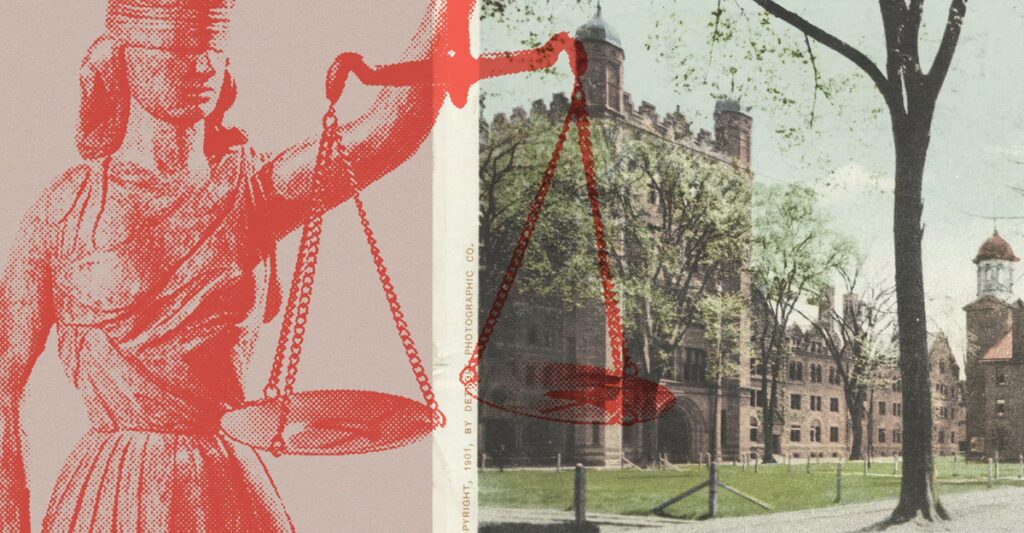
In late April 1982, their newly formed group, the Federalist Society, held its first conference, at Yale University. The formal title of the three-day affair was “A Symposium on Federalism: Legal and Political Ramifications,” but the snoozy name belied the energy of the weekend. Young Reaganites packed their sleeping bags and overnighted on the floors of fellow students they’d never met before. During smoke breaks, they chatted up Robert Bork, the famous Yale professor, and Antonin Scalia, then a lesser-known professor from the University of Chicago.
But if the attendees were idealistic about the Reagan era and the emergence of a harder-core strain of conservatism known as the New Right, they also understood that they were still a tiny minority in both the academic and legal worlds. Movements opposed to racism, sexism, and injustice remained the animating forces of campus life. Many students across the country were embracing Marxism and socialism. To make headway, young conservatives needed a voice—and a strategy.
To this end, Bork proved essential. He had recently been nominated by President Ronald Reagan to serve on the D.C. Circuit Court of Appeals and spoke with both knowledge and authority. Bork announced to his eager audience that media and academia had become left-wing machines. The Supreme Court was inventing new “rights” with no basis in the Constitution, he said, and the only path forward was to return to the words of the Founding Fathers.
[Quinta Jurecic: DOJ enters a new, even more aggressive phase]
Whether Bork truly believed in the conspiracies he outlined or whether he was merely exaggerating is unclear. But in his remarks at that first Federalist Society conference, Bork effectively mapped out what the right-wing legal movement would do over the course of the next four decades.
“We have a Court,” Bork declared in his speech, “which is creating individual rights which are not to be found in the Constitution by any standard method of interpretation.”
He went on to outline the formation of a nascent conservative approach called originalism. In the originalist view, constitutional rights existed only as the Founding Fathers imagined them, unless officially added via constitutional amendment. By embracing what Bork called a “strict” or “textualist” reading of the Constitution, conservatives could argue that recent social changes never specifically considered by the Founders were not constitutionally protected. The approach could return the country to its true, “conservative” values.
In championing this interpretation of the law, Bork proved to be ahead of his time. He saw benches and courtrooms as the final frontier in the right-wing culture war. Effete liberals either had persuaded judges to ignore the Constitution, he said, or had themselves colonized the bench. Bork railed against the media and academia as corrupting influences: “The institutions to which the court responds are the press and the law-school faculties. Those are the people they talk to; those are the people who are responsible for the reputations of individual judges.”
And those people were liberals. Bork cited a survey from the magazine Public Opinion, which concluded that the people who worked in American media were “heavily left liberal.”
More than 80 percent of the press, he continued, had voted for the Democratic candidate in every presidential election since 1968. The values of the press were “egalitarian and permissive.” And professors were no better: “They want sexual freedoms; they want freedom for abortions; they want the death penalty outlawed.”
Bork believed academic elites were bastardizing the First Amendment and the Fourteenth Amendment to suit their ends, creating “new constitutional values which are nothing more than the imposition of upper-middle-class values on society.” He blamed the “enormous industry in the law schools” and their faculty for these invented “rights.” If the professors had their way, he warned, they would indoctrinate a new class of law students that would promote liberal ideals on benches across the country. This all added up to, Bork stated with thinly veiled disgust, “the gentrification of the Constitution.”
Bork closed his remarks by outlining the constitutional means by which the New Right could overturn federal protection for abortion. Abortion and “acceptable sexual behavior” were matters for the states to decide—not constitutionally protected rights, as Roe v. Wade had recently found. Reproductive freedom, Bork advised, was “a classical case for local control. There is simply no national moral consensus about abortion, and there is not about to be.”
[Adam Serwer: So much for leaving abortion up to the states]
Soon, the Reagan administration would call upon the students that Bork had trained to carry out this strategy of curtailing rights, one case at a time. Four decades later, the Roberts Court would echo Bork’s language when it struck down Roe.
If the Federalist Society had begun as a campus alt-community, it quickly blossomed into something much more important. As Calabresi, one of its co-founders, later recalled, “Our conference was covered by the National Review and suddenly conservatives at fifteen other law schools began calling us and telling us they wanted to attend the conference and they wanted to form chapters, too. That was a process of almost spontaneous generation.” Less than a year after the 1982 Yale conference, 17 law schools across the country had a Federalist Society chapter.
Soon after its inception, the student group was on the White House’s radar. In attendance at that first conference were several members of the Reagan Justice Department, including the future acting solicitor general and the next assistant attorney general at the Office of Legal Counsel. By 1985, all three founding members of the Federalist Society—Liberman, Calabresi, and McIntosh—had positions at DOJ.
Half a century later, every sitting Supreme Court justice appointed by a Republican president is a member of the Federalist Society. During the first Trump presidency, 46 of his 54 nominees to the federal appeals courts were members. His White House counsel, two attorneys general, and deputy attorney general were all members as well.
From that very first conference, the Federalist Society awoke a power lying dormant among marginalized conservatives. It offered them an identity, a larger community, and hope—clarifying the battle at hand and, most essentially, suggesting that they might win it.
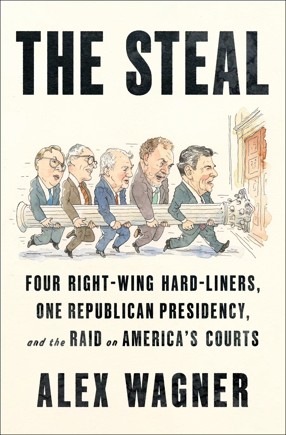
This article has been adapted from Alex Wagner’s new book, The Steal: Four Right-Wing Hard-Liners, One Republican Presidency, and the Raid on America’s Courts.
The post The Legal Right’s Unofficial Birthday appeared first on The Atlantic.