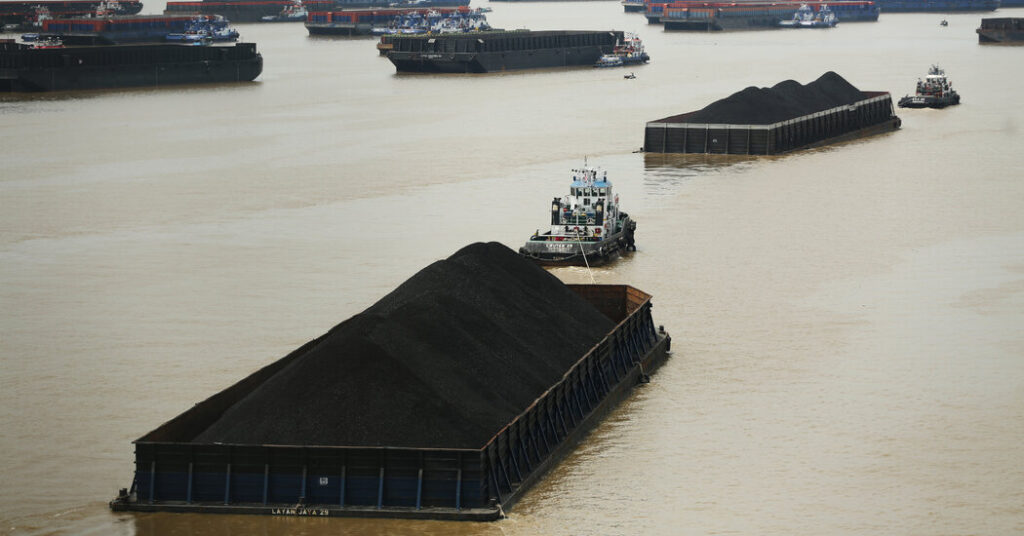
The world is set to burn record amounts of coal this year, in large part because of the ongoing conflict in the Middle East, the International Energy Agency said on Thursday.
The agency projected that global coal consumption will increase 1.2 percent this year compared to last year, reaching an all-time high of 8.94 billion metric tons. A big reason is that many countries have struggled to procure enough oil and natural gas because of disruptions to shipping in the Strait of Hormuz. That has led places like Europe, China, Japan and Korea to burn more coal for electricity instead. While coal is highly polluting, it is also abundant and often cheap.
At the same time, a powerful global weather pattern known as El Niño is expected to drive up coal use this year in countries like Vietnam and India by increasing demand for air-conditioning and reducing output from hydropower dams, the agency said.
The increase in coal use is a major setback for efforts to address climate change. When burned for fuel, coal produces more air pollutants and more planet-warming greenhouse gases than any other energy source, including natural gas. Five years ago at an international climate conference in Glasgow, diplomats from nearly every country agreed to “phase down” global coal consumption to slow the rise in global temperatures.
Since that agreement, however, many countries have continued to burn even more coal to help meet rising demand for electricity. While nations are also installing solar panels and wind turbines at a rapid pace, renewable energy hasn’t been increasing fast enough to satisfy the growth in energy demand, which means fossil fuel use has continued to rise as well.
In recent years, the International Energy Agency had projected that global coal use would peak by 2030 and then decline. But the agency has repeatedly had to revise its projections as demand remains strong.
A major factor in this year’s leap in coal consumption has been the U.S.-Israeli war with Iran, which has led Iranian leaders to choke off shipping traffic in the Strait of Hormuz. Before fighting began, about one-fifth of the world’s trade in liquefied natural gas went through the strait — much of it imported by countries in Europe and Asia for use in electricity or industry.
To compensate for the loss in gas supplies, many countries are running their existing coal plants more often or finding other uses for coal, which is often widely available in domestic stockpiles all over the globe. China has been using more coal instead of oil to produce chemicals. In South Korea, coal use is expected to jump roughly 6 percent this year because of high domestic natural gas prices.
“Although virtually no coal shipments pass through the Strait of Hormuz,” the agency said, “disruptions associated with the war have nonetheless affected coal markets by driving up natural gas prices.”
One notable exception is the United States. Even though President Trump has promised to revive America’s long-declining coal industry, U.S. coal consumption is expected to fall roughly 7 percent this year after an unexpected jump last year.
The Trump administration has taken the extraordinary step of ordering several aging coal plants that had been headed for retirement to stay open and keep running. But that hasn’t been enough to halt an overall decline in coal demand. The United States has an abundance of cheap natural gas and has largely been insulated from disruptions in the global gas trade, and many utilities have opted to burn gas instead of coal. Solar and wind power have also been growing fast in the United States this year despite the administration’s hostility to renewables, further cutting into coal’s market share.
The agency said it was still unclear whether global coal demand would keep rising next year. It will depend on whether the conflict in the Middle East ends and flows of liquefied natural gas, or L.N.G., restart.
“If L.N.G. flows through the Strait rebound and natural gas prices decline back toward prewar levels, global coal demand could decrease in 2027, but if the Strait remains largely closed to L.N.G. shipments, coal demand could increase further,” the agency said.
The disruptions in the Strait of Hormuz have already pushed some countries to seek out alternatives to imported gas and oil to bolster domestic energy security. Some are accelerating plans to build more renewable energy or nuclear power. But those plans will take time, and coal could benefit in the interim.
The post The Iran War Is Pushing Global Coal Use to Record Highs appeared first on New York Times.